










 (+1) 905 597 5955



Deadline alert. Any commercial LED disc light qualified under DLC 5.1 drops off the rebate list on December 15, 2026. If your project closes after that date with an older-spec fixture, the rebate goes to zero. That’s the single biggest reason Canadian facility managers are re-specifying disc lights right now.
The right commercial LED disc light hits six numbers: 125+ lm/W efficacy, 800 to 1,600 lumens per fixture, 80+ CRI (90+ for retail), 0-10V dimming, a cULus or CSA mark, and a DLC 6.0 listing. Nail those and you clear Canadian code, pass inspection, and lock in utility rebates worth up to 75% of project cost.
This guide is built for electrical contractors, facility managers, and B2G procurement officers who need to spec, order, and install disc lights across Canadian commercial sites. We’ll cover the DLC 6.0 rules effective January 5, 2026, provincial rebate programs, a real Toronto retrofit case, and the six spec mistakes we pull from bid packages every week.
Quick Reference: Commercial Disc Light Spec Cheatsheet
| Spec | Minimum for Commercial | Preferred | Notes |
| Efficacy | 125 lm/W (DLC 6.0) | 135+ lm/W | DLC Premium hits 135+ |
| Lumen output | 800 lm | 1,200-1,400 lm | Per 6-inch fixture |
| CRI | 80 | 90+ | 90 for retail/clinics |
| CCT | Project-specific | 3500K-4000K | Selectable SKUs preferred |
| Dimming | 0-10V | 0-10V or DALI | TRIAC for small jobs only |
| Certification | cULus / cETL / CSA | cULus + DLC 6.0 | Both marks required for rebate |
| Lifespan | L70 at 50,000 hrs | L80 at 50,000 hrs | L80 = 80% output at end of life |
What Is an LED Disc Light, and Why Commercial Specs Use Them
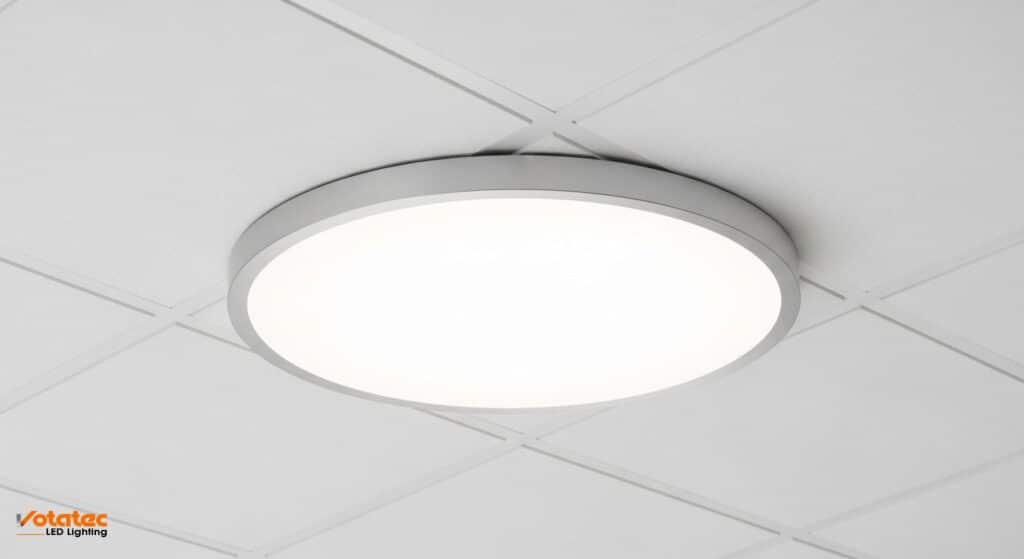
An LED disc light is a low-profile, surface-mount ceiling fixture with the driver and light engine packed into a round housing, typically 4 to 6 inches across and under 1.5 inches deep. It mounts directly to a ceiling junction box, a retrofit adapter inside an old can, or a bracket plate. No plenum required.
For commercial ceilings, three traits make the difference:
- No housing needed. Mounts flush against the ceiling surface, which matters for concrete ceilings and fire-rated assemblies.
- Integrated driver. Everything sits inside the disc, so there’s no separate can to buy, wire, or maintain.
- Shallow depth. Runs under ducts, beams, and drop-tile grids where traditional cans won’t fit.
That’s why LED disc lights dominate retrofit jobs. When a Canadian facility manager is replacing 400 T8 troffers or PAR38 halogen cans across an office floor, disc lights cut install time roughly in half compared to new recessed cans, and they slot in alongside LED downlights for areas that need deeper optics.
How Does a Disc Light Compare to a Recessed Can?
The short version: disc lights win for retrofits and low ceilings, cans win for new builds with high lumen needs.
| Feature | LED Disc Light | Recessed Can with LED |
| Ceiling depth needed | 0.5 to 1.5 in | 4 to 6 in |
| Install time per fixture | 10 to 15 min | 30 to 45 min |
| Works in concrete ceilings | Yes | No |
| Works in drop-tile | Yes | Yes |
| Fire-rated options | Yes (select models) | Yes |
| Lumen range per fixture | 800 to 1,600 lm | 600 to 3,000+ lm |
| Best application | Retrofits, shallow plenums | New builds, high-output needs |
Cans still hold a spot in new commercial construction when the design calls for deeper aperture optics or 2,000+ lm per fixture. For almost every retrofit, disc lights come out ahead on cost and schedule.
The Six Specs That Actually Matter on a Commercial Disc Light
1. Efficacy (lm/W)
DLC 6.0 sets the floor at roughly 125 lumens per watt for most indoor commercial LED disc light categories, a 14% jump from DLC 5.1. That single change is why many disc lights on the 2024 and 2025 catalogues are now obsolete for rebate purposes.
- DLC Standard (125 to 134 lm/W): Meets baseline, qualifies for most utility rebates.
- DLC Premium (135+ lm/W): Higher rebate tier in most provinces, worth the extra per-fixture cost on 50+ fixture jobs.
Ask for the DLC 6.0 QPL listing number on every quote. No listing, no rebate.
2. Lumen Output
Match lumens to the task, not the square footage alone:
- Offices, classrooms, clinics: 30 to 40 lumens per square foot
- Retail, showrooms: 50 to 75 lumens per square foot
- Warehouses, back-of-house: 20 to 30 lumens per square foot
- Corridors, washrooms: 15 to 25 lumens per square foot
A typical 6-inch commercial disc light delivers 1,000 to 1,400 lumens at 14 to 16W. That’s one fixture per 35 to 50 sq ft in standard office use.
3. Colour Temperature (CCT)
CCT is measured in Kelvin (K). For commercial ceilings in Canada:
- 3000K (warm white): Hospitality, healthcare patient rooms, lobbies
- 3500K (neutral): Mixed-use offices, retail
- 4000K (cool white): Schools, warehouses, general commercial
- 5000K (daylight): Industrial, inspection areas, parking garages
A selectable-CCT disc light with a 3500K/4000K/5000K switch gives facility managers a single SKU that works across multiple sites. That cuts ordering headaches and backstock costs.
4. Colour Rendering Index (CRI)
CRI measures how accurately a light source renders colours versus daylight, on a 0-100 scale:
- CRI 80+: Warehouses, storage, utility spaces
- CRI 85+: Offices, schools, healthcare general areas
- CRI 90+: Retail display, clinics, patient-facing spaces
- CRI 95+: Art galleries, photography studios, colour-critical tasks
Spec CRI 90 when the client cares how products, skin tones, or finishes look under the fixture. Spec 80 when they care more about the utility bill.
5. Dimming Protocol
Commercial dimming splits three ways:
- TRIAC (phase-cut): Works with standard wall dimmers. Cheapest. Common in small offices.
- 0-10V: The standard for commercial networked controls and daylight sensors.
- DALI: Full digital addressing, used in larger buildings with a BMS.
Most 2026 commercial specs call for 0-10V. Read the driver label before ordering. A TRIAC-only disc light on a 0-10V circuit won’t dim at all.
6. Canadian Safety Certification
Every LED disc light installed in a Canadian commercial building needs one of:
- cULus (UL with Canadian recognition)
- cETL (ETL with Canadian recognition)
- CSA (Canadian Standards Association)
A plain UL mark without the “c” Canadian identifier won’t pass provincial inspection. ESA Ontario, Technical Safety BC, RBQ Quebec, and other authorities will reject the install.
How Much Does a Commercial LED Disc Light Retrofit Actually Save?
Real numbers beat generic percentages. Here’s what Canadian facility managers are reporting from recent retrofits:
Toronto Office Building (Mid-Rise)
- Before: T8 fluorescent troffers, PAR38 halogen common areas, HID exterior fixtures
- After: Full LED retrofit including disc lights on ceiling zones
- Energy use: 313,317 kWh/year dropped to 144,891 kWh/year
- Reduction: 54%, or 168,426 kWh saved annually
- Annual electricity savings: $20K+
- Source: Faraday Lighting Ontario retrofit case study, 2026
For the full ROI framework behind these numbers, see our commercial lighting upgrade ROI guide.
50,000 sq ft Warehouse, 24/7 Operation
- Before retrofit cost: $87.6K/year in lighting energy
- After retrofit cost: $35K/year
- Annual savings: $52.5K
- Typical payback: 12 to 24 months after utility rebate
Maintenance Cost Impact
Commercial buildings typically see lighting maintenance costs drop 80% to 90% after a full LED retrofit. Fewer lamp changes, fewer ballast failures, fewer service calls. For a facility manager running 500+ fixtures, that shows up as thousands in the maintenance budget within the first year.
Canadian LED Rebates: What You Can Claim in 2026
Rebate dollars are on the table in most provinces. Programs change often, so verify current rules before committing to a PO.
Ontario: Save on Energy
The Save on Energy Retrofit Program covers commercial, industrial, and institutional upgrades. Small businesses can receive up to $3K in direct incentives for LED lighting and networked controls. DLC 6.0 listing is mandatory for eligibility on 2026 projects.
British Columbia: BC Hydro Business Programs
BC Hydro’s commercial lighting rebates can offset up to 75% of fixture and installation cost on qualifying projects. Projects submitted before the Feb 12, 2026 early-bird deadline earn a 30% bonus on top of the standard rebate. Pre-approval is required before any work starts.
Quebec: Hydro-Québec Efficient Solutions
Hydro-Québec runs business incentives under the Efficient Solutions program for commercial buildings. Rebate amounts vary by fixture type, control strategy, and project scope. DLC 6.0 listing is the common gating requirement.
Alberta, Manitoba, Atlantic Canada
Programs run through Efficiency Alberta, Efficiency Manitoba, Efficiency NS, and Efficiency PEI. Each has its own QPL, cap, and application workflow.
The pattern across the country: DLC 6.0 listing required, pre-approval recommended, itemized invoices needed at closeout. Miss any of those three and you pay full freight.
How Do You Size LED Disc Lights for a Commercial Ceiling?
Here’s the five-step calculation any estimator can do on a site visit.
Step 1: Measure the room
Width x length = square footage.
Step 2: Pick target lumens per square foot
Use the task-based ranges in Section 2 above.
Step 3: Calculate total lumens needed
Total lumens = square footage x target lumens per sq ft.
Step 4: Divide by fixture output
Number of fixtures = total lumens / lumens per disc light.
Step 5: Check spacing ratio
Most commercial disc lights publish a spacing-to-mounting-height ratio (SMH). For 10 ft ceilings, that’s usually 1.0 to 1.2, meaning fixtures sit 10 to 12 ft apart. Tighter on lower ceilings, wider on higher ones.
Worked example: Dental office. 400 sq ft, 40 lm/sq ft target. That’s 16,000 total lumens. A 14W disc light at 1,200 lm means 13 to 14 fixtures. Arrange on a 5×3 grid at roughly 7.5 ft centres. Total wattage: 196W. Compared to the old T8 fluorescent setup at 640W, that’s a 69% energy drop on the lighting circuit alone.
Installation: Junction Box or E26 Retrofit?
Canadian electrical code (CEC) allows two install methods for commercial disc lights:
Method 1: Direct junction box mount. The LED disc light bracket screws to a standard 4-inch octagon box. Line voltage wires splice inside the housing. Preferred for new work and clean retrofits. Passes Canadian Electrical Code (CEC) 30-400 without issue.
Method 2: E26 screw-in retrofit. The fixture uses an E26 adapter that screws into an existing bulb socket. Spring clips hold the disc flush. Faster on replacement work, but can’t go in sealed fixtures or insulated ceilings unless the disc is IC-rated.
For B2B and B2G projects, Method 1 is the right call 90% of the time. Commissioning inspectors prefer it, and it simplifies the commissioning paperwork.
Common Mistakes on Commercial Disc Light Specs
The same six mistakes show up on half the bid packages we review:
- Specifying only watts, not lumens. A 14W disc from one brand puts out 900 lm. Another brand at the same 14W puts out 1,400 lm. Always write the lumen number.
- Skipping the dimming protocol. Contractor installs TRIAC, building has 0-10V controls, nothing dims. Commissioning fails.
- Mixing CCT across one floor. Fixtures at 3000K next to 4000K makes the whole space look broken.
- Ignoring CRI for retail. CRI 80 washes out merchandise. Spec CRI 90 wherever customers judge colour.
- Forgetting damp-rated labels for washrooms and covered exteriors. IP-rated disc lights cost a little more and save warranty claims.
- Ordering non-DLC 6.0 fixtures on a rebate-dependent project. If the DLC 6.0 QPL number isn’t on the spec, the rebate is gone.
Troubleshooting Commercial Disc Light Installs
When a commercial LED disc light goes dark, flickers, or trips the circuit, the cause is usually one of four things:
- Incompatible dimmer. TRIAC driver on a 0-10V controller or vice versa. Swap the dimmer or the fixture.
- Driver overheat. Disc lights installed without the specified airgap can overheat the integrated driver. Check the spec sheet for minimum clearance.
- Voltage mismatch. Canadian commercial buildings often run 277V. Ordering a 120V-only fixture for a 277V circuit fries the driver immediately. Ask for universal 120-277V input.
- Open neutral. Common on older commercial panels. Tests fine on install day, fails a month later. Have an electrician verify neutral bonding.
When replacing a failed disc light, match the CCT, CRI, and lumen output of the remaining fixtures on that circuit. Mixing specs mid-life creates uneven ceilings that clients notice immediately.
Buying LED Disc Lights Wholesale in Canada
For B2B and B2G buyers, the purchase decision splits three ways:
- Big-box retail: Fine for small jobs under 10 fixtures, no volume pricing, limited DLC-listed SKUs.
- Distributor network: Good for mid-size jobs, standard lead times, access to name-brand catalogues.
- Direct from a Canadian LED manufacturer or wholesaler: Best pricing at 25+ fixtures, custom CCT/lumen/driver combinations, faster rebate documentation.
Votatec supplies LED disc lights, downlights, and commercial LED ceiling fixtures across Canada. All products carry CSA certification, DLC 6.0 QPL listings where applicable, and extreme-temperature ratings built for unconditioned Canadian spaces. For bid pricing, spec sheets, or a custom-configured order, contact our team with your project details.
Frequently Asked Questions
What is a commercial LED disc light?
A commercial LED disc light is a low-profile ceiling fixture, usually 4 to 6 inches across and under 1.5 inches deep, built for office, retail, institutional, or industrial use. It mounts to a junction box or retrofits an existing can, carries DLC and CSA certifications, and delivers 800 to 1,600 lumens per fixture at 12 to 16W.
How long do commercial LED disc lights last?
Quality commercial LED disc lights are rated for 50,000 hours at L70 (70% lumen maintenance at end of life). For a building running lights 12 hours a day, that works out to roughly 11 years of service before output drops below the design threshold.
Can I use residential LED disc lights in a commercial building?
Not if you want the rebate or a code-compliant install. Residential-grade disc lights often skip DLC listing, 0-10V dimming, and commercial wet/damp ratings. Commercial inspectors may also fail installs that lack the right certification marks.
Are LED disc lights fire-rated?
Some are. The label will say so, typically 1-hour or 2-hour fire rating. Fire-rated disc lights are required wherever you cut through a fire-rated ceiling assembly. Confirm with your AHJ (authority having jurisdiction) before install.
What size disc light do I need for a 10-foot ceiling?
For a 10-foot ceiling in a standard office, a 6-inch disc light at 1,200 to 1,400 lumens spaced on 8 to 10 foot centres gives even coverage. Go bigger (1,600 lm) for retail or showroom use. Smaller spaces can run 4-inch fixtures at 800 to 1,000 lm.
How do I qualify for a Canadian LED rebate in 2026?
Three things: the fixture must be on the DLC 6.0 Qualified Products List, you need pre-approval from your provincial utility before starting work, and you submit itemized invoices at project closeout. Miss any one and the rebate gets denied.
How do I replace a failed LED disc light on a commercial circuit?
Power down the circuit, remove the failed disc using the spring-clip or bracket release, disconnect the junction box wiring, and install a matching replacement. Match the CCT, CRI, lumen output, and driver type of the remaining fixtures. Mismatched replacements create visible colour and brightness gaps.
What’s the difference between DLC Standard and DLC Premium?
DLC Standard meets the baseline efficacy threshold (roughly 125 lm/W on DLC 6.0). DLC Premium exceeds Standard by 10 to 15% on efficacy (roughly 135+ lm/W). Most Canadian utility programs pay a higher rebate on Premium, which usually pays back the small price premium within a year on 50+ fixture projects.
Key Takeaways
- DLC 5.1-qualified disc lights drop off the rebate list Dec 15, 2026. Re-spec before then.
- Minimum commercial efficacy in 2026: 125 lm/W under DLC 6.0.
- Match lumens to task (30-40 lm/sq ft for offices, 50-75 for retail).
- Spec CRI 90 for retail and healthcare, CRI 80 for warehouses and back-of-house.
- 0-10V is the commercial dimming standard. Read the driver label.
- cULus, cETL, or CSA marks are legally required for Canadian installs.
- Rebates in 2026 can offset up to 75% of project cost, but require pre-approval and DLC 6.0 listing.
- Real-world payback: 12 to 24 months on warehouse retrofits after rebate.
Ready to spec your next commercial ceiling project before the DLC 5.1 cutoff? Contact Votatec for Canadian-certified LED disc lights with DLC 6.0 listings and volume pricing, or request a bid quote for contractors, facility managers, and procurement teams.