









 (+1) 905 597 5955


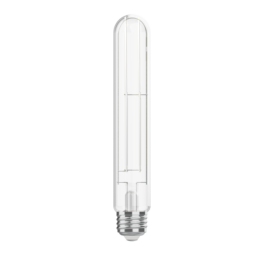
The T30 is a 190mm clear-glass filament tube on a standard E26 base, and it's the brightest 6W T30 we've measured against the Canadian market.
6W draws 775 lm at 3000K, 738 lm at 4000K and 756 lm at 5000K. CRI 80+, 120V, dimmable, 360-degree output. Three neutral and cool whites, no amber.
Clear high-strength glass, rated for enclosed fixtures, 2.5kV surge protection as standard, cUL listed, IP20, 3-year warranty.
What is a T30 bulb?
A T30 is a tubular bulb 30mm across, which is where the number comes from. The "T" means tubular and the "30" is the diameter in millimetres, so a T30 measures 1.18 inches wide. This one stands 190mm (7.38 inches) tall on an E26 medium screw base, the same socket as a standard household bulb.
What does the T mean in light bulbs, and what are T bulb sizes?
T is the shape code for a straight tube, and the number after it is the diameter. Two systems are in circulation, which is why the same lamp gets two names. Metric codes give the diameter in millimetres, so T30 is 30mm. Imperial codes give it in eighths of an inch, so T10 is 10/8 inch, or 31.75mm. They're within two millimetres of each other, and you'll see suppliers list "T10/T30" on one product.
Diameter isn't what separates them in practice. Length is. If you need the shorter 5-inch tube in the same 6W platform, that's our T10 Filament LED.
What incandescent bulb does a 6W T30 replace?
Match lumens, not watts. At 775 lm this sits where a 60W incandescent tube used to, but we don't print a wattage equivalence because the fixtures these go into vary too much. Compare the lumen figure on the spec sheet against whatever you're pulling out.
Where it fits, and one orientation tip
It's rated for enclosed fixtures, so jars, lanterns and schoolhouse shades are all fine. Operating range is -20C to +40C, and 2.5kV surge protection comes standard. Use the Leviton and Lutron dimmers named in the specification panel.
One thing the datasheet doesn't tell you. The filament sits in two flat planes, so a clear tube throws more light off its faces than its edges. In an open fixture, turn a face towards the room.