










 (+1) 905 597 5955


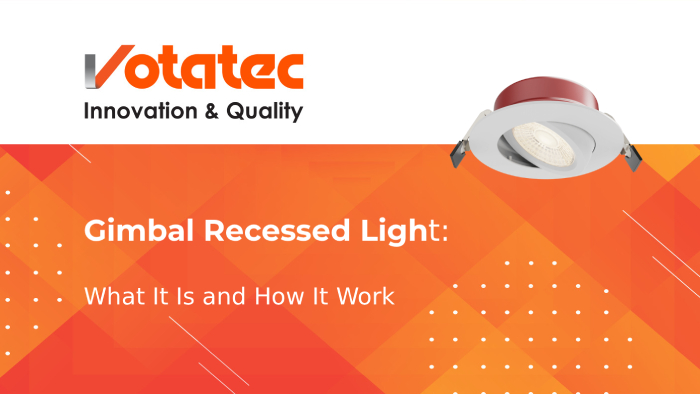

A gimbal recessed light is a recessed trim whose light engine tilts up to about 40 degrees and rotates up to 360 degrees to aim the beam. The trim sits flush with the ceiling while the LED module behind it swivels, so you can point light exactly where you need it without moving the fixture.
That one feature solves real problems for facility managers, contractors, and procurement teams. Sloped ceilings, accent walls, retail shelving, artwork: all of it needs light at an angle, not straight down. This guide covers what a gimbal recessed light is, how it works, where it fits a commercial spec, and how to choose the right one.
What is a gimbal recessed light?
A gimbal recessed light is an adjustable recessed downlight whose internal lamp or LED module pivots inside the housing. The trim ring sits flat against the ceiling. The light source behind it swivels, so you can point the beam in almost any direction within the fixture’s range.
The name comes from the gimbal: a pivoting support that lets an object rotate on one or more axes. Camera stabilisers use the same idea. In a ceiling fixture, the gimbal lets the LED tilt off-vertical and spin around its centre.
Most modern gimbal recessed lights are integrated LED fixtures. The LED, driver, and optics come as one sealed unit. There are no bulbs to replace, and the whole module lasts the rated life of the fixture, often 50,000 hours or more (Source: Natural Resources Canada, ENERGY STAR lighting guidance).
How does a gimbal recessed light work?
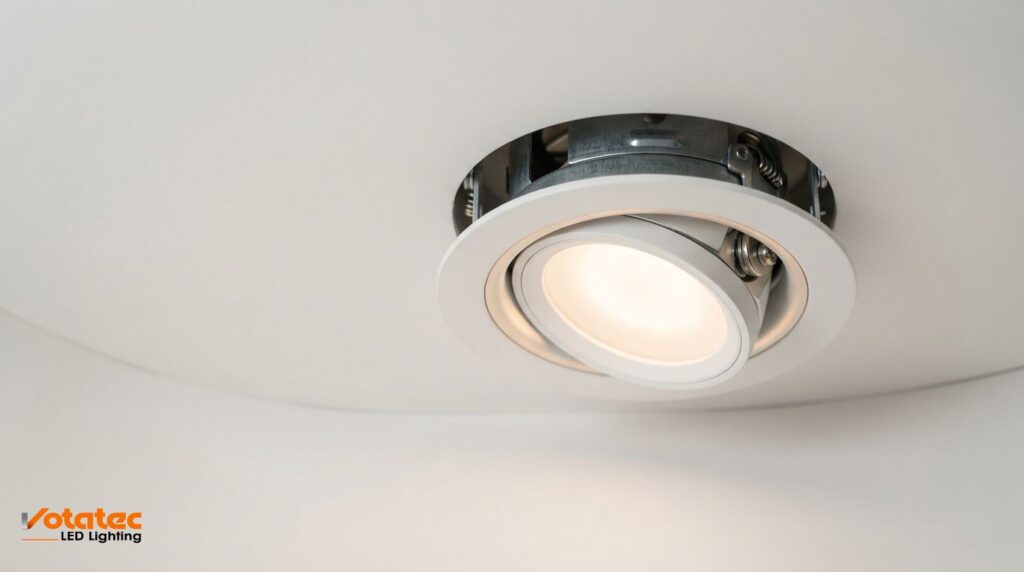
The mechanism is simple and reliable. The fixture has two parts that matter here: a fixed outer frame mounted in the ceiling, and a movable inner ring or yoke that holds the LED. The inner ring is connected to the frame by pivot points, the gimbal joints. Those joints let the light tilt and turn.
You set the aim by hand. Push the module to the angle you want and it holds position through friction or a detent. No tools, no rewiring. If the room layout changes, you re-aim in seconds.
Tilt and rotation explained
Two movements give a gimbal its reach:
- Tilt swings the beam away from straight down. Typical commercial gimbals tilt 30 to 40 degrees off vertical. Some directional models go further.
- Rotation spins the module around its vertical axis, usually a full 350 to 360 degrees.
Combine the two and you can hit nearly any target within a cone below the fixture. That’s why a single gimbal can wash a wall, spotlight a sign, or graze a textured surface depending on how it’s set.
Canless vs. housing-based construction
Gimbal recessed lights come in two build styles, and the difference affects installation.
Canless (canister-free) gimbals connect to a small junction box and clip directly into the ceiling opening. They sit shallow, so they fit tight plenums, remodels, and ceilings with little space above the drywall. Most slim LED gimbals on the market today are canless.
Housing-based gimbals drop into a traditional recessed can. If a building already has cans installed, a gimbal retrofit module or trim can convert fixed downlights into adjustable ones without cutting new holes.
Votatec’s adjustable downlight range includes both slim canless gimbals and retrofit options, so the choice usually comes down to what’s already in the ceiling.
Gimbal vs. eyeball vs. fixed downlight
These three terms get mixed up constantly. Here’s the plain difference.
| Feature | Fixed downlight | Gimbal | Eyeball |
|---|---|---|---|
| Beam direction | Straight down only | Tilts and rotates | Tilts and rotates |
| Profile at the ceiling | Flush | Flush or low-profile | Protrudes below ceiling |
| Glare control | Good | Good (module recesses) | Lower (lamp sits proud) |
| Best for | General ambient light | Accent, sloped ceilings, clean look | Heavy directional aiming |
| Visual footprint | Minimal | Minimal | More visible |
The key distinction: a gimbal pivots inside the housing, so the trim stays close to the ceiling and the look stays clean. An eyeball protrudes, with the lamp poking out below the trim like an eye in a socket. Eyeballs aim aggressively but draw the eye and create more glare. Gimbals give you most of the adjustability with a flush, low-glare finish. That’s why gimbals dominate commercial accent work today.
A fixed downlight does one job well: even, downward ambient light. If nothing needs aiming, fixed costs less and works fine. The moment you need to point light at something, you want a gimbal.
Where gimbal recessed lights make sense
Adjustability is only worth paying for when the space needs it. These are the cases where a gimbal earns its spec.
Sloped and vaulted ceilings
This is the classic use. On a pitched ceiling, a fixed downlight throws its beam at an angle that follows the slope, lighting the wrong spot. A gimbal tilts the module back to vertical (or any angle you want), so the light lands where it should. For lobbies, atriums, and modern offices with angled ceilings, gimbals are the standard answer.
Retail and display lighting
Stores live and die by how product looks under light. Gimbals let you aim narrow beams at shelving, mannequins, end caps, and feature walls, then re-aim when the merchandising changes. A retail fit-out that uses gimbals can re-light a whole floor in an afternoon without an electrician.
Wall washing and accent work
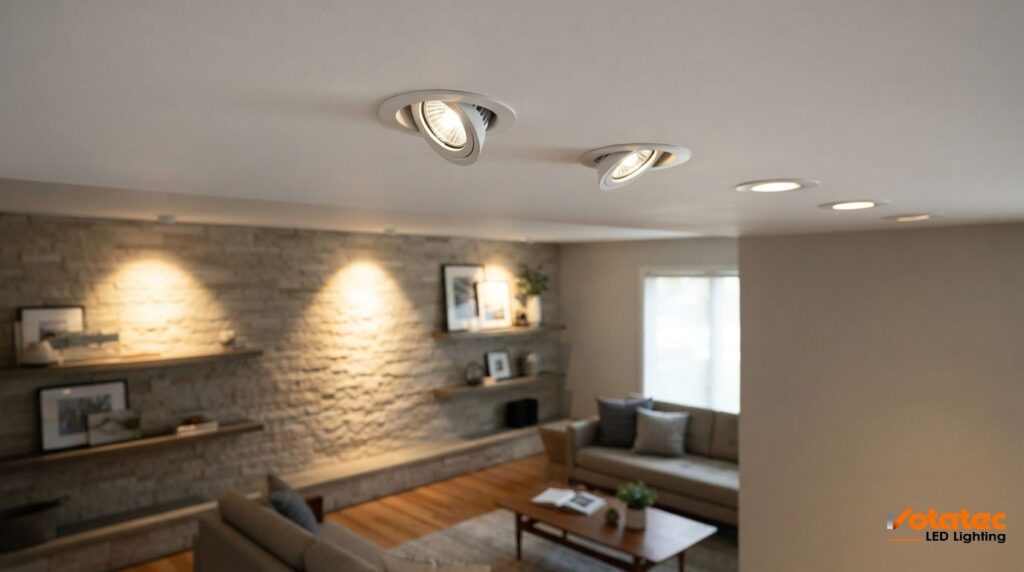
Aim a row of gimbals at a wall and you get a smooth wash that makes the space feel larger and brighter. Tilt them closer to the surface and you graze it, pulling out texture in stone, brick, or wood. Galleries, hotel corridors, and corporate reception areas use this constantly.
Task and workstation lighting
In labs, kitchens, and back-of-house areas, a gimbal can drop focused light onto a counter or bench instead of the floor. That puts the light where the work happens and cuts shadows.
Museums, galleries, and architectural features
Anywhere the goal is to highlight an object rather than fill a room, directional control matters. Gimbals with a tight beam angle and high colour accuracy are built for this.
Gimbal recessed lights for sloped ceilings
Sloped ceilings are the single biggest reason to specify a gimbal. A fixed downlight mounted in a pitched ceiling throws its beam along the angle of the slope, so the light lands on a wall or the floor well away from the target. The room looks lit at the ceiling and dark where people actually stand.
A gimbal fixes that. Tilt the module back toward vertical and the beam drops straight down, or aim it at whatever the space needs. For a 4-in-12 or steeper pitch, check that the fixture’s tilt range covers the slope angle plus any extra aiming you want. Most commercial gimbals handle common residential and light-commercial pitches comfortably at their 30 to 40 degree range.
A few extras matter on sloped installs. Confirm the housing is rated for the ceiling type, since many slopes sit against attic insulation and need an IC or airtight (ICAT) fixture. A wider beam angle helps too, because steep aiming can otherwise create a hot spot. Gimbals also make a clean retrofit for older sloped-ceiling eyeball trims: swap the trim or drop in a canless module and you upgrade to LED and a flush finish in one step. Votatec’s regressed gimbal models suit sloped work well, since the recessed lens cuts glare when the light is aimed at an angle.
How to spec a gimbal recessed light
This is where a project either works or causes callbacks. Run through these eight factors before you order.
1. Aperture size
Aperture is the ceiling opening, measured across the trim. Common commercial sizes:
- 2 to 3 inch: tight, modern look. Good for accent and residential-grade commercial.
- 4 inch: the workhorse. Balances output and a clean appearance. Most specified size.
- 5 to 6 inch: higher output, wider coverage. Good for general lighting and higher ceilings.
Match the aperture to the ceiling height and the look you want. Smaller apertures read as more refined; larger ones push more light.
2. Lumens and wattage
Spec by lumens (light output), not watts (power draw). A modern 4-inch LED gimbal might draw 9 to 12 watts and deliver 700 to 900 lumens. Decide how much light the space needs first, then pick the fixture that hits it at the lowest wattage. Lower watts for the same lumens means lower operating cost and better efficacy.
3. Colour temperature (CCT)
CCT sets the warmth of the light, measured in Kelvin:
- 2700K to 3000K: warm white. Hospitality, retail, residential.
- 3500K to 4000K: neutral. Offices, retail, mixed-use.
- 5000K: cool, daylight-like. Warehouses, task areas, parking.
Many commercial gimbals now ship as selectable CCT (sometimes called 5CCT or multi-CCT). A small switch on the fixture sets the temperature at install, so one SKU covers several rooms. That cuts inventory and ordering errors. Votatec’s 4-inch multi-directional gimbal and 4-inch airtight gimbal slim panel both use a 5-way CCT switch.
4. Colour rendering (CRI)
CRI scores how accurately a light shows colour, on a scale to 100. For general commercial spaces, aim for 80+ CRI. For retail, galleries, and anywhere colour sells the product, push to 90+ CRI. The higher number costs a little more and is worth it where appearance matters.
5. Beam angle
Beam angle controls how wide the light spreads. A narrow beam (around 24 degrees) concentrates light for spotlighting. A wider beam (40 degrees or more) covers more area for general or wall-wash use. Gimbals commonly sit around a 40-degree beam, which suits most accent and ambient jobs. For tight spotlighting, look for narrower optics.
6. Dimming
Confirm the dimming protocol matches the building’s controls. 0-10V dimming is standard in commercial settings. TRIAC (phase-cut) dimming suits smaller projects on standard wall dimmers. A mismatch here causes flicker and buzzing, so check it against the existing control system before you buy.
7. Ratings and certifications
In Canada, these matter for code compliance and rebates:
- cETLus or CSA listing: required for safe, code-compliant installation in Canada. Do not skip this.
- ENERGY STAR: signals efficiency and often qualifies the fixture for utility rebates.
- IC rating: lets the fixture sit in direct contact with insulation. Essential for many ceilings.
- Airtight (ICAT): seals against air leakage between conditioned and unconditioned space. Improves building efficiency.
- Wet or damp rating: needed for bathrooms, covered exterior soffits, and similar spots.
8. Trim finish
White is the default and disappears into most ceilings. Black trims reduce visible glare and suit dark or industrial interiors. Match the finish to the design, not just the budget.
What contractors should know before installing
A gimbal install is close to a standard recessed light, with a few extra notes.
- Check plenum depth. Canless gimbals are shallow, but confirm clearance above the ceiling before cutting.
- Cut the right hole. Use the manufacturer’s cut-out dimension, not the trim size. A loose hole means the spring clips won’t grip.
- Mind the swivel before final aim. Set rough aim during install, then fine-tune once power is on and you can see the beam.
- Verify the junction box. Canless models include a low-profile box. Make sure it’s rated and accessible per code.
- Test dimming on site. Confirm no flicker across the full dimming range before you leave.
Always follow the fixture’s instructions and local electrical code. In Canada, that means the Canadian Electrical Code and any provincial amendments.
Common mistakes to avoid
A few errors show up again and again on commercial jobs.
- Specifying by watts instead of lumens. LED efficacy varies. Two fixtures at the same wattage can output very different light. Always compare lumens.
- Ignoring CRI in retail or galleries. Low CRI makes products and finishes look flat or off-colour. It quietly costs sales.
- Skipping the IC or airtight rating. An uninsulated-contact fixture buried in insulation is a fire and warranty risk. Match the rating to the ceiling.
- Mismatching the dimmer. The most common callback. Confirm protocol compatibility first.
- Buying eyeball trims when you wanted a clean look. If glare and a flush finish matter, choose a gimbal, not an eyeball.
- Forgetting Canadian listing. A US-only UL listing may not satisfy a Canadian inspector. Look for cETLus or CSA.
Energy savings and rebates in Canada
LED gimbals do more than aim light. They cut energy use sharply. LED lighting uses up to 75% less energy than incandescent and lasts far longer (Source: Natural Resources Canada). For a commercial building running fixtures 12 hours a day, that adds up fast across hundreds of points.
Many Canadian utilities and provincial programs offer rebates for efficient lighting upgrades, often tied to ENERGY STAR certification or DesignLights Consortium (DLC) listing. Programs change, so confirm current incentives with your local utility before you quote a job. Specifying certified fixtures keeps the rebate door open.
Payback on a commercial LED retrofit commonly lands in the 12 to 36 month range, depending on hours of use and local energy rates. The adjustability of gimbals adds a soft saving too: re-aiming costs nothing, while moving fixed fixtures costs labour and patching.
Best gimbal recessed lights for Canada (2026)
“Best” depends on the job, but for Canadian commercial work in 2026, a few traits separate a strong gimbal from a risky one. Start with the listing: a fixture needs cETLus or CSA certification to pass a Canadian inspection, no matter how good the spec sheet looks. From there, the features worth paying for are selectable CCT (one SKU for many rooms), 90+ CRI for retail and display, airtight (ICAT) construction for energy code compliance, and a driver that matches the building’s dimming system.
For most projects, a 4-inch canless gimbal with 5-way CCT, 0-10V dimming, and an airtight, IC-rated body covers the widest range of spaces. Tighter accent work calls for a 2 to 3 inch aperture and a narrower beam. Higher ceilings want a 5 to 6 inch fixture for output. Rather than chase a single “best” model, match these traits to the room.
Votatec builds its adjustable downlight and gimbal range to Canadian listing and energy requirements, with options like the 4-inch multi-directional gimbal for accent work and the 5-inch and 6-inch retrofit downlight for converting existing cans. Always confirm current certifications and rebate eligibility on the spec sheet before you order a large run.
How to remove a gimbal recessed light
Removing a gimbal is straightforward, but cut the power first. Switch off the breaker for that circuit and confirm it’s dead with a tester. Never rely on the wall switch alone.
Here’s the basic sequence for a canless or trim-style gimbal:
- Kill power at the breaker and verify the fixture is off.
- Grip the trim by its edge and pull straight down a few centimetres. Most slim gimbals are held by spring or torsion clips behind the trim.
- Pinch the clips. For coil springs, the fixture pulls free as you lower it. For torsion clips, squeeze each clip inward and guide the legs out of their slots in the ceiling frame.
- Lower the module until the wiring is exposed.
- Disconnect the quick-connector between the fixture and the junction box, then set the unit aside.
If the gimbal sits in an old recessed can, the trim usually unclips the same way, and the retrofit module unscrews from the socket or releases from the can’s clips. When anything feels stuck, stop and check the manufacturer’s instructions rather than forcing it. Forcing a clip can crack the ceiling.
Frequently asked questions
What is a gimbal recessed light?
A gimbal recessed light is a recessed downlight whose inner LED module tilts and rotates inside a flush-mounted trim. It lets you aim the beam in different directions without moving the housing, which makes it ideal for accent lighting, sloped ceilings, and display work.
What is the difference between a gimbal and an eyeball light?
Both aim light, but a gimbal pivots inside the housing so the trim stays close to the ceiling, giving a clean, low-glare look. An eyeball protrudes below the trim, with the lamp sticking out for aggressive aiming. Gimbals are the more common choice for a flush, modern finish.
How far can a gimbal recessed light tilt and rotate?
Most commercial gimbals tilt 30 to 40 degrees off vertical and rotate 350 to 360 degrees. That range covers nearly any aiming need below the fixture. Check the spec sheet, since some directional models tilt further.
Can you use gimbal lights on a sloped ceiling?
Yes. Sloped and vaulted ceilings are the top reason to choose gimbals. A fixed downlight on a slope throws its beam at an awkward angle, while a gimbal tilts the module back to vertical so the light lands where you want it.
Are gimbal recessed lights dimmable?
Most are. Confirm the dimming protocol matches your controls. 0-10V is standard in commercial buildings, while TRIAC suits smaller projects on standard wall dimmers. Test the full range on site to rule out flicker.
What size gimbal recessed light should I choose?
Four inch is the most specified size for commercial work, balancing output and a clean look. Use 2 to 3 inch for tight, refined accent lighting and 5 to 6 inch for higher output on taller ceilings. Match the aperture to ceiling height and the visual effect you want.
Is a gimbal an adjustable recessed light?
Yes. A gimbal is one of the main types of adjustable recessed light. Its inner light engine tilts and rotates inside a flush trim, so the beam aims in different directions without moving the housing. Eyeball trims are the other common adjustable type, but they protrude below the ceiling, while a gimbal stays flush and lower in glare.
Where can I buy gimbal recessed lights in Canada?
Gimbal recessed lights are sold through lighting wholesalers, electrical distributors, and big-box retailers across Canada. For commercial and project volumes, a wholesaler is usually the better route, since you get cETLus or CSA-listed fixtures, selectable CCT options, and quote-based pricing on bulk orders. Votatec supplies its gimbal and adjustable downlight range to contractors, facility teams, and procurement buyers nationwide.
The bottom line
A gimbal recessed light gives you a flush ceiling fixture that aims wherever you need it. The tilt-and-rotate gimbal mechanism handles sloped ceilings, accent walls, retail displays, and task areas that a fixed downlight can’t. When you spec one, lead with lumens, CCT, CRI, beam angle, dimming, and the right Canadian listing. Get those right and the fixture pays back in both energy and flexibility.
Need help choosing the right gimbal for a project? Browse Votatec’s adjustable LED downlight and gimbal range or contact the team for a wholesale quote on commercial volumes.