










 (+1) 905 597 5955



Here’s the short answer. For most outdoor and wet commercial jobs in Canada, IP65 waterproof lights are enough. They’re dust-tight and survive rain, snowmelt and hose spray from any direction. Step up to IP66 waterproof lights when the fixture gets hit with powerful water jets, like a car wash bay or a food plant that’s hosed down every shift. IP67 is for waterproof lights that might sit briefly under water, such as in-ground lights in a lawn that floods. IP68 is the only rating meant for continuous submersion, and the depth and time are set by the manufacturer, not the standard.
One more thing most guides skip. With waterproof lights, a higher number isn’t always “more waterproof.” IP67 and IP68 test immersion. IP65 and IP66 test jets. They’re different tests, and a light that passes one hasn’t automatically passed the other.
And in Canada, the IP code isn’t what your electrical inspector signs off on. That’s the certification mark and the wet location listing. We’ll cover both.
What Does “Waterproof” Mean? How IP Ratings Work on LED Fixtures
An IP rating is a two-digit code from IEC 60529 that shows how well a light’s enclosure keeps out solids and dust (first digit, 0 to 6) and water (second digit, 0 to 9). On waterproof lights, the higher each digit, the tougher the test.
Here’s a fun fact. The standard behind IP ratings never uses the word “waterproof.” “Waterproof lights” is a marketing label. The real language comes from IEC 60529, the international standard for degrees of protection provided by enclosures. The International Electrotechnical Commission explains the code on its IP ratings page.
IP stands for Ingress Protection. The two digits after it tell you how well the enclosure of your waterproof lights keeps things out.
The First Digit: Dust and Solid Objects
The first digit runs from 0 to 6. For waterproof lights, only two values really matter:
- 5 = dust-protected. Some dust can get in, but not enough to interfere with operation.
- 6 = dust-tight. No dust gets in at all. The test runs the enclosure in a dust chamber, often under vacuum.
Every rating in this article starts with 6. So IP65, IP66, IP67 and IP68 waterproof lights are all fully dust-tight. That’s great news for warehouses, sawmills and gravel lots.
The Second Digit: Water
The second digit runs from 0 to 9. Here’s where waterproof lights split into very different products:
- 5 = water jets. A 6.3 mm nozzle sprays about 12.5 litres a minute from 2.5 to 3 metres away, from every practical direction, for at least 3 minutes.
- 6 = powerful water jets. Same idea, but a 12.5 mm nozzle pushing about 100 litres a minute. That’s eight times the flow.
- 7 = temporary immersion. The enclosure goes under water up to 1 metre deep for 30 minutes.
- 8 = continuous immersion. Conditions are agreed with the manufacturer and must be tougher than the IPX7 test.
- 9 = high-pressure, high-temperature water jets. Added later for washdown equipment.
Sometimes you’ll see an X, like IPX7. The X just means that digit wasn’t tested or isn’t stated. You’ll see it a lot on cheap waterproof lights sold online.
IP65 vs IP66 vs IP67 vs IP68 Waterproof Lights: The Quick Comparison
Here’s the whole thing in one table. Save it. Most buyers of waterproof lights only need this.
| Rating | Dust | Water test | What it handles | Typical LED fixtures |
|---|---|---|---|---|
| IP65 | Dust-tight | 6.3 mm jets, ~12.5 L/min | Rain, snow, sprinklers, light hosing | Wall packs, area lights, UFO high bays, neon flex |
| IP66 | Dust-tight | 12.5 mm jets, ~100 L/min | Pressure washing, heavy wind-driven rain, washdown | Vapour tight fixtures, flood lights, bollards, stadium lights |
| IP67 | Dust-tight | Immersion to 1 m, 30 min | Short flooding, puddles, snowmelt pooling | In-ground well lights, some step lights |
| IP68 | Dust-tight | Continuous immersion, maker’s spec | Permanent submersion | Fountain, pond and underwater lights |
Notice what the table doesn’t say. It doesn’t say IP67 beats IP66. Hang on to that, we’ll come back to it.
IP65 Waterproof Lights: Rain, Snow and Hose Spray
IP65 waterproof lights are the workhorse rating for outdoor commercial lighting. They’re dust-tight, and they shrug off water jets from any angle. That covers pretty much everything Canadian weather throws at waterproof LED lights on a wall or a pole: driving rain, sleet, snow blowing sideways, sprinkler spray, a maintenance crew rinsing a canopy.
Where IP65 waterproof lights make sense:
- Wall packs on building exteriors and loading docks
- Parking lot area lights and pole lights
- Canopy lights at gas stations and drive-throughs
- Exterior soffits and entrances that get wind-driven rain
- UFO high bays in dusty or humid warehouses
At Votatec, our LED wall pack lights, LED area lights and 150W UFO high bays are rated IP65. So is the flexible neon rope, which carries a cETL wet location listing too.
Here’s the catch with that neon rope. The product page says it plainly: skip the end-cap sealing after a field cut and IP65 is gone. Honestly, that’s true of most waterproof lights. The rating belongs to the fixture as tested, not the fixture as installed.
So can IP65 waterproof lights handle heavy rain? Yes. Rain is far gentler than a 12.5 litre-a-minute jet. What IP65 waterproof lights can’t handle is sitting in water.
IP65 vs IP66: When You Need Powerful Jet Protection
The difference between IP65 and IP66 is jet strength. IP66 waterproof lights survive water jets with eight times the flow of the IP65 test. That gap matters in places where someone points a hose or pressure washer straight at the fixture. It also matters for waterproof lights on exposed coastlines and open sites where wind drives rain hard into gaskets.
Pick IP66 waterproof lights over IP65 for:
- Car washes and vehicle wash bays
- Food and beverage processing rooms with daily washdown
- Parking garages that get hosed down in spring to clear road salt
- Livestock barns, dairies and agricultural buildings
- Sports fields and open yards facing coastal storms
This is where vapour tight LED fixtures earn their keep. Votatec’s 2ft, 4ft and 8ft vapour tight fixtures are sealed to IP66 and carry a cULus wet location listing. Our LED flood lights are IP66 and IK08, rated from -30°C to +50°C, and our bollards and stadium lights are IP66 as well. For more on where these sealed fixtures fit, see our guide to where to use vapour tight LED fixtures.
One real-world detail from the flood light manual. The CCT and wattage switches sit behind a metal plug, and that plug is what holds the IP66 rating. Set the switches, then reseat the plug fully. Leave it loose and you’ve built a water trap. Kind of ridiculous how often that happens on site.
What About IP69 and IP69K?
If you’re lighting a meat plant or dairy with hot, high-pressure sanitation, you may see IP69 or IP69K on spec sheets. IPX9 covers close-range, high-pressure, high-temperature jets. IP69K comes from a separate road vehicle standard but means much the same thing in practice. For most commercial waterproof lights, IP66 is plenty. IP69 is a food-safety niche.
IP67 vs IP68: When Waterproof Lights Go Under Water
IP67 and IP68 waterproof lights are tested for immersion, not spray. That makes them a different kind of product, not just a “better” version of IP66.
IP67: Temporary Immersion
IP67 means waterproof lights survive being submerged up to 1 metre deep for 30 minutes. Think of a lawn that floods after a summer storm, or snowmelt pooling around an in-ground fixture in April.
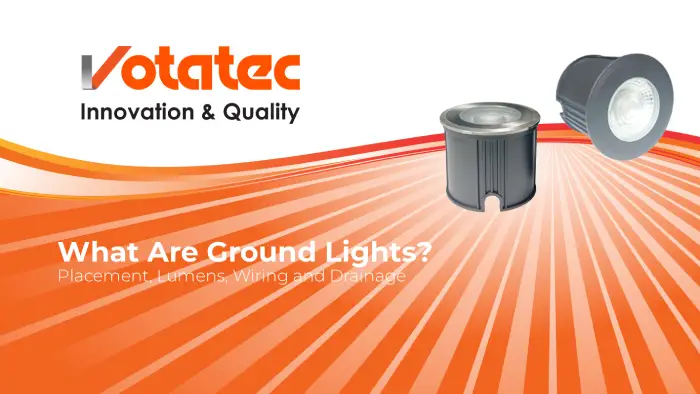
Votatec’s 1.5″ and 3″ in-ground spot lights are a good example. They’re stainless steel with tempered glass, IP67 sealed and cETL listed for wet locations. But the manual says plainly not to install them under water. IP67 is for “it flooded for a bit.” It isn’t for “it lives in a pond.”
So drainage matters more than the rating. Set in-ground waterproof lights on a gravel bed, keep them out of low spots where water collects, and you’ll avoid most early failures. Our guide to installing garden and walkway lighting covers the gravel base step by step.
IP68: Continuous Submersion
IP68 is the only rating meant for waterproof lights that stay under water. But here’s the thing. IEC 60529 doesn’t set one fixed IP68 test. The manufacturer declares the depth and duration, and it has to be tougher than the IP67 test.
So “IP68” alone tells you very little. IP68 waterproof lights rated for 1.5 metres for 2 hours aren’t the same product as ones rated for 3 metres continuously. Always ask for the depth and time. If the spec sheet doesn’t list them, that’s a red flag.
Votatec doesn’t currently stock submersible IP68 luminaires. You’ll see “IP68” on some of our flood light pages, but that refers to the IP68-rated connectors recommended for the input wiring joints, not the fixture itself. We’d rather tell you that than have you drop an IP66 flood into a fountain. For pools and fountains, use fixtures listed for that purpose and follow the pool rules in Section 68 of the Canadian Electrical Code.
IP65 vs IP67: Which Is Better for Outdoor Lights?
For lights on walls and poles, IP65 is usually the better buy. Water runs off them, it doesn’t pool, so the IP65 jet test matches real life. IP67 only earns its price where a fixture can end up under water, like an in-ground light in a lawn that floods. Paying for IP67 waterproof lights on a wall pack buys you a test it’ll never face.
Why IP67 Waterproof Lights Aren’t Automatically Better Than IP66
This trips up a lot of buyers of waterproof lights. Under IEC 60529, a product marked only IPX7 or IPX8 isn’t considered suitable for water jets. Immersion presses steadily on a seal. A jet hammers it from an angle. Different stress, different test.
That’s why you’ll sometimes see dual markings like IP66/IP67. That fixture passed both tests. If waterproof lights say only IP67 and they’re going in a car wash, they haven’t proven they can take the jets. Make sense?
Which IP Rating Do Your Waterproof Lights Need? A Canadian Job-by-Job Guide
Here’s how we’d match waterproof lights to common Canadian commercial jobs. These are practical minimums for waterproof lights, not code requirements. Your engineer and local inspector have the final say.
| Location | Minimum rating | Why |
|---|---|---|
| Covered entrance or soffit, fully sheltered | IP44 to IP54, damp-rated | No direct rain, but humidity and frost |
| Exposed building wall, loading dock | IP65 | Wind-driven rain, snow, ice |
| Parking lot poles and area lights | IP65 | Rain, snow, salt spray from ploughs |
| Underground parking garage | IP65 to IP66 | Salty slush, spring hose-downs |
| Cold storage and freezers | IP65 to IP66 | Condensation when doors open |
| Car wash, food processing, washdown | IP66 (IP69 for hot sanitation) | Direct high-flow jets |
| Sports fields, coastal sites | IP66 | Storms and sustained wind |
| In-ground lights in lawns or pavers | IP67 plus drainage | Temporary flooding |
| Fountains, ponds, pools | IP68 with a stated depth and pool listing | Permanent submersion |
For covered areas that only see humidity, you don’t need to pay for fully waterproof lights. Our explainer on wet-rated vs damp-rated exterior can lights shows where that line falls. Bathrooms follow their own logic, covered in our guide to bathroom ceiling light fittings, IP ratings and zones.
Waterproof Lights vs Wet Location Listings: What Canadian Code Cares About
This is the part most guides to waterproof lights miss, because most of them aren’t written for Canada.
An IP rating on waterproof lights is a test result. It isn’t a Canadian electrical approval. In Canada, luminaires have to be certified to Canadian standards by an accredited body. That’s what marks like CSA, cULus and cETLus show. The CSA Group explains its certification marks and labels if you want to see what to look for.
The Canadian Electrical Code, Part I (CSA C22.1:24, the 26th edition) covers luminaires in damp and wet locations in Section 30, Rules 30-316 to 30-322. Broadly, the code treats a wet location as anywhere liquid can drip, splash or flow onto equipment. In practice, inspectors look for waterproof lights that are listed and marked as suitable for wet locations, and installed the way their instructions say.
In Ontario, the Electrical Safety Authority only accepts equipment carrying a recognised mark. ESA keeps the full list of recognized certification marks on its site. Other provinces follow the same principle through their own safety authorities.
So for waterproof lights in Canada, you want both:
- A wet location listing with a recognised Canadian certification mark. This is what passes inspection.
- The right IP rating for the water and dust exposure. This is what keeps the light alive.
A cheap import with “IP68 waterproof” printed on the box and no certification mark may look tougher on paper. It isn’t installable. Not ideal.
Canadian Weather: What IP Tests Don’t Cover
IP tests happen in a lab with fresh water at room temperature. Canada isn’t a lab. Here’s what the rating on your waterproof lights doesn’t tell you.
Freeze-thaw cycles. Water that sneaks past a gasket can freeze, expand and push the gap wider. Spring and fall swings around 0°C are tough on seals, especially in Montreal and Ottawa. Check the operating temperature range, not just the IP code. Our flood lights, for instance, are rated to -30°C.
Condensation. This one’s underrated. Sealed waterproof lights that warm up and cool down can pull moist air in through tiny gaps, then trap it as condensation inside the lens. It’s common in freezers and unheated garages. Quality vapour tight fixtures handle this with good gaskets and sealed driver compartments.
Road salt and corrosion. IP tests use fresh water. Salt spray from Toronto and Calgary roads attacks aluminium housings, screws and brackets. Look for powder-coated die-cast housings and stainless hardware on waterproof lights near roads or parking.
Impact. A dented lens leaks on any waterproof lights, no matter the IP rating. Impact resistance is a separate code called the IK rating, from IEC 62262. IK08 or higher makes sense anywhere a hockey puck, a forklift mast or a vandal might hit the light. We cover sealed fixtures for freezers and harsh plants in our industrial LED lighting guide for cold storage.
How to Read an LED Spec Sheet: A 7-Point IP Checklist
Before you order waterproof lights, run through this checklist:
- Find the full IP code. “Waterproof lights” on its own means nothing. You want IP65, IP66 or a dual marking like IP66/IP67.
- Check that the rating covers the whole fixture. Sometimes only the driver or the connector is rated, not the luminaire. That’s exactly the IP68 connector point above.
- Look for a wet location listing. cULus, cETLus or CSA, marked for wet locations.
- Read the operating temperature range. Anything that can’t start at -30°C is a gamble on the Prairies.
- Check the IK rating if people, vehicles or pucks are nearby.
- For IP68, demand the depth and duration. No numbers, no deal.
- Read the installation notes. Wiring connections, cable glands and end caps all affect the real-world seal.
Basically, the spec sheet for waterproof lights should answer four questions: what water, what dust, what temperature and what approval. If it can’t, keep shopping.
Common IP Rating Mistakes on Canadian Job Sites
We see the same handful of errors on Canadian job sites:
- Buying IP67 for a wash bay. Immersion-rated fixtures aren’t proven against jets unless they’re dual marked.
- Treating IP68 waterproof lights as a universal upgrade. Without a stated depth, it’s just a number.
- Mixing up damp and wet. A damp-rated fixture under a roof overhang is fine, and you don’t need fully waterproof lights there. The same one on an open wall isn’t.
- Breaking the seal on install. Unsealed cable entries, loose plugs and cut neon flex without end caps are the top causes of early failure.
- Ignoring drainage. In-ground waterproof lights in a low spot will sit in water longer than any IP67 test.
- Assuming the IP code means approval. It doesn’t. Look for the certification mark.
Honestly, most “the waterproof light failed” calls we hear come down to installation, not the rating.
Frequently Asked Questions About Waterproof Lights
Is IP65 waterproof enough for outdoor lights in Canada?
Yes, for most exposed outdoor jobs. IP65 waterproof LED lights are dust-tight and protected against water jets from any direction, so rain, snow, sleet and sprinklers aren’t a problem. Pair IP65 with a cULus, cETLus or CSA wet location listing. Move up to IP66 for pressure washing or coastal storms, and IP67 if the light could end up under water.
What’s the difference between IP66 and IP67?
IP66 is tested against powerful water jets, roughly 100 litres a minute through a 12.5 mm nozzle. IP67 is tested by submerging the fixture up to 1 metre for 30 minutes. They’re different stresses, so neither rating includes the other. If waterproof lights need to handle both jets and immersion, look for a dual marking like IP66/IP67.
Can IP68 waterproof lights stay under water permanently?
They can, within the limits the manufacturer states. IEC 60529 lets the manufacturer set the IP68 depth and duration, as long as it’s tougher than the IP67 test. Check the spec sheet of IP68 waterproof lights for the exact depth and time. For pools and fountains, also use fixtures listed for that use under the Canadian Electrical Code.
Do I need IP66 waterproof lights for a car wash?
Yes, IP66 waterproof lights are the practical minimum for a car wash bay. The fixtures take direct, high-flow spray every day, which is what the IP66 jet test simulates. Vapour tight waterproof lights with an IP66 rating and a wet location listing are the usual choice. For hot, high-pressure sanitation, as in food plants, look at IP69 as well.
Are waterproof lights the same as wet location rated lights?
No. An IP rating describes how well the enclosure keeps out dust and water in a lab test. A wet location listing is a safety certification from an accredited body like CSA, UL or Intertek, and it’s what Canadian inspectors check. Good waterproof lights for Canadian projects carry both.
Bottom Line: Matching Waterproof Lights to the Job
Here’s the takeaway, in five lines:
- IP65 for most outdoor walls, poles, canopies and dusty interiors
- IP66 for washdown, car washes, garages and storm-exposed sites
- IP67 for in-ground lights that might flood, with good drainage
- IP68 only for permanent submersion, with a stated depth
- Always a wet location listing with a recognised Canadian certification mark
Pick waterproof lights by the water they’ll actually face, not the biggest number on the box. And check the installation, because that’s where most seals fail.
Need help matching waterproof lights to a project? Browse our full range of LED light fixtures, see the types of LED fixtures we stock, or read more on the Votatec blog. Contractors and facility managers can contact Votatec for a quote on wet location rated waterproof lights, shipped across Canada.