










 (+1) 905 597 5955



Lighting eats about 13% of the energy used in a Canadian commercial or institutional building, according to Natural Resources Canada. That’s a big line item to get wrong. And most spec mistakes we see aren’t about brand or price. They’re about picking the wrong kind of LED fixture for the space.
So here’s the short version, right up front.
Commercial LED fixtures split into five families: recessed and ceiling-grid LED fixtures (troffers, panels, pot lights), linear LED fixtures (strip, wrap, architectural), high bay LED fixtures (UFO and linear), outdoor and site LED fixtures (wall packs, area lights, floods, canopies), and life-safety LED fixtures (emergency and exit). Pick the family by mounting height and environment first. Then match lumens, then check the listing.
That order matters. Get it backwards and you end up with a beautiful DLC Premium LED fixture that’s rated for dry locations sitting in a wash bay.
This guide walks all five families, with the numbers Canadian buyers actually need.
One note before we start, because the counts you’ll see elsewhere disagree. Ask the internet how many types of LED fixtures there are and you’ll get three, four, or seven, depending on who’s counting. Those lists usually sort by room (ambient, task, accent) or by bulb type. This one sorts by how the LED fixture mounts and what environment it survives, because that’s what decides a commercial purchase order. Five families, and residential ceiling products sit inside the first one. If a ceiling fixture is all you need, our types of LED ceiling lights guide goes deeper on that family alone.
What Counts as an LED Fixture (and What Doesn’t)
Quick definition, because it trips people up on quote requests.
An LED fixture (or luminaire) is a complete unit: housing, driver, optics, and LED boards, all listed together as one assembly. An LED lamp is a replacement bulb or tube that goes into an existing housing. Different products, different rebates, different code treatment.
Why care? Because utility programs and the DesignLights Consortium treat them as separate categories with separate efficacy thresholds. A contractor who quotes lamps when the program funds luminaires loses the incentive. Comparing tubes instead? Our Type A vs Type B LED tube guide covers that.
The Five Specs That Actually Decide Which LED Fixtures You Buy
These five numbers narrow a catalogue of hundreds down to three or four real options.
1. Mounting Height Picks the Family
This is the single biggest filter. Ceiling height, not room size.
- Under 3 m (10 ft): troffers, panels, pot lights, surface mounts, wraps
- 3 to 6 m (10 to 20 ft): low bay LED fixtures, linear strip, architectural linear
- Over 6 m (20 ft): high bay LED fixtures, UFO or linear
Put a troffer at 8 m and you’ll light the ceiling. Put a UFO high bay at 2.7 m and you’ll blind everyone under it. Neither is a product fault.
2. Lumens on the Floor, Not Lumens on the Box
Delivered light is what the space gets. The box number is what the LED fixture makes.
The Illuminating Engineering Society publishes recommended illuminance by task, and for garage and shop spaces the targets are lower than most people guess:
| Space | Foot-candles |
|---|---|
| Storage | 5 |
| Parking garage | 10 |
| Service garage | 10 to 20 |
| Repair area | 50 to 100 |
| Machine shop, medium bench work | 50 to 100 |
| Machine shop, fine bench work | 200 to 500 |
Multiply foot-candles by floor area for a rough lumen target. A single-car bay is around 240 sq ft, so storage-level light needs about 1,200 lumens and service-level needs 2,400 to 4,800. That’s one LED fixture, not four. Our high bay lighting calculator handles taller spaces.
3. Damp, Wet, or Dry Location
Canadian buyers get burned here constantly.
Dry means indoor, conditioned, no moisture. Damp means covered outdoor or humid indoor, like a soffit or a loading dock overhang. Wet means direct water exposure: exposed exterior, wash bays, cold storage with condensation.
IP ratings run alongside that listing. IP65 handles low-pressure jets from any direction, IP66 handles high-pressure jets. For a car wash or a food plant that gets hosed down, IP66 is the answer and IP65 isn’t. Read both the IP number and the CSA location listing. They’re not the same claim.
4. Voltage, and the 347V Question
Most commercial LED fixtures ship as 120-277V universal input. Fine for the majority of buildings.
But plenty of Canadian commercial and industrial buildings run 347/600V service, which is rare enough in North American catalogues that it quietly kills projects at the ordering stage. If your panel is 347V, filter for it before you fall in love with an LED fixture. It’s a real Canadian differentiator and worth asking about on every quote.
5. DLC Listing, and a Deadline You Should Know About
Utility rebates across Canada generally require the LED fixture to be on the DLC Qualified Products List. Two tiers: Standard and Premium.
Under SSL V6.0, the minimum efficacy thresholds look like this:
| Primary use | Standard (lm/W) | Premium (lm/W) |
|---|---|---|
| Troffer | 120 | 135 |
| Linear ambient | 125 | 140 |
| High bay, non-hazardous | 135 | 150 |
| Low bay, non-hazardous | 130 | 145 |
| Interior directional | 95 | 110 |
| Wall-mounted area | 125 | 140 |
| Parking garage | 115 | 130 |
| Bollard | 115 | 130 |
Here’s the part to diarise. DLC’s qualified products list transitions to SSL V6.0 on 2026-12-15. Products that weren’t updated by 2026-10-09 get delisted. So an LED fixture listed today under the older V5.1 requirements may not be listed in January.
What to do about it: ask for the DLC product ID, not the word “Premium.” Then check it yourself on the QPL before you submit a rebate application. Our DLC certification explainer covers how the listing works, and the LED rebates in Canada guide covers program specifics by province.
One more thing on certifications. ENERGY STAR no longer certifies lamps or general luminaires. The program sunset, and brand owners were told to stop using the mark by 2024-12-31. The only carve-out is recessed downlights, under a separate downlights specification. If a spec sheet on a wall pack or a panel still says ENERGY STAR, that claim is dead. Treat it as a red flag on the whole document.
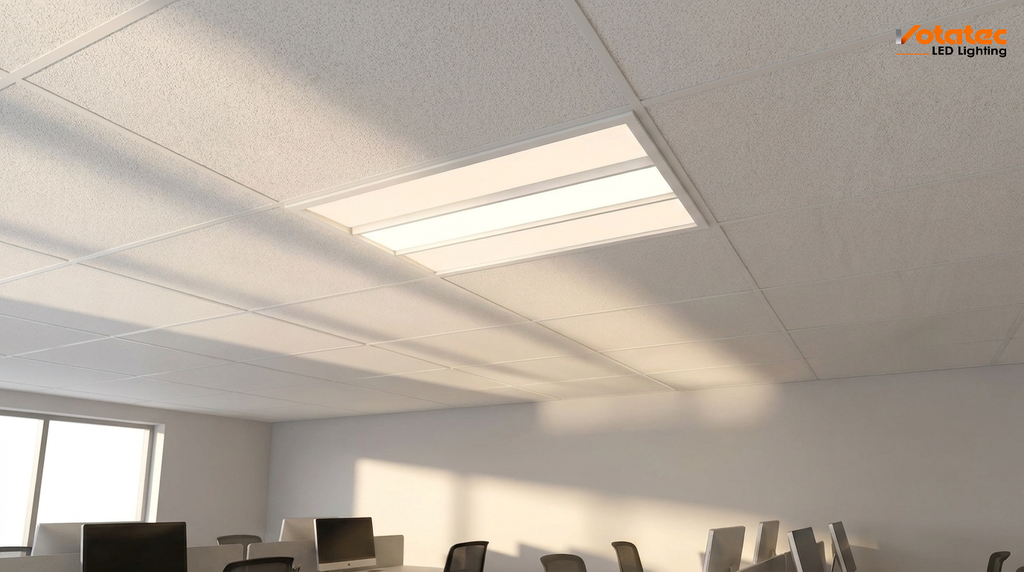
Indoor Ceiling LED Fixtures
Now the product tour. Starting indoors, at normal ceiling heights.
LED Troffers
The rectangular LED fixture that drops into a suspended ceiling grid. 2×4, 2×2, and 1×4 are the standard sizes, matched to the T-bar grid rather than to the room.
Troffers are the default for offices, schools, clinics and corridors with drop ceilings. They’re also the most common fluorescent replacement in Canada, because the old troffer and the new LED one occupy the same hole.
What to check:
- Grid size first. Measure it. 2×4 and 2×2 aren’t interchangeable.
- Glare control. For offices with screens, look for UGR under 19. Open desks under a bare-lens troffer is a complaint waiting to happen.
- Selectable CCT and wattage. Field-selectable units cut the number of SKUs you stock and let you correct a lighting level on site instead of reordering.
- Dimming. 0-10V is standard for commercial controls.
Browse LED troffers, or read the full troffer replacement guide if you’re planning a fluorescent retrofit.
Recessed Downlight and Pot Light LED Fixtures
Round recessed LED fixtures. Canadians call them pot lights, spec sheets call them downlights or slim panels, and they’re the same product. Worth knowing, because searching the wrong term hides half the catalogue from you.
Slim or wafer versions install in shallow ceilings with a junction box and no housing can, which makes them the go-to for retrofit work where plenum depth is tight. Canless designs cut labour on renovation jobs.
Sizing runs 4″, 6″ and 8″ apertures. Spacing rule of thumb for general ambient light is roughly ceiling height divided by 1.5, though that’s a starting point and not a design. Fire-rated versions aren’t optional where the assembly is rated.
See LED downlights or the recessed downlight explainer.
Surface Mount and Flush Mount LED Fixtures
When there’s no plenum to recess into, these mount flat to the deck. Concrete ceilings, corridors, stairwells, storage rooms, washrooms.
They’re underrated, honestly. No cutting, no housing, minimal labour. Many are damp-rated out of the box, which covers unheated vestibules and similar spaces.
Check the surface mount range, and if you’re deciding between the two mounting styles, flush mount vs surface mount sorts it out.
LED Wrap Lights
A lens that wraps around the housing, throwing light sideways as well as down. Cheap, bright, and unfussy.
Wraps belong in utility spaces: back-of-house corridors, storage, mechanical rooms, stairwells, parkade interiors. The lens lifts the walls, so a narrow corridor feels less like a tunnel. Nobody specs a wrap for a boardroom, and that’s fine.
Browse LED wrap lights.
Linear Strip LED Fixtures
The bare-bones linear channel. No decorative housing, just a body, a driver, and a diffuser or an open lens. Mounts to the surface, chains end to end, or hangs on cable or chain.
Strip LED fixtures are the workhorse for retail stockrooms, low-bay warehouses and garages, anywhere a continuous run of light matters more than looks. They row-mount, so they suit aisles where you want uniformity down the length rather than pools of light.
Watch out for one thing: the term “strip light” also means flexible LED tape, which is a completely different product. If you’re sourcing a rigid LED fixture, say “linear strip fixture” on the RFQ.
See strip light fixtures and linear lights for warehouses.
Architectural Linear LED Lighting
The finished version of the same idea. Extruded aluminum body, continuous-looking runs, suspended or recessed or surface, with optics designed to be looked at.
This goes in lobbies, open offices, conference rooms and retail where the LED fixture is part of the design. Continuous runs need matched joiners and a driver plan, so these get specified as a system. Higher cost per metre, and the payoff is the finish.
Browse architectural linear LED lighting.
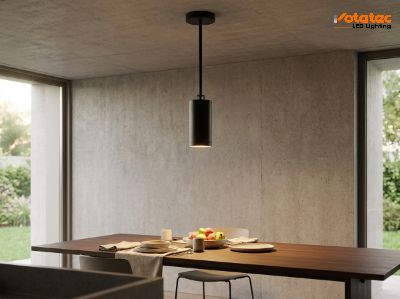
Track Lighting LED Fixtures
Adjustable heads on a powered rail. H, J, and L track standards exist and they’re not compatible with each other, so match the track type to whatever’s already on the ceiling.
Track earns its place in retail, galleries, showrooms and hospitality, anywhere the merchandise moves and the light has to follow. Beam angle matters most: narrow spots for accent, floods for wall washing.
See track lighting.
High Bay LED Fixtures for Warehouses and Industrial Spaces
Over about 6 m of mounting height, the physics change. You need concentrated output and optics that push light down without scattering it into the roof structure.
UFO High Bay LED Fixtures
Round, compact, high output. The shape is a heat sink, not styling.
UFOs suit open floor: distribution centres, manufacturing bays, arenas, big-box retail. Beam angle does the work. Narrow for tall racking aisles, wide for open floor at moderate height. Most commercial UFOs land between 100W and 240W, replacing 400W to 1000W metal halide.
Linear High Bay LED Fixtures
Same job, different shape. A long body that runs parallel to an aisle, spreading light along the rack rather than in a circle.
Rule of thumb: aisles get linear, open floor gets UFO. Racking creates canyons, and a round beam pattern wastes half its output on the rack faces instead of the floor between them. We wrote up the full decision in UFO vs linear high bay.
Browse UFO high bays or linear high bay fixtures.
Vapor Tight LED Fixtures
Sealed linear LED fixtures with gasketed housings, built for water, dust, and washdown.
Where they go: parking garages, car washes, cold storage, food processing, breweries, tunnels, agricultural buildings, exterior soffits. Anywhere the LED fixture gets wet or dirty on purpose.
IP65 versus IP66 is the distinction to get right. Cold storage adds a second one, because a standard driver can fail cold. Ask for the operating temperature range, not just the IP number.
See vapor tight fixtures and where to use vapor tight fixtures.
A note on what these are not. Vapor tight is not the same as explosion proof. Hazardous locations with flammable vapours or combustible dust need LED fixtures listed for the specific class and division, and a sealed IP66 housing doesn’t qualify on its own. Different listing, different product.
Outdoor and Site LED Fixtures
Wall Pack LED Fixtures
Building-mounted exterior LED fixtures. Entrances, loading docks, service doors, perimeter walls, stairwells.
Full-cutoff versions push light down instead of sideways. That matters twice over: dark-sky bylaws increasingly require it in Canadian municipalities, and it stops light trespassing onto the neighbour’s property. Photocells and motion sensors cut runtime on an LED fixture that would otherwise burn dusk to dawn.
Area Light and Shoebox LED Fixtures
Pole-mounted, for parking lots and roadways. “Shoebox” is the shape of the housing.
Distribution type decides everything. Type II for narrow strips like a driveway, Type III for standard lot perimeters, Type IV forward-throw where you can’t spill light backwards, Type V for symmetric coverage from a central pole. Pole height, spacing and distribution get designed together, so ask for a photometric layout on any lot over a handful of poles.
Browse LED area lights, and see the commercial outdoor area lighting spec guide or the shoebox light explainer.
Flood Light LED Fixtures
Aimable, wide-beam LED fixtures for lighting a surface or an object: building facades, signage, yards, sports areas, equipment compounds.
Floods and wall packs get confused all the time. Simple split: a wall pack lights the area next to a building from a fixed mount, a flood aims wherever you point it. If you need to control where the beam lands, you need a flood. LED wall pack vs flood light has the longer comparison.
See wall pack lights and LED flood lights.
Canopy LED Fixtures
Low-profile LED fixtures for covered exterior ceilings: fuel stations, drive-throughs, parkade decks, building overhangs, transit shelters.
The design problem under a canopy is glare, not output. Drivers look up into these LED fixtures, so diffused lenses beat bare optics. Damp or wet listing is mandatory even though the space is covered, because wind-driven rain doesn’t respect a soffit.
Browse canopy lighting.
Bollard and Grounds LED Fixtures
Short pole LED fixtures for walkways, plus in-grade and accent LED fixtures for grounds. Wayfinding and safety products, not area lighting. Low mounting height means you need plenty of them or you get scallops of light with dark gaps between.
See landscape lighting.
Emergency and Exit LED Fixtures: What Canadian Code Actually Requires
This section gets misquoted more than any other, so let’s be precise.
Emergency lighting in Canada is governed by the National Building Code and the provincial codes built on it, plus provincial fire codes. Duration is not a single number. It’s a ladder that depends on the building:
- 2 hours for high buildings, as defined in NBC Article 3.2.6
- 1 hour for Group B occupancies (care, treatment, detention)
- 30 minutes for other buildings
So where does 90 minutes come from? It’s a product rating, from CSA C22.2 No. 141 and UL 924. Manufacturers build to it because it clears the common code minimums with margin and satisfies the US market too. A good product spec, yes. A Canadian code requirement, no. Quoting it as one is how a high building that needed 2 hours ends up under-designed.
Get the occupancy classification from the drawings, then match the duration. Don’t work backwards from the LED fixture.
Product types in this family:
- Emergency battery units: central or self-contained, with remote-capable heads
- Remote heads: unpowered lamp heads fed by a battery unit
- Combination units: exit sign plus egress heads in one housing
- Running man exit signs: the ISO 7010 pictogram is the current Canadian standard, not the word EXIT
- Self-test diagnostics: worth the premium, because monthly manual testing rarely happens
- Low-temperature batteries: required for unheated garages and vestibules, where a standard battery loses capacity
Browse LED emergency lights or read exit signs to backup systems.
Lighting Controls: The LED Fixtures Requirement Buyers Forget
Here’s the one that costs projects money at inspection. You can buy perfectly good LED fixtures, install them correctly, and still fail the energy code, because in Canada the controls on your LED fixtures are code, not an upgrade.
The rules live in the National Energy Code of Canada for Buildings 2020, Division B, Part 4. Most product pages skip this entirely. Here’s what it actually says.
Indoor control rules (NECB 2020, Article 4.2.2.1)
Which rules apply to your LED fixtures depends on the space type, which comes out of Table 4.2.1.6. The requirements themselves:
- Manual control in every space. At least one manual control device per area of 250 m2 or less, where the space is 1,000 m2 or less. For spaces over 1,000 m2, one per 1,000 m2 area. It has to be readily accessible, with the lighting it controls in view.
- Automatic Full OFF spaces: lighting shuts off within 20 minutes of the space being unoccupied, and each automatic device controls no more than 50 m2. That 50 m2 cap is the number people miss. One sensor covering a big open room full of LED fixtures won’t pass.
- Scheduled Shut-off spaces: a time-of-day device turns lighting off on a programme. Each device covers 2,500 m2 maximum, on one floor only.
- Manual override limits: an override on a scheduled system can only turn lighting on for 2 hours or less per press, and can only cover 500 m2 or less.
- Bi-Level spaces: controls must offer at least one intermediate level between 30% and 70% of full lighting power, or continuous dimming.
- Daylight response: where general lighting in the primary sidelighted area draws 150 W or more, or 300 W or more across primary plus secondary areas, that lighting needs separate photocontrols.
Exemptions exist where automatic shut-off would endanger occupant safety or security, and for lighting that has to run continuously for operational reasons. Don’t assume the exemption applies. Get it in writing from the designer.
Storage garages get their own article, and it’s stricter
NECB Article 4.2.2.2 covers storage garages separately. If you’re buying LED fixtures for a parkade, these four numbers decide your control layout:
- Lighting divided into zones no larger than 360 m2
- Each zone reduces power by at least 30% when no activity is detected for 20 minutes
- Covered vehicle entrances and exits are separately controlled, reducing by at least 50% from sunset to sunrise
- Luminaires within 6.1 m of a perimeter wall with a net opening-to-wall ratio of 40% or more, and no obstruction within 6.1 m, must dim in response to daylight where their combined input tops 150 W
Daylight transition zones and ramps without parking are exempt from the zoning, occupancy and daylight sentences.
So a parkade retrofit isn’t just vapor tight LED fixtures on a grid. It’s zoned, sensored, and daylight-aware at the perimeter. Price the sensors into the LED fixtures quote at the start. Our garage lights page shows the fixture side of that build.
Outdoor control rules (NECB 2020, Article 4.2.4.1)
Exterior LED fixtures have to be controlled by astronomical time controls, photosensors, or photosensors combined with a timer shut-off switch. Dusk-to-dawn lighting is narrower still: astronomical time controls or photosensors only.
Then two requirements on outdoor LED fixtures that catch people:
- All exterior lighting, signage and parking lot lighting included, must be capable of automatically reducing total connected lighting power by at least 30%.
- Facade lighting and landscape lighting must be able to shut off automatically.
And any lighting schedule controller needs backup provisions to hold its programming and time setting for at least 10 hours through a power outage.
Covered vehicle entrances and exits from buildings or storage garages are exempt where the lighting is needed for safety, security or eye adaptation.
Control types by space, at a glance
| Space | Typical NECB control requirement |
|---|---|
| Private office, meeting room | Automatic Full OFF, 20 min, 50 m2 per device |
| Open office | Scheduled Shut-off plus daylight response at windows |
| Corridor, lobby | Scheduled Shut-off |
| Warehouse aisle | Occupancy reduction, often bi-level |
| Storage garage | 360 m2 zones, 30% reduction after 20 min |
| Parkade entrance | Separate control, 50% reduction sunset to sunrise |
| Parking lot, signage | 30% automatic reduction capability |
| Facade, grounds | Automatic shut-off capability |
Confirm your own space types against Table 4.2.1.6 before you order LED fixtures. This table is a planning aid, not a substitute for the code.
Votatec stocks the control side too: photoelectric sensors for dusk-to-dawn switching and LED dimmer switches for the 0-10V and bi-level requirements.
347V and Multi-Voltage LED Fixtures: The Canadian Difference
This deserves its own section, because it’s the single most common reason a Canadian order gets cancelled after approval.
Most commercial LED fixtures sold in North America are built for 120-277V input. That covers 120V, 208V, 240V and 277V systems, which is most of the US market and plenty of Canadian buildings.
But Canada runs a lot of 347/600V service. Older industrial plants, warehouses, arenas, big-box retail, many school boards and municipal buildings. 347V is a Canadian and, to a lesser extent, a European convention. It barely exists in the US, so it barely exists in US-built catalogues.
What goes wrong: a facility manager specs an LED fixture from a spec sheet, the electrician arrives, opens the panel, finds 347V, and the LED fixture won’t accept it. Now you’re either buying step-down transformers per LED fixture, which destroys the payback math, or you’re reordering and eating the lead time.
How to avoid it:
- Confirm the panel voltage before you shortlist any LED fixtures. Not after.
- Ask whether the LED fixture is native 347V or multi-tap. Native is cleaner.
- Watch for 120-347V on the spec sheet. That’s the range you want in a 347V building.
- For emergency LED fixtures, check the battery unit’s input voltage separately from the heads.
- Confirm the driver is listed for the voltage, not just physically compatible.
Provincial electrical safety rules require equipment to be installed within its listing, so a mismatched driver isn’t just a performance question. In Ontario, the Electrical Safety Authority is the enforcement body, and provincial equivalents apply elsewhere.
The upside for buyers: 347V capability is a genuine LED fixtures filter. Ask about it early and it narrows a huge catalogue fast.
Matching LED Fixtures to Building Type
A shortcut table for the common Canadian commercial jobs.
| Building type | Primary LED fixtures | Secondary |
|---|---|---|
| Office | Troffers, architectural linear | Downlights, emergency |
| Warehouse, high ceiling | UFO or linear high bay | Wall packs, emergency, exit |
| Warehouse, low ceiling | Linear strip, wraps | Vapor tight at docks |
| Retail | Track, downlights, linear | Wall packs, canopy |
| Parking garage | Vapor tight, canopy | Wall packs, emergency |
| Parking lot | Area lights on poles | Floods, bollards |
| School, clinic | Troffers, surface mount | Downlights, exit signs |
| Car wash, food plant | Vapor tight, IP66 | Wall packs |
| Workshop, service bay | Linear strip, low bay | Vapor tight, task lighting |
Application pages with full product lists: warehouse lighting, office lighting, garage lights.
Retrofit the Lamp or Replace the LED Fixture?
Real question on every fluorescent conversion, and the answer moved recently.
Canada’s Products Containing Mercury Regulations prohibited the manufacture and import of T5 and T8 linear fluorescent lamps after 2025-12-31, under the Minamata Convention. A replacement-lamp exemption runs to 2027-12-31, and sale of existing stock is prohibited by the end of 2029. Details are in the Government of Canada announcement.
So the supply clock is running whether or not you upgrade now.
Swap the lamps when: housings are sound, the layout works, budget is tight, and the space isn’t a priority. Cheapest option, fastest install.
Replace the LED fixture when: housings are past 20 years, ballasts are failing anyway, you want the rebate, or the light level was never right. Full LED fixtures carry the DLC listing most programs require, warrant the whole assembly, and let you fix a bad layout instead of preserving it.
Middle path: retrofit kits keep the housing and replace the guts. Cheaper than a full LED fixture, but check rebate eligibility first, because programs treat kits differently than luminaires. Full detail in our commercial LED retrofit guide.
Five Mistakes Canadian Buyers Make
Specifying by wattage. Wattage tells you consumption, not brightness. Compare delivered lumens and efficacy in lm/W.
Ignoring colour temperature consistency. Mixing 4000K and 5000K in one space looks like a mistake because it is one. Pick one CCT per area. Our colour temperature guide covers the choice.
Buying dry-rated LED fixtures for damp spaces. Unheated garages, loading docks and covered walkways all need damp or wet listing. The most expensive mistake here, because it shows up as failures in year two.
Trusting the word “Premium” without the DLC ID. With the QPL transition landing 2026-12-15, verify the listing yourself.
Forgetting the controls. Occupancy sensors and photocells often deliver more savings than the LED fixture upgrade alone, and some rebate programs require them.
Frequently Asked Questions
What are the main types of LED fixtures used in commercial buildings?
Commercial buildings use five families. Ceiling-grid and recessed LED fixtures (troffers, panels, pot lights, surface mounts) for normal ceiling heights. Linear LED fixtures (strip, wrap, architectural) for continuous runs. High bay LED fixtures (UFO and linear) above about 6 m. Outdoor LED fixtures (wall packs, area lights, floods, canopies, bollards) for building exteriors and sites. Life-safety LED fixtures (emergency battery units, remote heads, running man exit signs) as required by the building code. Most commercial projects use LED fixtures from three or four of these families.
What are the different types of LED light fixtures?
Sorted by mounting and environment, there are five: ceiling-grid and recessed LED fixtures (troffers, panels, pot lights, surface mounts, wraps), linear LED fixtures (strip, wrap, architectural), high bay LED fixtures (UFO and linear), outdoor and site LED fixtures (wall packs, area lights, floods, canopies, bollards), and life-safety LED fixtures (emergency battery units, remote heads, exit signs). Other lists count three or four types because they sort by room function (ambient, task, accent) or by lamp type instead. For a commercial purchase, mounting and environment is the useful split.
How do I know which LED fixtures suit my ceiling height?
Mounting height is the first filter. Below 3 m, use troffers, panels, pot lights, surface mounts or wraps. Between 3 m and 6 m, use low bay or linear strip LED fixtures. Above 6 m, use high bay LED fixtures, choosing UFO for open floor areas and linear for racked aisles. Beam angle then fine-tunes the result: narrow beams for tall narrow aisles, wide beams for open floor at moderate height.
Do LED fixtures need to be DLC listed for Canadian rebates?
Usually, yes. Most Canadian utility incentive programs require the LED fixture to appear on the DLC Qualified Products List, and some pay more for Premium than Standard. Ask suppliers for the DLC product ID rather than accepting the word “Premium,” then verify it on the QPL yourself. This matters right now because the QPL transitions to SSL V6.0 requirements on 2026-12-15, and products not updated by 2026-10-09 get delisted.
What’s the difference between damp-rated and wet-rated LED fixtures?
Damp-rated LED fixtures handle moisture and humidity but not direct water: covered soffits, loading dock overhangs, unheated vestibules, humid indoor rooms. Wet-rated LED fixtures handle direct water exposure: exposed exterior mounting, wash bays, cold storage. IP ratings sit alongside the location listing, with IP65 covering low-pressure water jets and IP66 covering high-pressure jets. Check both the IP number and the CSA location listing, because they describe different tests.
How long do emergency LED fixtures have to stay on in Canada?
It depends on the building, not the LED fixture. The National Building Code sets 2 hours for high buildings, 1 hour for Group B occupancies, and 30 minutes for other buildings. The 90-minute figure printed on most emergency units is a product rating from CSA C22.2 No. 141 and UL 924, not a Canadian code minimum. Confirm the occupancy classification from the drawings, then choose a unit that meets or exceeds that duration.
Bottom Line
Pick the family by mounting height and environment. Size by delivered lumens against an IES target. Verify the listing with a DLC ID and a location rating, not a marketing word. Do those three things in that order and the rest of the spec falls into place.
Votatec stocks the full range of commercial LED fixtures in Canada, from troffers and pot lights to high bays, vapor tights, wall packs and emergency units, at wholesale pricing for electrical contractors, facility managers and public-sector buyers. Send us the ceiling height, the area and the environment. We’ll come back with the LED fixture that fit and the photometrics to back them up.