











 (+1) 905 597 5955


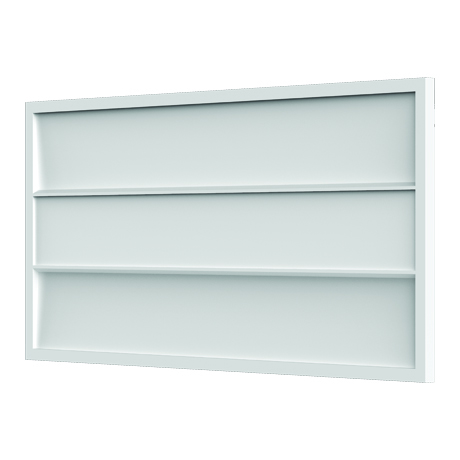
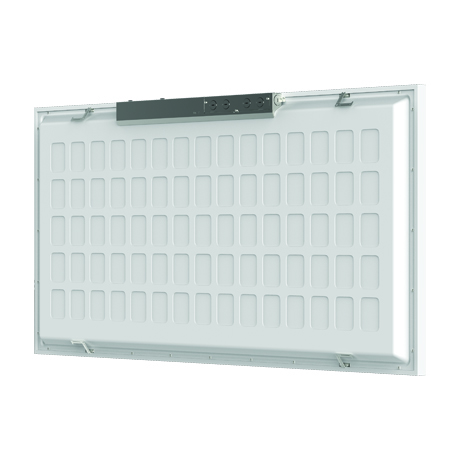


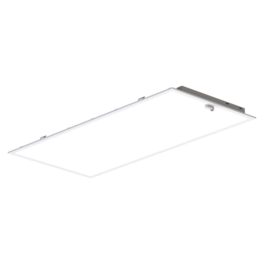
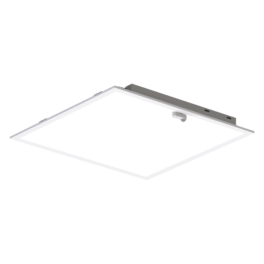
This architectural LED troffer drops into a 2x4 T-bar grid, and its tri-zone angled lens gives a ceiling depth instead of the flat wash of a plain panel.
Wattage and colour both set on site: 30W, 40W or 50W, and 3500K, 4000K or 5000K. Output reaches 6,300 lm at 4000K. It ships set to 50W and 3500K.
Aluminum frame, PMMA lens, cULus listed for damp locations, DLC Premium, 5 year warranty.
What's the difference between a troffer and an LED flat panel?
A troffer recesses its lens behind the frame inside the ceiling grid, so you read the fixture as light. A flat panel presents one even luminous slab flush with the tile. This goes further than either: three lens zones angled behind the frame, lifting brightness off the ceiling plane and taking the edge off the glare of one large uniform surface. In offices and classrooms where people look up all day, that beats another 200 lumens.
How long do LED troffer lights last?
This fixture is rated at 50,000 hours. The light source isn't replaceable, so plan the maintenance cycle around swapping the luminaire, not a lamp. Flicker stays under 5%, inside the IEEE limit, and power factor holds above 0.9 across the whole AC120-347V range.
Nine settings, one part number
Three wattages by three colour temperatures gives nine outputs from one SKU. For a distributor that's one shelf line instead of nine. For the contractor, a 30W corridor run and a 50W open-office run come off the same skid, set with DIP switches before the fixture goes up. Efficacy holds between 122 and 129 lm/W at every step, so dialling the wattage down costs you nothing. And 347V matters on Canadian commercial services where most imported troffers stop at 277V.
Will it fit your ceiling and your dimmer?
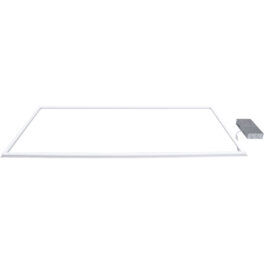
T-bar recessed is the standard install and needs no accessory. Suspended mounting needs the MG-D001 kit, a drywall ceiling needs the recessed frame, and the external junction box that adds wiring space is separate too. That box takes 90 degree conduit through a side knockout. Dimming is 0-10V, and Lutron's DSTV-Diva is the only dimmer tested, down to 10%. The cULus listing covers damp locations, but it's an indoor fixture, so no wet locations and no insulation packed against it.
For the wiring diagram, the DIP switch positions and the field adjustment steps, open the Manual (PDF), and pull the IES files if your designer is running photometrics. Send us the fixture count and the ceiling type and we'll come back with a wholesale quote plus a check on whether your utility's rebate survives the DLC V5.1 delisting in December.