












 (+1) 905 597 5955




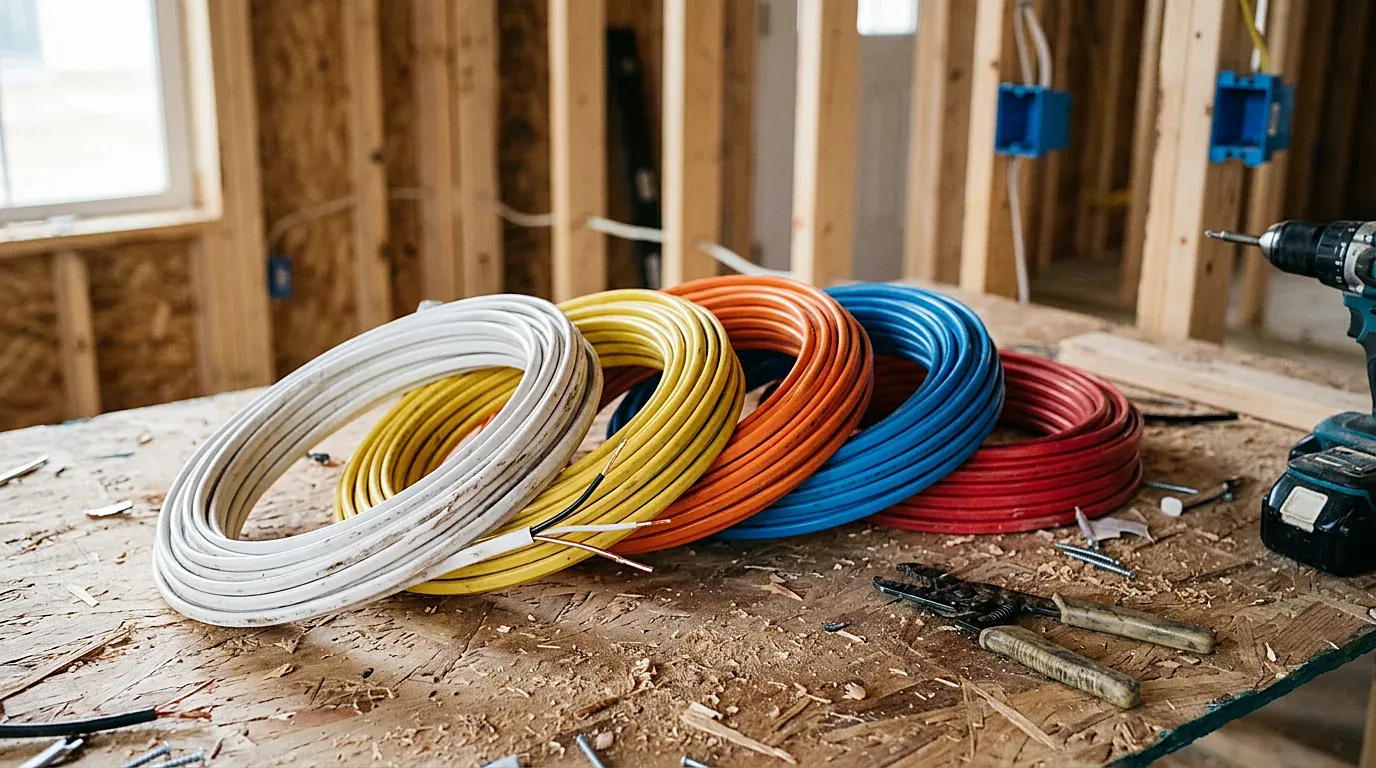
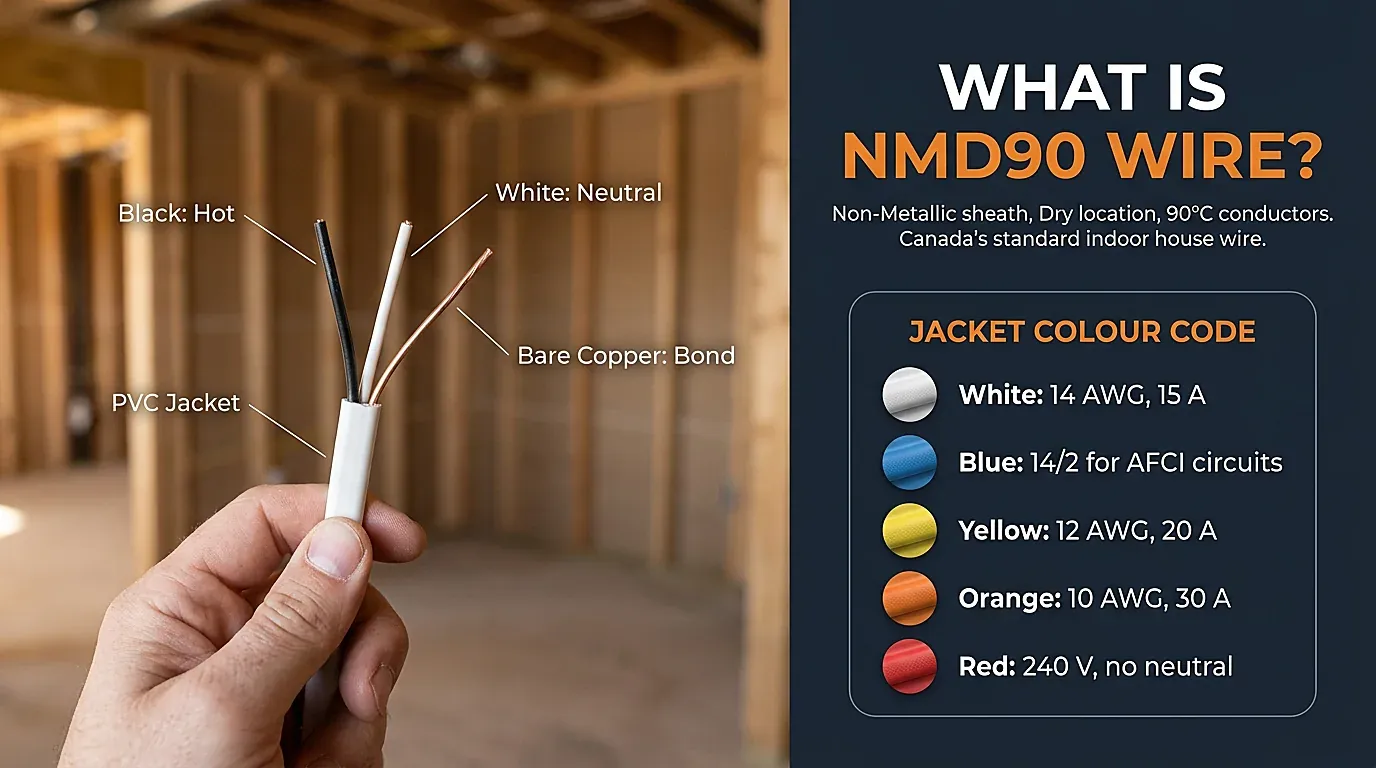
NMD90 is the standard non-metallic sheathed cable used to wire Canadian homes and small buildings. The name spells out the rating: Non-Metallic sheath, Dry location, 90°C conductor temperature. It’s built to CSA C22.2 No. 48, rated 300 V, and sold in sizes like 14/2, 12/2 and 10/3. You’ll know it by its coloured jacket: white, yellow, orange, blue or red.
Here’s the short version:
- What it is: insulated copper (or aluminum) conductors plus a bare bonding wire, all inside a PVC jacket.
- Where it goes: exposed work in dry locations, concealed work in dry or damp locations. Never underground, never in a wet location.
- Amp ratings: 14 AWG copper is capped at 15 A, 12 AWG at 20 A and 10 AWG at 30 A under CEC Rule 14-104.
- NMD90 vs NMWU: NMWU is the wet-location, direct-burial cousin. It’s rated 60°C instead of 90°C.
That covers the basics. The rest of this guide explains what “14/2” actually means, how the NMD90 jacket colour code works, how ampacity is really decided, and when you need NMWU instead. If you buy cable for jobs across Canada, the sizing table further down is worth a bookmark.
Already know the sizes you need? Votatec quotes building wire by size and length, shipped across Canada.
What Does NMD90 Mean?
NMD90 is a CSA cable type, not a brand. Trade names vary by maker, but the type stamped on the jacket is what an inspector checks. A 2004 Nexans Canada article in Canadian Copper put it plainly: the type is NMD90, “meaning non-metallic, dry location, 90 degree Celsius rated.”
Each part of that name tells you something useful:
| Letter or number | Means | What it changes on the job |
|---|---|---|
| NM | Non-metallic sheath | A PVC jacket, not armour. Lighter and cheaper than AC90, but it needs physical protection in exposed spots |
| D | Dry location | Fine for dry and (concealed) damp spots. Not for wet locations or underground |
| 90 | 90°C conductor temperature | Sets the top ampacity column. Your breaker and lugs usually set a lower one |
The cable is also rated 300 V and carries an FT1 flame rating. That’s the vertical flame test it passes, and it matters in commercial buildings. More on that later.
What’s Inside an NMD90 Cable?
Strip the jacket back and you’ll find:
- Insulated conductors. In copper NMD90, sizes 14 to 10 AWG are solid and 8 AWG and up are stranded. Each conductor has PVC insulation, often with a nylon sheath.
- A bare bonding conductor. Bare copper on copper cable. It’s usually the same size as the circuit conductors on 14 AWG, then drops a size or two on bigger cable. One maker’s current spec lists a 14 AWG bond in 12/2, a 12 AWG bond in 10/2 and an 8 AWG bond in 6/2.
- The PVC jacket, which holds it all together and carries the printed markings.
Conductor colours are standard: 2-conductor cable has black and white, and 3-conductor adds red.
What Do 14/2, 12/2 and 10/3 Mean?
The first number is the conductor size in AWG. The second is how many insulated conductors are inside, not counting the bare bond. So:
- 14/2 wire is two 14 AWG conductors (black and white) plus a bare bond. It’s the most-searched NMD90 size in Canada.
- 14/3 NMD90 adds a red conductor. You’ll see it between 3-way switches and on split kitchen receptacles.
- 12/2 NMD90 is two 12 AWG conductors plus bond, for 20 A circuits.
- 10/3 NMD90 is three 10 AWG conductors plus bond, for 30 A loads like a dryer.
Smaller AWG numbers mean thicker wire. That trips up new buyers every season.
How to Read the Printing on an NMD90 Jacket
The jacket is printed every so often along its length. A typical legend reads something like: CSA LLxxxxx 12 AWG 2 CDRS BLACK/WHITE NMD90 (-25C) 300 VOLTS FT1. In plain words: the CSA file number, the conductor size and count, the insulation colours, the cable type, the minimum installation temperature, the voltage rating and the flame rating.
If a coil isn’t marked NMD90 with a CSA (or other accepted Canadian) certification mark, it isn’t NMD90. Doesn’t matter what the box says.
NMD90 Jacket Colour Code: What Each Colour Means
Canadian NMD90 jackets are colour-coded by size and purpose. It’s a quick way to check, from across a basement, that nobody ran 14 AWG on a 20 A breaker.
| Jacket colour | Typical NMD90 cable | Common use |
|---|---|---|
| White | 14/2, 14/3, and most 8 AWG and larger 3-conductor | General 15 A lighting and receptacle circuits |
| Blue | 14/2 | 15 A bedroom circuits on arc-fault (AFCI) protection |
| Yellow | 12/2, 12/3 | 20 A circuits, like kitchen counter T-slot receptacles |
| Orange | 10/2, 10/3 | 30 A circuits, like a dryer |
| Red | 2-conductor cable in several sizes (black and red conductors, no white) | 240 V loads with no neutral, like electric baseboard heat |
Sources: a current manufacturer spec sheet for copper NMD90 (updated 2025-08-10) and the City of Calgary’s 2026 Homeowner Electrical Wiring Guide, which says 240 V loads such as electric heating “should use NMD90 cables with a red outer jacket.”
Is the NMD90 Colour Code Required by Code?
No. And this catches people out.
Nexans, which introduced the scheme in the early 2000s, said it at the time: “The jacket colour coding is not required by any electrical code or by CSA product requirements.” It’s a manufacturer convention that the industry adopted. So a white jacket is a strong hint, not proof. The size printed on the jacket is the fact. Read it before you land a cable on a breaker.
Two more colour quirks worth knowing:
- Larger cable is mostly white or red, so colour stops telling you the size once you get past 10 AWG.
- Blue started as an AFCI marker. When the 2002 CEC required arc-fault protection for bedroom outlets, blue 14/2 made those home runs easy to spot at the panel.
Need cable by the coil for a job? Votatec’s wire and cable range covers building wire for residential and light-commercial work, and we quote by size and length.
NMD90 Amp Ratings: How Big a Breaker Can Each Size Take?
This is the question behind most NMD90 searches. And the honest answer has two layers.
Layer one: small conductors have hard caps. CEC Rule 14-104(2) limits the overcurrent protection for copper to 15 A on 14 AWG, 20 A on 12 AWG and 30 A on 10 AWG. Those caps win, no matter what the ampacity table says.
Layer two: bigger conductors depend on the termination. For 8 AWG and up, the ampacity comes from CEC Table 2 (copper) or Table 4 (aluminum). Which column you use depends on the temperature rating of the breaker, lugs or equipment the cable lands on. That’s Rule 4-006.
NMD90 Sizes, Amp Ratings and Typical Uses
Here’s a quick reference for copper NMD90. The 75°C and 90°C values are from a manufacturer’s current spec, based on the 2024 CEC Table 2.
| NMD90 size | Overcurrent cap (Rule 14-104) | Table 2, 75°C | Table 2, 90°C | Typical jobs |
|---|---|---|---|---|
| 14/2, 14/3 | 15 A | 20 A | 25 A | Lighting, general receptacles, 3-way switching |
| 12/2, 12/3 | 20 A | 25 A | 30 A | Kitchen counter T-slot receptacles, dedicated 20 A circuits |
| 10/2, 10/3 | 30 A | 35 A | 40 A | Dryers, small water heaters, 30 A loads |
| 8/2, 8/3 | Set by termination rating | 50 A | 55 A | Ranges, some sub-panels |
| 6/2, 6/3 | Set by termination rating | 65 A | 75 A | Sub-panels, larger fixed loads |
Read the 14 to 10 AWG rows left to right and stop at the cap. That’s your breaker. The 20 A and 25 A figures for 14 AWG are real ampacities, but you still can’t put 14/2 wire on anything bigger than 15 A.
Calgary’s 2026 guide gives two familiar examples: dryer outlets are type 14-30R “with #10/3 AWG cables,” and a 14-50R stove outlet uses #8 AWG wire.
8/3 and 6/3 NMD90: Ranges, Sub-Panels and Bigger Loads
Once you pass 10 AWG, the jobs get bigger and fewer. 8/3 NMD90 is the usual range cable, since a 14-50R outlet needs two hots, a neutral and the bond. 6/3 NMD90 shows up on sub-panels and larger fixed loads. Size both from a load calculation, the equipment’s installation instructions and the termination rating, not from the jacket colour (which is often white or red at these sizes anyway).
Why 90°C Doesn’t Mean 90°C Amps
The “90” in NMD90 is the conductor rating, but the circuit is only as hot as its weakest part.
Rule 4-006 says that where a breaker or lug is marked with a termination temperature, you size from that column. Where it isn’t marked, equipment rated 100 A or less (or marked for No. 1 AWG and smaller) defaults to the 60°C column. That’s how IAEI Magazine summarised the rule in a 2020 article on the 2018 CEC. The rule applies to the first 1.2 m of conductor from the termination.
So check the marking on the breaker or lug before you pick a column. Don’t assume.
Then derate where needed. More than three current-carrying conductors bundled together, cable buried in thermal insulation or a hot attic all cut the allowable ampacity. And on long runs, voltage drop (Rule 8-102) often decides the size before ampacity does.
Aluminum NMD90
NMD90 also comes with aluminum conductors, usually in feeder sizes. Votatec’s NMD90 aluminum building cable is AA-8000 series alloy in #6, #4 and #2 3-conductor, for sub-panels and feeders. Aluminum ampacity comes from Table 4, it needs a larger size than copper for the same load, and every lug and breaker has to be rated for aluminum. Our guide to aluminum vs copper wire in Canada walks through sizing and cost.
12/2 vs 14/2: Which NMD90 Do You Need?
It comes down to the breaker. 14/2 wire goes on 15 A circuits, and 12/2 goes on 20 A circuits.
You can always run 12/2 on a 15 A breaker. You can never run 14/2 on a 20 A breaker.
That’s the whole rule. So why not just buy 12/2 for everything?
Say Daniel, a contractor in Brampton, prices out a three-bedroom basement finish. Lighting and general receptacles come to about 300 m of cable. Running it all in 12/2 sounds safer, but 12 AWG costs noticeably more per metre, it’s stiffer to bend into device boxes, and it takes up more box fill. Push-in terminals on many devices won’t take it either.
So Daniel sticks with 14/2 for the 15 A circuits and orders yellow 12/2 only where the design calls for 20 A. The savings cover a day of labour, and the boxes close up properly.
Here’s where each one usually fits:
- 14/2 NMD90: bedroom, living room and hallway receptacles, most lighting, bathroom fans, smoke alarm circuits.
- 14/3 NMD90: 3-way switch runs, and 15 A split receptacles at the kitchen counter.
- 12/2 NMD90: kitchen counter 20 A T-slot receptacles, and other dedicated 20 A circuits a design calls for.
- 12/3 NMD90: multi-wire 20 A runs.
Check your provincial code before you settle the kitchen. Calgary’s guide, for one, accepts “15A split or 20A T-slot” receptacles at islands and peninsulas, and limits how many kitchen outlets share a breaker.
Pairing cable with LED fixtures and switches on a renovation? Votatec supplies wiring devices, LED fixtures and building wire together. Send us your material list and we’ll quote it as one order.
Where Can NMD90 Wire Be Used, and Where Can’t It?
Manufacturer specs describe NMD90 as suitable “for both exposed work in dry locations or concealed work in dry or damp locations.” That’s the core of it. The details come from CEC Section 12 and your provincial code.
Where NMD90 Is Fine
- Inside the framed walls, floors and ceilings of houses and other wood-frame buildings.
- Exposed in dry spots, like a dry unfinished basement or utility room, as long as it’s protected where it could be damaged.
- Concealed in damp locations, which the cable’s rating allows.
Where NMD90 Isn’t Allowed
- Underground. Even in conduit. Calgary’s guide is blunt: cable in underground PVC conduit “must be acceptable for use in wet locations (NMD90 is not acceptable).”
- Wet locations, including outdoor runs. Outdoor conduit collects condensation too, so plan on a wet-location cable there.
- Commercial buildings required to be non-combustible, in most cases. NMD90 carries an FT1 flame rating. Under the National Building Code (Article 3.1.5.21), cables in buildings that must be non-combustible generally need a higher flame rating such as FT4, or have to run in a non-combustible raceway. That’s why most commercial branch wiring goes in AC90 armoured cable, TECK90 or conduit. Confirm with the designer and the local inspector.
Installation Rules That Trip People Up
From the 2026 Calgary guide, which includes the 2024 CEC amendments:
- Support: straps or staples within 300 mm of each box, then every 1.5 m.
- Nail plates: needed where cable passes within 32 mm of the face of a stud or joist.
- Exposed cable within 1.5 m of the floor needs mechanical protection, like guard strips.
- Heating ducts: keep cable at least 25 mm away.
- Metal studs: use approved bushings or grommets, and don’t fish NMD90 into walls with metal studs.
- Box length: leave at least 150 mm of conductor in each box.
Winter Installs: Mind the Temperature
Here’s a detail that rarely makes it into NMD90 guides. The jacket has a minimum installation temperature. One current spec lists -25°C for 2-conductor cable and -10°C for 3-conductor, and recommends storing cable above 0°C for 24 hours before installation.
Picture Marie-Ève, an electrician roughing in a garage in Sherbrooke in January. The 14/3 for the job sat in the truck overnight at -22°C. That’s below the 3-conductor rating, and cold PVC cracks when it’s bent hard around a box.
So Marie-Ève brings the coils into the heated house the night before and pulls them the next morning. Same cable, no cracked jackets, no failed inspection.
NMD90 vs NMWU: What’s the Difference?
NMWU is the wet-location, underground version of non-metallic sheathed cable. The “W” means wet, the “U” means underground. Ontario’s Electrical Safety Authority notes that cable approved for direct earth burial usually has a “U” in its type designation, and it gives NMWU as an example.
| NMD90 | NMWU | |
|---|---|---|
| Locations | Exposed dry, concealed dry or damp | Wet and dry, exposed to weather, underground |
| Direct burial | No | Yes, at the required cover depth |
| Max conductor temperature | 90°C | 60°C |
| Voltage | 300 V | 300 V |
| Standard | CSA C22.2 No. 48 | CSA C22.2 No. 48 |
| Jacket | Colour-coded PVC | PVC, not part of the colour code. Votatec’s is black |
| Typical sizes | 14/2 up to feeder sizes | 14/2 to 2 AWG, depending on maker |
| Typical jobs | Interior branch circuits and feeders | Garden and yard lighting, sheds, detached garages, pumps |
Why NMWU’s 60°C Rating Matters
A lower conductor rating means NMWU ampacity comes from the 60°C column. On 14/2 and 12/2 the Rule 14-104 caps still give you 15 A and 20 A, so nothing changes on common circuits. On bigger runs, you’ll often need to upsize compared with an indoor NMD90 run of the same load.
Can You Bury NMWU? How Deep?
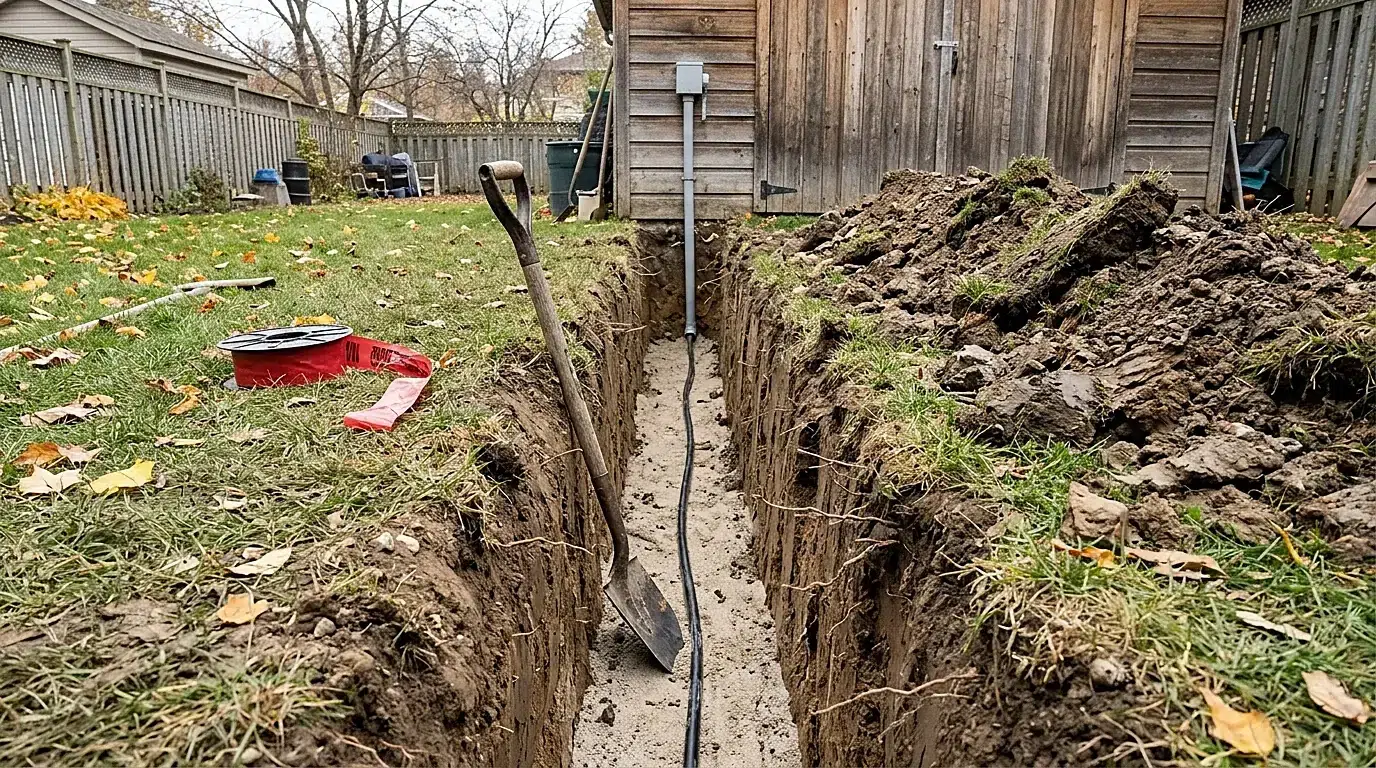
Yes. NMWU is made for it. CEC Rule 12-012 sets the cover depths (Table 53), and Calgary’s guide shows typical values:
| Wiring method | Cover, non-vehicle areas | Cover, under vehicle traffic |
|---|---|---|
| NMWU direct buried | 600 mm | 900 mm |
| NMWU in rigid PVC conduit | 450 mm | 600 mm |
ESA’s buried wiring info sheet adds the trench details. Directly buried cable sits in at least 75 mm of screened sand or screened earth above and below. A 38 mm treated plank or 50 mm of concrete over the cable lets you reduce the cover by 150 mm. And marking tape goes in about halfway between the cable and grade.
Can You Run NMWU in Conduit?
Yes. NMWU in rigid PVC conduit is a standard method, and Calgary’s cover table lists it with a shallower depth than direct burial. Conduit also makes sense where the cable rises out of the ground and needs protection from damage.
Take Gurpreet, a facility manager at a small retail plaza in Surrey. The plaza needs a new 120 V circuit for LED bollards along the walkway. Their maintenance crew suggests running leftover NMD90 through PVC conduit to save a trip.
Then the electrical contractor flags it: underground conduit is a wet location, and NMD90 isn’t allowed there. They switch to NMWU in rigid PVC, which meets the cover table, and the inspection passes first time.
If you’re wiring outdoor fixtures, our guides on in-ground well lights, installing low-voltage garden and pathway lighting and outdoor pole lights for driveways cover the fixture side. For the cable, Votatec stocks NMWU building cable in 14/2 and 12/2 copper, 75 m coils.
NMD90 vs NM-B: Can You Use American Cable in Canada?
Not on its own marking. NM-B is the US equivalent, built to US standards for the US National Electrical Code. It looks almost identical. But Canadian inspection authorities expect cable certified for Canada, and the NMD90 type marking is what they look for on residential non-metallic cable.
So when a deal on cross-border cable looks too good, check the jacket. If it says NM-B and nothing else, it’s the wrong cable for a Canadian job.
Common NMD90 Mistakes (and How to Avoid Them)
Most failed inspections and callbacks involving NMD90 come down to a short list:
- 14 AWG on a 20 A breaker. The single most common sizing mistake. Read the jacket, not just the colour.
- NMD90 outdoors or underground, even in conduit. Use NMWU, TECK90 or wire rated for wet locations.
- Sizing from the 90°C column. The termination rating usually sets the limit.
- Missing nail plates where cable runs within 32 mm of the stud face.
- Unprotected cable low on basement walls. Within 1.5 m of the floor, exposed NMD90 needs protection.
- Pulling cold cable. Below the rated minimum, the jacket cracks.
- Forgetting the neutral. New switch boxes in Canada need a neutral, so a switch loop often needs 14/3 rather than 14/2.
- Overfilled boxes. Bigger cable and more conductors mean a bigger box.
Who can do the work matters too. In Ontario, the Electrical Safety Authority says almost all electrical work needs a notification of work. In Québec, the Régie du bâtiment du Québec says electrical installation work has to be done by a licensed contractor, even in your own home. For commercial and institutional buildings, hire a licensed electrical contractor, full stop.
Buying NMD90 and NMWU for Canadian Projects
Choosing cable is mostly about three questions. Where does it run, what does it feed, and what does the termination allow?
- Interior branch circuits: copper NMD90, 14/2 for 15 A and 12/2 for 20 A.
- Feeders and sub-panels: larger copper NMD90, or aluminum NMD90 in AA-8000 alloy.
- Underground and wet locations: NMWU, or ACWU90 for heavier outdoor feeders.
- Commercial branch wiring: AC90 or TECK90.
- Thermostats and low-voltage controls: LVT cable.
Votatec supplies building wire alongside the LED fixtures, dimmers, sensors and photocells that go on the end of it, shipped across Canada. Browse the wire and cable category, or request a quote with your sizes and metres.
Frequently Asked Questions
What is NMD90 wire used for?
NMD90 is used for most interior wiring in Canadian homes and wood-frame buildings: lighting, receptacles, and appliance circuits like dryers and ranges. It’s rated for exposed work in dry locations and concealed work in dry or damp locations. It can’t go underground or in wet locations.
What does NMD90 stand for?
NMD90 stands for non-metallic sheathed cable, dry location, rated for a 90°C conductor temperature. It’s a CSA cable type built to CSA C22.2 No. 48 and rated 300 V.
What size breaker for 14/2 NMD90?
15 A. CEC Rule 14-104(2) caps 14 AWG copper at 15 A overcurrent protection, even though its table ampacity is higher. Use 12/2 NMD90 for a 20 A circuit and 10 AWG for 30 A.
What is the colour code for NMD90 jackets in Canada?
White is 14 AWG for general 15 A circuits, blue is 14/2 for AFCI-protected bedroom circuits, yellow is 12 AWG for 20 A, orange is 10 AWG for 30 A, and red marks 240 V cable with no neutral. Larger sizes are mostly white or red. The scheme is voluntary, so always read the size printed on the jacket.
What is the difference between NMD90 and NMWU?
NMD90 is for dry and damp interior locations and is rated 90°C. NMWU is for wet locations and underground use, including direct burial, and is rated 60°C. Use NMWU, not NMD90, for any underground run, including in PVC conduit.
Can NMD90 be run outside?
No. Outdoor runs are wet locations, and NMD90 isn’t accepted underground either, even inside PVC conduit. Use a wet-location cable like NMWU, or a cable such as TECK90, for outdoor and underground work.
Bottom Line
NMD90 is simple once you can read it:
- NMD90 means non-metallic, dry location, 90°C conductors, 300 V, built to CSA C22.2 No. 48.
- The size code is AWG over conductor count: 14/2, 12/2, 10/3 and so on.
- The jacket colour code (white, blue, yellow, orange, red) is a helpful convention, not a code rule.
- Breaker size for 14, 12 and 10 AWG copper is capped at 15, 20 and 30 A. Above that, the termination rating decides.
- Underground or wet? Use NMWU, never NMD90.
Bottom line: buy the cable the location calls for, size it to the termination, and read the jacket. Planning a project? Talk to Votatec about building wire, wiring devices and the LED lighting at the end of the run.