










 (+1) 905 597 5955


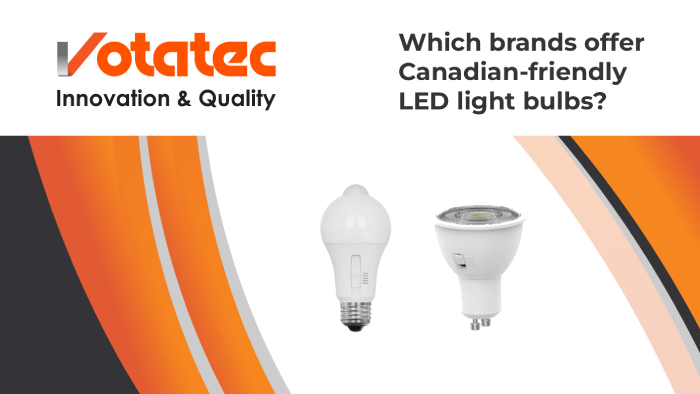

Short answer, right up front. Canadian-friendly LED light bulbs are lamps that carry a Canadian safety mark (CSA, cUL, or cETL), run on Canadian voltage, and come from a supplier who can back the warranty on this side of the border. Brands that fit include Canadian-owned names like Votatec, Liteline, Standard Products, Globe Electric, Xtricity, and CSC LED, plus the global lines and house brands stocked at Canadian Tire, Home Depot Canada, RONA, Costco, and IKEA.
Where you buy depends on volume. One bulb for a bedside lamp? Retail. Two hundred bulbs for a condo retrofit? A Canadian distributor or wholesaler.
Here’s the part most guides skip. “Canadian-friendly” means two different things to two different shoppers, and mixing them up is how people end up with a box of bulbs that fails inspection.
What Makes an LED Bulb “Canadian-Friendly”?
A Canadian-friendly LED bulb is one that’s legally certified for sale and installation in Canada, built for 120V residential or 120-347V commercial circuits, and supported by a warranty you can claim from a Canadian address. That’s the compliance definition. The second definition, the one driving a lot of searches lately, is “made or owned in Canada.”
Both are valid. They’re just not the same question.
The Certification Mark Is Non-Negotiable
Every line-voltage electrical product sold here needs a recognised safety certification mark. Canadian-friendly LED light bulbs carry one of three:
- CSA (CSA Group, the Canadian standards body)
- cUL or cULus (the small “c” is what matters, it signals Canadian certification)
- cETL (Intertek’s Canadian mark)
Notice the pattern. A plain UL mark with no “c” is a US-only certification. It does not automatically transfer. That bulb needs additional testing against Canadian standards before it’s legal here, and an electrical inspector is within their rights to reject it.
This trips up more buyers than you’d expect. A pallet of bulbs bought online can light up perfectly and still fail inspection, because the inspector isn’t testing brightness. They’re checking the mark. Fail that, and the bulbs come back out of the ceiling at your cost.
Certification for LED lamps is typically tested against UL 8750 (LED light sources) and the matching Canadian national standards, then listed in the certifier’s public database. If a model number isn’t in CSA Group’s product listing, or the equivalent Intertek or UL directory, treat the mark on the box as unverified.
Voltage, Base, and Fit for Canadian Buildings
Canada runs on 120V for residential and light commercial. Commercial and industrial buildings add 208V, 240V, 277V, and 347V. That last one, 347V, is distinctly Canadian and almost never appears on American product spec sheets.
So when you’re sourcing Canadian-friendly LED light bulbs for a warehouse or a school, check the input range. A lamp rated 100-277V will not survive a 347V circuit. It’ll fail fast, and the warranty won’t cover it.
Base types are more forgiving. E26 medium screw base is the North American standard, so most retail bulbs drop right in. Where it gets fussy is the specialty stuff: GU10 and MR16 for track and accent lighting, G4 and G9 for under-cabinet and decorative fixtures, and PL lamps for pot light conversions. Those need a spec match, not a guess.
Cold performance matters too. A bulb rated to -20°C is not a bulb rated for a Winnipeg loading dock in January. Check the operating temperature range on anything going outdoors.
Canadian-Owned vs Canadian-Certified: Two Different Questions
The Buy Canadian push is real, and it shows up in the data. The Bank of Canada’s Canadian Survey of Consumer Expectations has tracked consumers continuing to prioritise Canadian-made goods through 2026. More than half of Canadians say they’d pay more for a Canadian-made product. But roughly three-quarters won’t go past a 10% premium.
That’s the honest tension. People want Canadian. They want it within 10%.
Here’s the thing about light bulbs specifically. Almost no finished LED lamps are manufactured in Canada anymore. LED chip fabrication and lamp assembly consolidated into Asia over the last fifteen years. What Canada does have is Canadian-owned companies that design, spec, certify, warehouse, and warrant their product here, plus a handful of firms doing genuine domestic fixture assembly.
So if “Canadian-friendly” means Canadian-owned, you have real options. If it means “assembled in Ontario,” your options for screw-in bulbs are close to zero. Anyone who tells you otherwise is selling you a story.
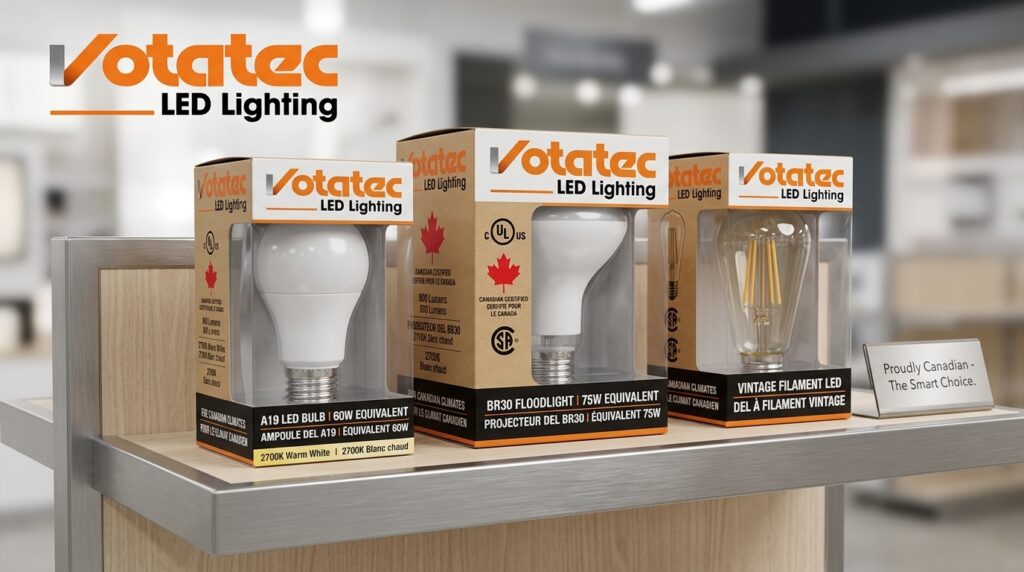
Quick-Reference: Canadian-Friendly LED Light Bulbs by Buyer Type
| Buyer | Best channel | What to look for | Typical price per bulb |
|---|---|---|---|
| Homeowner, 1-10 bulbs | Canadian Tire, Home Depot, Costco, IKEA | CSA or cUL mark, lumens not watts, 2700K-3000K | $1 to $8 |
| Landlord, 20-100 bulbs | Costco Business Centre, online retail multipacks | Case quantities, 5-year warranty, consistent CCT | $1 to $4 |
| Electrical contractor | Electrical distributor or Canadian wholesaler | Spec sheets, DLC listing, project pricing, stock in Canada | Quote-based |
| Facility or property manager | Direct from Canadian supplier | Documentation for inspection, rebate paperwork, reorder consistency | Quote-based |
| Municipal or institutional buyer | Direct or through procurement | CSA docs, DLC Qualified Products List entry, warranty terms | Quote-based |
Which Brands Offer Canadian-Friendly LED Light Bulbs?
Now the actual list. We’ve split it three ways, because the brand that makes sense for a homeowner buying four bulbs is rarely the brand that makes sense for a contractor buying four hundred.
Canadian-Owned Brands and Suppliers
These companies are headquartered in Canada, hold Canadian certifications, and stock Canadian-friendly LED light bulbs domestically.
- Votatec (that’s us, so weigh this accordingly). Commercial and residential LED lamps in A-type, GU10, MR16, PAR, filament, corn, and T5/T8 tube formats. CSA or cUL certified across the commercial range, DLC and Energy Star eligible lines available, 5-year warranty on commercial-grade product, stock held in Canada rather than drop-shipped from overseas. Quote-based pricing, so it’s built for contractors and facility teams rather than one-off purchases.
- Standard Products (Stanpro). Montreal, operating since 1961. Broad lamp and fixture catalogue, strong presence with electrical distributors nationwide. The heritage all-rounder.
- Liteline. Richmond Hill, Ontario, independently owned since 1979, with genuine domestic fixture manufacturing out of a large Ontario facility. Better known for fixtures than screw-in lamps, but the Canadian-made claim holds up where it counts.
- Globe Electric. Pointe-Claire, Quebec, founded 1932. Consumer-focused, widely stocked at Canadian big-box retail, and a past ENERGY STAR award winner.
- Xtricity. Quebec-based, consumer and light commercial lamps. Available through Walmart Canada, BMR, Amazon.ca, and Best Buy Marketplace. Budget-friendly, which is exactly its job.
- CSC LED. Canadian, strong on high-volume standard product for contractors.
If you want more depth on the Canadian manufacturer side, we broke down the full contractor field in our guide to the best LED lighting brands in Canada.

Global Brands Widely Stocked in Canada
These aren’t Canadian companies. But their Canadian retail product is certified for Canada, easy to find, and perfectly fine for most residential work. Names you’ll see on the shelf at Canadian Tire, Home Depot Canada, RONA, and Best Buy include Philips, Sylvania, Feit Electric, GE Cync, Luminus, WiZ, and Govee for smart bulbs.
The advantage is availability and price. A 4-pack of 60W-equivalent A19 bulbs runs about $8 at Home Depot Canada, and the same Philips multipack shows up on Amazon.ca around $11 to $15.
The catch is warranty support. Some of these brands handle Canadian claims well. Some route you to a US call centre that asks for a zip code. Worth knowing before you buy 60 of something.
House Brands and Private Labels
Retail house brands are quietly some of the best value in Canadian-friendly LED light bulbs, because the retailer owns the certification and the return path.
- NOMA at Canadian Tire. Canadian Tire’s own brand, decades old, easy returns.
- EcoSmart at Home Depot Canada. Cheap, sometimes under $1 per bulb on multipacks.
- SOLHETTA and MOLNART at IKEA Canada. SOLHETTA for efficiency, MOLNART for decorative filament looks. Around $4 to $15.
- Luminus at Costco Canada. Sold in large multipacks, which is why it dominates the “LED light bulbs Costco” searches.
Returns are the underrated feature here. When a bulb fails at month eight, walking into a store beats filing a claim with an overseas manufacturer.
Commercial and Wholesale Lamp Lines
Different category entirely. Commercial buyers aren’t shopping SKUs, they’re matching specs.
What you’re buying at this level: corn bulbs for HID retrofits in parking garages and high bays, T8 and T5 tubes replacing fluorescent, PAR lamps for retail track, and PL lamps for pot light conversion. All in consistent colour temperature across hundreds of units, with documentation attached.
Consistency is the whole game. Two cases of “4000K” bulbs from different production runs can visibly differ. In a corridor, that looks like a defect. Buying from one Canadian supplier with steady stock avoids it.
Where Can You Buy Canadian-Friendly LED Light Bulbs?
Five channels, and they’re genuinely different products at different prices.
National Retail and Big-Box
Best for 1 to 20 bulbs, right now, today.
- Canadian Tire: NOMA, Globe, Philips, Sylvania. Good for odd bases and one-offs.
- Home Depot Canada: EcoSmart, Philips, Feit. Deepest selection, lowest unit prices on multipacks.
- RONA: GE Cync and general residential stock.
- Costco Canada: Luminus multipacks. Best per-bulb price if you need ten of the same thing.
- IKEA Canada: SOLHETTA and MOLNART, strong on decorative shapes.
- Best Buy Canada and Amazon.ca: smart bulbs, WiZ, Govee, Xtricity.
- Staples Canada: Northern Stars and office-grade lamps.
Everything on those shelves has already cleared Canadian certification. That’s the quiet benefit of buying Canadian-friendly LED light bulbs from an established Canadian retailer.
Electrical Distributors
Contractor territory. Distributors carry Canadian-friendly LED light bulbs from Standard Products, Liteline, and similar lines, they’ll pull spec sheets, and they extend account terms. Counter staff who know the Canadian Electrical Code are worth a lot on a tight job.
Pricing is account-based, not shelf-based. Which means it’s usually better than retail at volume, and worse for a single bulb.
Direct From a Canadian Supplier or Wholesaler
This is where mid-size and large projects should live. Buying Canadian-friendly LED light bulbs direct from a Canadian wholesaler gets you three things retail can’t:
- Project pricing. Case and pallet quantities priced per job, not per shelf tag.
- Documentation. CSA certificates and DLC listings you can hand an inspector or attach to a rebate application. Not a screenshot of a product page.
- Reorder consistency. Same bin, same production run, same colour temperature in twelve months when unit 4B needs replacements.
Votatec ships Canada-wide from Canadian stock, which matters more than it sounds. Orders drop-shipped from overseas carry four to six week lead times, and a short case on delivery means the crew stands around waiting. Stock already sitting in Canada removes that risk. You can request bulk pricing or talk to our team if you’re pricing a retrofit.
For a wider view of the wholesale field, including who serves which region, see our roundup of Canadian LED lighting wholesalers.
Utility and Municipal Programmes
Some provincial utilities run direct-install or discounted-product programmes for small business. Worth a phone call before you buy anything, because the free-install option sometimes beats the cheapest bulb you can find.
Online Marketplaces: Where Compliance Goes Sideways
Now the warning. Third-party marketplace listings are the single biggest source of non-compliant bulbs entering Canada.
What goes wrong:
- UL mark, no “c”. US-only certification, not valid here on its own.
- No mark at all, or a printed logo with no listing behind it.
- Wrong voltage. 277V-only commercial lamps sold to buyers on 120V circuits.
- Inflated lumen claims. “150W equivalent” on a bulb pulling 9W. The physics doesn’t work.
- No warranty path. Seller vanishes, listing disappears, you own the problem.
The bulbs are cheap for a reason. If a marketplace lamp is 70% below the Canadian retail price, the missing 70% is usually certification, binning quality, and the driver.
Buy from Canadian retailers, Canadian distributors, or Canadian suppliers. Boring advice. Saves real money.
The 2026 Rule Change That Should Shape What You Buy
This is the current-events piece almost no bulb guide has updated for, and it changes the math on retrofits.
On 1 January 2026, Canada’s ban on the import and manufacture of mercury-containing compact fluorescent lamps took effect, under amendments to the Products Containing Mercury Regulations. It’s driven by Environment and Climate Change Canada as part of Canada’s obligations under the Minamata Convention. The government announced the phase-out in June 2024 and published the amending regulations in the Canada Gazette, Part II. Ottawa projects a 91% cut in mercury released from lamps by 2035, around 681 kg, plus 4.6 megatonnes of avoided greenhouse gas emissions.
The timeline that matters for buyers:
| Date | What changes |
|---|---|
| 1 January 2026 | Import and manufacture of most common mercury-containing fluorescent lamps prohibited |
| 31 December 2027 | Replacement-lamp exemption ends for pin-base CFLs, straight and non-linear fluorescents |
| 31 December 2028 | Import and manufacture of HID lamps for general lighting prohibited (metal halide, high-pressure sodium) |
| End of 2029 | Retailers may sell through existing stock until roughly this point |
| 1 January 2030 | Sale of replacement lamps prohibited |
Read that HID line again if you manage a warehouse or a parking structure. Metal halide and high-pressure sodium are on the same road. Planning a lamp-by-lamp fluorescent swap in 2026 buys you a few years and then a second project. Moving straight to Canadian-friendly LED light bulbs, with T8 tube retrofits or corn bulbs sized to the fixture, is one project.
Do it once.
How to Verify Canadian-Friendly LED Light Bulbs Before You Buy
Four checks. Takes two minutes.
Read the Lighting Facts Label
Ignore the “60W equivalent” marketing on the front. Turn the box over.
- Lumens: actual light output. 800 lm is the classic 60W-incandescent replacement, 1600 lm replaces 100W.
- Watts: real draw. Divide lumens by watts for efficacy. Anything under 80 lm/W is dated product in 2026; good commercial lamps land in the 100-140 lm/W range.
- Kelvin (CCT): 2700K warm for living spaces, 3500K-4000K for offices and retail, 5000K for warehouses and shops. Our colour temperature guide covers the choice by room.
- CRI: 80+ is fine for general use, 90+ for retail displays, salons, and anywhere colour accuracy sells product.
- Rated life: 15,000 to 50,000 hours. Look for L70 data rather than a bare hours claim.

Check the Mark, Then Check the Database
Find the CSA, cUL, or cETL mark. Then look the model number up in the certifier’s public listing. A mark that isn’t in the database is a printed logo, nothing more.
Confirm Dimming and Fixture Compatibility
Not every LED bulb dims, and not every dimmable LED bulb works with your existing dimmer. Mismatched pairs flicker, buzz, or drop out at the low end. Enclosed fixtures are the other quiet failure point, since trapped heat cooks the driver. If a bulb isn’t rated for enclosed use, don’t put it in a sealed dome. We wrote up which LED bulbs actually dim properly if you’re specifying a whole building.
Ask for the Spec Sheet
Commercial buyers only, but non-negotiable there. A real supplier sends a PDF with photometrics, certification numbers, warranty terms, and DLC status. A supplier who can’t produce one within a day isn’t a supplier you want on a $40K retrofit.
What Canadian-Friendly LED Light Bulbs Actually Cost
Live Canadian retail pricing, sampled 30 July 2026:
| Type | Retail range (each) | Notes |
|---|---|---|
| A19, 60W eq, non-dimmable | $0.96 to $2.50 | Cheapest at Home Depot Canada multipacks |
| A19, 60W eq, dimmable | $2.50 to $8 | Philips and Sylvania mid-range |
| Decorative filament / B11 | $4 to $15 | IKEA MOLNART, Globe Electric |
| GU10 / MR16 | $6 to $14 | Spec match matters more than price |
| Smart bulbs (A19) | $13 to $20 | WiZ, Govee, GE Cync |
| Commercial corn bulb | Quote | HID replacement, 54W to 150W |
| T8 LED tube | Quote | Case pricing, ballast-bypass vs plug-and-play |
At retail, the spread on a basic A19 is roughly $1 to $8, and the $1 bulb is often perfectly adequate for a closet. For a hundred-unit building, that same choice costs you in failure rate and colour drift. Cheap bulbs aren’t a scam. They’re just a different product.
Commercial lamps sit outside retail pricing entirely, which is why wholesale is quote-based. Wattage, quantity, certification level, and warranty all move the number.
Rebates: Where Canadian-Friendly LED Light Bulbs Pay You Back
Utility rebates are the piece homeowners ignore and smart facility managers build into the budget.
Most Canadian utility rebate programmes require the product to be on the DesignLights Consortium Qualified Products List. You can search the DLC Qualified Products List directly by model number before you buy. Not on the list, not eligible. It’s that binary, and it’s why “DLC listed” appears on commercial spec sheets in bold.
Programmes to check by province: Save on Energy in Ontario, BC Hydro in British Columbia, Hydro-Québec in Quebec, Efficiency Manitoba, and Efficiency Nova Scotia. Terms change annually, so verify the current programme year before you commit a budget. We covered how the certification works in more detail in what DLC certification means.
One more note on ENERGY STAR, because it’s genuinely confusing right now. The US EPA sunset its ENERGY STAR specifications for lamps and luminaires effective 31 December 2024, with recessed downlights carved out under a new specification. Natural Resources Canada still lists ENERGY STAR certified lighting categories, and the minimum performance rules in NRCan’s Guide to Canada’s Energy Efficiency Regulations still apply to lighting products sold here. But a brand-new bulb design in 2026 won’t be carrying a fresh ENERGY STAR mark the way it would have in 2020.
Practical version: for safety, look for CSA, cUL, or cETL. For rebates, look for DLC. Treat ENERGY STAR as a bonus signal on older SKUs rather than the test you screen by.
Common Mistakes When Buying LED Bulbs in Canada
Patterns that show up over and over when people shop for Canadian-friendly LED light bulbs.
- Shopping watts instead of lumens. Watts measure consumption. Lumens measure light. A 9W LED can outshine a 12W one.
- Assuming a UL mark covers Canada. It doesn’t. Look for the “c”.
- Mixing colour temperatures in one space. 3000K next to 4000K reads as a fault, not a design choice.
- Ignoring the 347V question. Common in Canadian commercial buildings, almost never on US spec sheets.
- Buying enough for today. Order 5% to 10% extra from the same run. Matching a discontinued SKU in three years is miserable.
- Skipping the dimmer check. Flickering LEDs are usually a driver-and-dimmer mismatch, not a defective bulb.
- Doing a fluorescent-for-fluorescent swap in 2026. The regulations already told you where that ends.
Frequently Asked Questions
Are all LED light bulbs sold in Canada CSA certified?
No. Bulbs sold through established Canadian retailers and distributors carry CSA, cUL, or cETL certification, because that’s a legal requirement for line-voltage products here. But third-party online marketplace listings regularly ship uncertified or US-only-certified lamps into Canada. Check for the mark, then verify the model number in the certifier’s public database.
Can I use American LED bulbs in Canada?
Sometimes, but not automatically. Canada and the US share 120V and the E26 base, so a US bulb often physically fits and lights up. Legally, a US-only UL mark isn’t accepted on its own for sale or installation in Canada. For anything inspected, permitted, or insured, use bulbs carrying CSA, cUL, or cETL. Personal use in a lamp is lower risk than a commercial install, but an inspector can still flag it.
Are any LED light bulbs actually made in Canada?
Very few finished screw-in bulbs. LED chip production and lamp assembly moved offshore years ago. What Canada has is Canadian-owned companies that design, certify, warehouse, and warrant product domestically, plus real domestic manufacturing of fixtures, notably Liteline in Ontario. If you want a Canadian-made light source, look at fixtures rather than replaceable lamps.
Do I still need ENERGY STAR when buying LED bulbs in Canada?
Not as your main filter. The US EPA sunset ENERGY STAR specifications for lamps and luminaires at the end of 2024, so newer bulb designs generally won’t carry the mark. Canada’s Energy Efficiency Regulations still set minimum performance rules for lighting products. Screen on CSA, cUL, or cETL for safety and DLC listing for rebate eligibility. ENERGY STAR is a useful extra signal, not the deciding one.
Where can contractors buy Canadian-friendly LED light bulbs in bulk?
Through electrical distributors or direct from a Canadian wholesaler. Distributors give you counter service and account terms. Direct suppliers like Votatec give you project pricing, CSA and DLC documentation for inspections and rebate filings, and Canadian-held stock so reorders match the original run. For anything over roughly 50 units, request a quote rather than buying retail multipacks. The paperwork alone is worth it on a rebate claim.
Bottom Line
- Canadian-friendly means two things. Certified for Canada (CSA, cUL, cETL, correct voltage) and, separately, Canadian-owned. Decide which you’re buying.
- Brands that offer Canadian-friendly LED light bulbs include Canadian-owned Votatec, Standard Products, Liteline, Globe Electric, Xtricity, and CSC LED, plus certified global and house-brand lines at Canadian retail.
- Where to buy scales with volume. Retail under 20 bulbs. Distributor or Canadian wholesaler above that.
- Check the mark, then the database. A logo on a box proves nothing on its own.
- The 2026 mercury lamp rules are already in force, and HID follows in 2028. Plan one retrofit, not two.
- DLC listing is the rebate gate. Verify before you buy, not after.
Sourcing Canadian-friendly LED light bulbs for a commercial or multi-unit project? Our team can match replacement specs, confirm CSA certification for your inspection file, and quote by the case. Browse the LED bulb ranges or request project pricing.