










 (+1) 905 597 5955


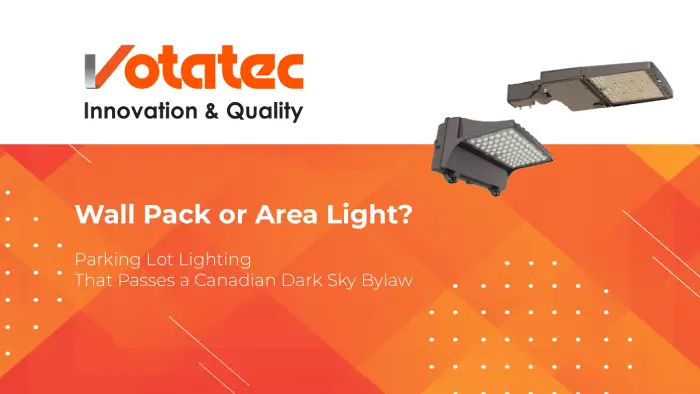

Here’s the short version. A wall pack lights the wall it’s bolted to and maybe 10 to 12 metres of pavement past it. An area light on a pole lights the lot. If your site plan shows more than two rows of parking, you need an area light, and the bylaw will usually tell you so before your budget does.
That’s the easy part. The hard part is that a growing number of Canadian municipalities now check how the fixture throws light, not just how much. Muskoka towns have had dark sky bylaws for over a decade. Huntsville’s outdoor lighting bylaw came into full force in early 2026. And an area light that sailed through approval in 2015 can get you a correction notice today.
So let’s go through what actually gets a parking lot approved. Real bylaw clauses, real numbers, and the three specs that decide it.
The short answer: wall pack or area light?
| Situation | What to spec | Why |
|---|---|---|
| Building face, doors, loading bays | Full cut-off wall pack | Mounted low, throws forward, no pole cost |
| Parking rows, drive aisles, the lot itself | Area light on a pole | Only fixture with the mounting height and optics to cover open pavement evenly |
| Perimeter row against a property line | Area light with Type IV optics | Forward throw keeps light off the neighbour’s lot |
| Fuel canopy, drive-thru, covered dock | Canopy light | Flush recessed, zero uplight by geometry |
| Sign or flagpole | Flood, aimed down from above | Bylaws almost always require top-mounted, downward aim |
Notice what’s missing. A wall pack is not on that list for lot coverage, and that’s deliberate. Most parking lot glare complaints in Canadian towns trace back to a building-mounted fixture being asked to do an area light’s job.
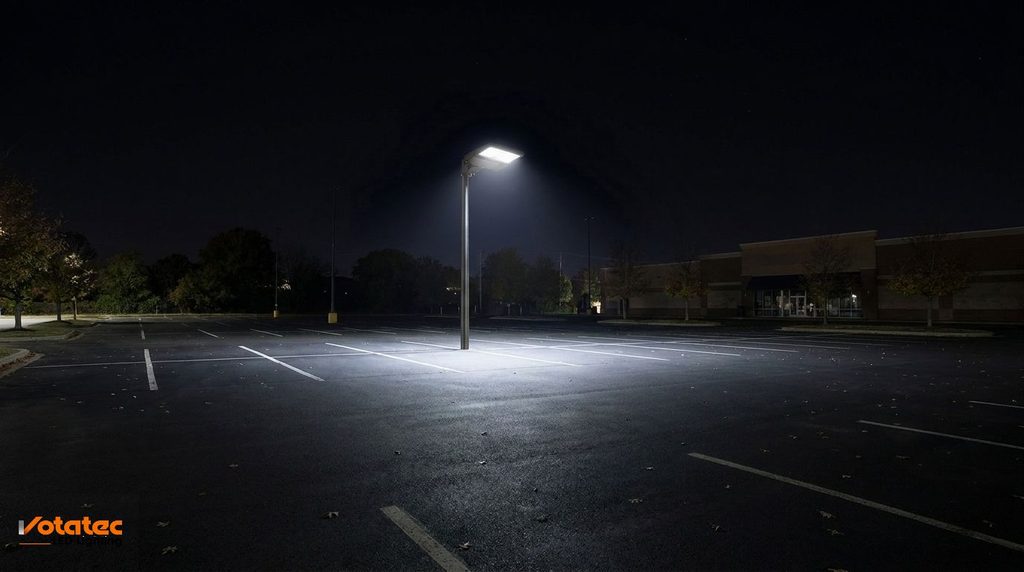
What is an LED area light?
An LED area light is a pole-mounted or wall-mounted outdoor luminaire that spreads light evenly across a horizontal surface like a parking lot, using a flat lens and a shaped optic to control where the light lands. It’s sometimes called a shoebox light, a parking lot light, or a pole light. All the same fixture family.
The defining feature isn’t wattage. It’s the optic. A proper area light uses an engineered distribution pattern to place light on pavement and keep it off everything else. A floodlight, by contrast, throws a cone at whatever you point it at. That difference is exactly what a dark sky bylaw cares about.
How an area light differs from a wall pack
Both can be full cut-off. Both can be 120W. The difference is geometry.
- Mounting height. An area light sits at 6 to 12 metres on a pole. A wall pack sits at 3 to 4.5 metres. Double the height and one fixture covers roughly four times the area at the same uniformity.
- Distribution. Area lights come in defined IES distribution types. Wall packs are usually fixed to one pattern.
- Backlight control. An area light can be specified to throw almost nothing behind itself. A wall pack has a building behind it, so backlight is less of an issue but forward spill is worse.
- Aiming. An area light mounts level on an arm. A wall pack tempts installers to tilt it. That tilt is where compliance dies.
Where floodlights fit, and why bylaws dislike them
This trips up a lot of quotes. Some Ontario bylaws define a wall pack as a floodlight. Gravenhurst’s dark sky bylaw literally says “Wall Pack light Fixture means flood light fixtures on exterior walls of buildings.” So a bylaw that restricts floods may be restricting your wall packs too. Read the definitions section, not just the rules. We’ve covered LED wall pack vs flood light separately.
What Canadian dark sky bylaws actually require
There’s no national dark sky law in Canada. It’s municipal, which means the requirements vary. But after reading through a stack of them, the same four rules keep showing up.
1. Full cut-off is the baseline
The Town of Gravenhurst’s By-law 2012-135 puts it plainly in section 2.5.1: “All new wall-mounted commercial lighting shall consist of Full-Cut-Off fixtures.” Section 2.2 extends completely shielded full cut-off fixtures to a list that names parking lot lighting, canopies, walkways, display and service areas, and signs.
Full cut-off means zero light emitted above the fixture’s horizontal plane. Not “a little.” Zero. Any area light with a drop lens, a sag lens, or a decorative glass bowl fails this, no matter what the box says.
2. The area light has to sit dead level
This is the clause that fails more installs than any other, and almost nobody reads it. Gravenhurst defines a full cut-off fixture as one that blocks light above horizontal and “must be installed in a horizontal position as designed.”
Read that again. Tilt a certified full cut-off area light up 15 degrees on an adjustable bracket and it’s no longer a full cut-off fixture. The certification described an area light sitting flat. The DesignLights Consortium landed in the same place independently: its LUNA requirements hold aimable outdoor luminaires to a tilt of less than plus or minus five degrees.
So if your area light ships with a tilt bracket, that bracket is a liability, not a feature. Set it to zero and lock it.
3. Lumen caps on security lighting
Huntsville’s outdoor lighting bylaw sets a hard number for commercial and industrial sites: light fixtures used for security purposes must be below 2,000 lumens.
That’s smaller than people expect. The smallest mini wall pack in most catalogues starts around 2,100 lumens at its lowest setting. Get the classification confirmed in writing before you order, because functional parking lot lighting and security lighting are often separate categories under the same bylaw.
Huntsville also requires substantial new commercial, industrial or institutional development to submit plans showing the outdoor lighting complies. That’s a site plan condition. Miss it and occupancy gets held up over an area light spec sheet.
4. Colour temperature: 3000K is the number
Warmer light scatters less in the atmosphere and does less damage to wildlife and sleep cycles. Most Canadian bylaws and guidance documents converge on 3000K or lower for outdoor fixtures. The Royal Astronomical Society of Canada’s sample lighting bylaw and example bylaw library rates LED sources under 3000K as the recommended tier.
This decides product selection more than any other spec. Plenty of wall packs and area light models are only offered in 3500K, 4000K and 5000K. If the bylaw says 3000K max, that whole product line is off the table. No amount of shielding saves it.
A CCT-selectable area light solves it cleanly. Votatec’s LED area light range switches between 3000K, 4000K and 5000K on the fixture itself, so one SKU passes in a dark sky town and in an industrial park with no rule. Same for the full cut-off wall pack. Check it before you commit, because the “regular” wall pack in that same catalogue starts at 3500K and can’t reach 3000K at all.
BUG ratings: how to prove an area light complies on paper
When a planner asks you to demonstrate compliance, the BUG rating is the evidence. It’s the IES system that scores a luminaire’s light distribution in three parts, each on a 0 to 5 scale.
- B, Backlight. Light thrown behind the fixture, toward the property you’re trying not to annoy.
- U, Uplight. Light emitted at or above horizontal. Skyglow.
- G, Glare. High-angle light aimed forward into eyes and windshields.
Lower is better on all three. For an area light in a dark sky context, one number does the heavy lifting.
The uplight number that matters
U0. Nothing else passes.
The Royal Astronomical Society’s Canadian Guidelines for Outdoor Lighting define a full cut-off luminaire as 0% uplight, and for certified preserves the guidelines call for a B0 U0 G0 designation outright. The DLC’s LUNA programme caps uplight prescriptively too, with wall-mounted products held to a stricter uplight limit than pole-mounted area light products.
Practical version: ask for the area light’s BUG rating before you buy. No BUG rating means no photometric file, and no photometric file means no lighting layout. Which means no answer to the planner’s next question.
Backlight and the property line
B is the one people forget. An area light in the middle of a lot can be B4 and nobody notices. Put that same area light on a perimeter pole three metres from a residential lot line and B4 is a complaint waiting to happen.
Fix it with optics, not with a shield bolted on afterward. Which brings us to distribution types.
Type III, Type IV, Type V: picking the right area light optic
IES distribution types describe the shape of an area light’s pattern on the ground. Get it wrong and you either waste lumens on grass or throw them onto the neighbour’s driveway.
| Type | Pattern | Where the area light goes |
|---|---|---|
| Type II | Narrow, elongated | Walkways, narrow drive aisles |
| Type III | Asymmetric, throws forward and to the sides | Roadside poles, perimeter, most wall packs |
| Type IV | Forward throw, very little behind | Property lines, building-mounted, lot edges |
| Type V | Square or circular, even in all directions | Centre-of-lot poles, open pavement |
Here’s the rule that makes the whole thing simple. Type V in the middle, Type IV at the edges. A Type V area light on a centre pole spreads light evenly in every direction because there’s nothing to protect on any side. Move to the perimeter and Type IV puts the light on your pavement and keeps it off the neighbour’s.
Most catalogues make you buy two SKUs to do that. Some newer models carry a field switch instead. Votatec’s 200W to 300W area light switches between T3, T4 and T5 on the fixture, so one part number covers interior and perimeter poles on the same lot. For a contractor holding stock, that’s one pallet instead of three.
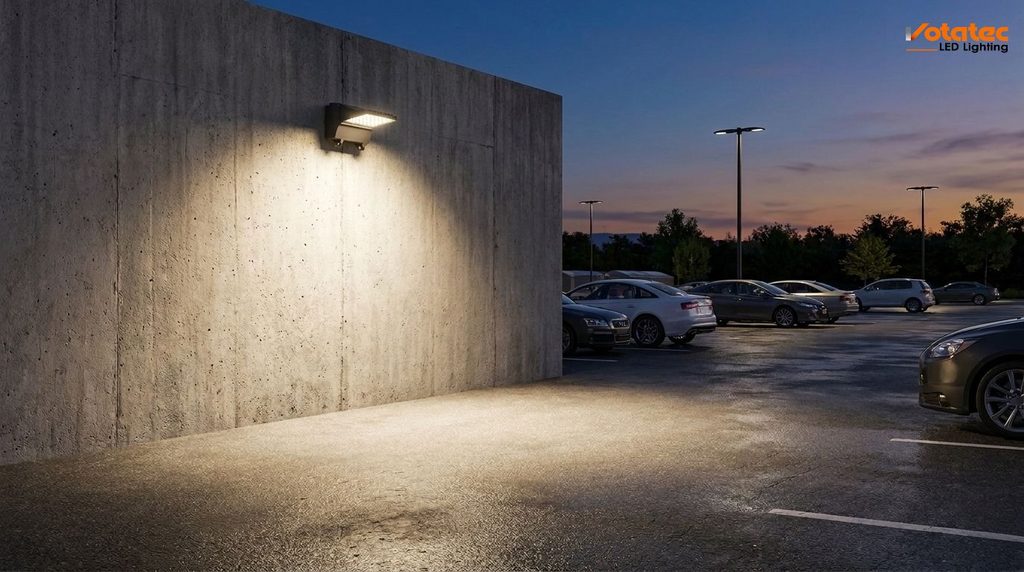
How much light does a Canadian parking lot actually need?
Less than most people spec. Over-lighting is the most common finding in a bylaw review, and it costs money twice: once on the area light and again every month on the bill.
The IES RP-20 recommended practice for parking facilities is the reference most Canadian consultants work from. The commonly cited targets for open lots:
- Basic level: around 0.2 foot-candles minimum horizontal illuminance, with average-to-minimum uniformity no worse than 4:1
- Enhanced security level: around 0.5 foot-candles minimum horizontal
- Vertical illuminance matters separately, because it’s what lets a camera or a person recognise a face
RP-20 is a paid standard from the Illuminating Engineering Society, so confirm the current edition against your jurisdiction before you stamp a drawing. Some municipalities set their own maximums. Inside a certified dark sky preserve, the RASC guidelines cap parking areas near 3 lux at a 6 metre mounting height, far below a typical retail lot.
Uniformity beats brightness every time. A lot at 0.3 fc with 3:1 uniformity feels safer than a lot at 1.0 fc with hot pools under each pole and black gaps between. Your eye adapts to the brightest thing it sees, so those hot spots make the dark parts read as darker. More area light fixtures at lower output usually wins.
More on levels and layout maths in the commercial outdoor area lighting spec guide.
Area light pole height and spacing without the guesswork
Rough starting point for a standard commercial lot: space poles at roughly three to four times the mounting height. A 7.5 metre pole gets you 22 to 30 metres of spacing at reasonable uniformity.
Taller poles cover more ground per area light and generally produce less glare, because the light arrives at a steeper angle. Thing is, dark sky bylaws sometimes cap mounting height, and some residential-adjacent zones cap it hard. Check before you design around a 12 metre pole.
Three things that decide the install:
- Voltage. An area light rated AC120-347V handles a 347V commercial service with no separate transformer, which is what most Canadian commercial buildings run
- Sealing. IP65 or better and a wet location listing, because freeze-thaw cycles find every gasket
- Selectable wattage, so you can trim an area light down at commissioning if the photometric layout came in hot, instead of re-ordering
Controls, curfews and keeping the rebate
Bylaws increasingly ask for more than a compliant area light. They ask for a compliant schedule. Huntsville reproduces DarkSky International’s five principles on its own bylaw page, and one of them is Controlled: light should only be on when needed, with timers and motion sensors.
So spec the controls in:
- Photocell for dusk-to-dawn switching, standard on wall packs and available on most area light models
- 0-10V dimming, so the site drops to 30% or 50% after closing instead of going dark
- Motion sensing on back lots and loading areas
- Curfew capability if the bylaw names one
There’s a deadline attached. The DesignLights Consortium moved to SSL V6.0 and LUNA V2.0, with applications opening 2026-01-05. Products not submitted for updating by 2026-10-09 get delisted from the Qualified Products List on 2026-12-15, per the DLC’s transition page. Delisted means no utility rebate.
That’s about a month away. Specifying an area light for a project closing in Q1 2027? Confirm its listing status now, not at commissioning. LUNA is the DLC’s dark-sky-specific listing, and a LUNA-listed area light is the fastest way to answer a planner asking for third-party proof.
The five-minute compliance check before you order
Run every fixture through this. Wall pack or area light, same list.
- Is it full cut-off? Flat lens, zero uplight, U0 on the BUG rating. Ask for the number.
- Does it mount level? If it has a tilt bracket, can it be locked at zero degrees?
- Can it hit 3000K? Check the actual CCT options, not the marketing copy. Selectable is safest.
- What’s the distribution type? Type IV or III near property lines, Type V for open lot centres.
- What’s the area light’s output at its lowest setting? Compare against any lumen cap in the bylaw.
- Is there a photometric file? No IES file, no layout, no approval.
- Is it DLC listed, and under which version? Check the delisting date.
- Does the site plan need a lighting drawing? In most towns with a bylaw, yes.
Tape it to the estimating desk. It catches most problems before they cost anything.
Common mistakes that fail a bylaw review
Using wall packs as lot lighting. Twelve wall packs on a building face won’t light a 60-space lot evenly. You get glare at the wall, darkness at the back fence, and the glare is what generates the complaint. Poles and area light fixtures cost more up front and less over the life of the site.
Tilting the area light up “just a bit.” Number one field failure. The certification assumed level.
Defaulting to 5000K. Looks brighter on a showroom floor. It’s also the exact spectrum most bylaws are written to reduce, and it’s harsher for drivers. 4000K is the practical maximum outside a dark sky zone, 3000K inside one.
Buying on lumens per dollar. A 150W area light at 24,000 lumens with no photometric file is worthless to a planner. Efficacy matters, but distribution control is what gets the permit.
Forgetting the existing fixtures. Some bylaws grandfather old installs, others require retrofit at replacement. Gravenhurst encourages owners with unshielded wall packs to shield them. Replacing three fixtures on a wall that has 15? Ask whether the whole wall now has to comply.
Choosing an area light for a Canadian site
For a typical retail or industrial lot in a municipality with a dark sky bylaw, the area light spec looks like this:
- Full cut-off housing, flat lens, U0
- 3000K, or a CCT-selectable area light set to 3000K at install
- Type V optics on interior poles, Type IV on perimeter poles
- AC120-347V input to suit Canadian commercial service
- Selectable wattage, IP65 or better, wet location listed
- 0-10V dimming plus photocell
- DLC listed under current requirements, LUNA listed where the bylaw wants proof
For the building itself, a full cut-off wall pack in Type III at 3000K covers doors and loading bays with no pole. Votatec’s wall pack range includes a full cut-off model with CCT selectable down to 3000K and 60W to 120W output. Covered areas differ again: canopy lights sit flush and produce no uplight by geometry, while flood lights belong on signs and facades aimed downward, never as lot coverage.
Outdoor pole lights and LED street lights are close cousins of the parking lot area light. Still mapping which fixture goes where? Start with outdoor light fixture types.
Frequently Asked Questions
Is an area light dark sky compliant?
Only if the area light is full cut-off with a U0 uplight rating, mounted level, and at or below the colour temperature your bylaw allows. The name guarantees nothing. Ask for the BUG rating and the IES file, and check CCT options before ordering. A drop-lens or sag-lens area light fails anywhere with a shielding requirement.
Can I use a wall pack instead of an area light to save on poles?
For the building face and first row of parking, yes. For a full lot, no. A wall pack at 3 to 4.5 metres can’t hit the uniformity an open lot needs, and raising its output to compensate creates exactly the glare and light trespass bylaws exist to stop. Full cut-off wall packs at the building, area light fixtures on poles for the lot.
What colour temperature do Canadian dark sky bylaws require?
Most converge on 3000K or lower, and the Royal Astronomical Society of Canada’s model bylaw rates sources under 3000K as recommended. Some go warmer still, to 2200K or amber near preserves. Requirements vary by town, so confirm with the municipality and spec a CCT-selectable area light that covers either case.
What is a full cut-off fixture?
A luminaire whose housing stops any light escaping above the horizontal plane at its base, producing zero uplight. Canadian bylaws add a second condition that’s easy to miss: it has to be installed in the horizontal position it was designed for. Tilting a full cut-off area light on an adjustable bracket voids the classification.
Do dark sky area lights still qualify for Canadian utility rebates?
Yes, and there’s a dedicated listing. The DesignLights Consortium’s LUNA programme lists outdoor products meeting light pollution criteria, and most Canadian utility rebates work from the DLC Qualified Products List. Watch the dates: an area light not updated to SSL V6.0 and LUNA V2.0 by 2026-10-09 comes off the QPL on 2026-12-15, ending its rebate eligibility.
Bottom line
The wall pack versus area light question answers itself once you look at the site plan. Walls get wall packs, lots get an area light on a pole, and the bylaw decides the rest.
What’s changed is that the rest is now a real list. Full cut-off, U0. Mounted dead level. 3000K where the bylaw asks for it. The right distribution type for where the pole sits. A photometric file. Controls that dim the site after hours. And a DLC listing that survives the December 2026 delisting.
Get those seven right and approval is a formality. Get one wrong and you’re pulling an area light off a pole in February.
Working on a lot that has to clear a dark sky bylaw? Request a quote with your site plan and target levels, and we’ll come back with an area light spec, the BUG ratings, and the photometric files your planner is going to ask for.