













 (+1) 905 597 5955



Here’s the short version. In Ontario, a running man exit sign is governed by Article 3.4.5.1 of the Building Code, and it isn’t required in every building. It’s required where an exit serves a building over 2 storeys tall, a building with an occupant load over 150, or a floor area with a fire escape in its required means of egress. When a sign is required, it has to be a green and white pictogram conforming to ISO 7010, it has to be continuously lit, and its backup power has to last 30 minutes, 1 hour, or 2 hours depending on the building.
That last number is where most online guidance gets Ontario wrong. We’ll get to it.
The current rules sit in the 2024 Building Code, O. Reg. 163/24, which came into force on 2025-01-01 and revoked the 2012 edition. If you’re specifying, installing, or inspecting exit signage in Ontario, this is the article set you’re working against.
The Short Answer: Ontario’s Running Man Exit Sign Rules at a Glance
| Requirement | Code article | What it says |
|---|---|---|
| When a sign is required | OBC 3.4.5.1(1) | Over 2 storeys, occupant load over 150, or a fire escape in the egress route |
| Symbol and colour | OBC 3.4.5.1(2) | Green and white, ISO 3864-1 colours, ISO 7010 symbols E001, E002, E005, E006 |
| Internally lit signs | OBC 3.4.5.1(3) | Continuously illuminated, built to CSA C22.2 No. 141 |
| Photoluminescent signs | OBC 3.4.5.1(4.1) | Conform to CAN/ULC-S572, labelled for tested duration |
| Circuit rules | OBC 3.4.5.1(5) | Dedicated circuit, connected to emergency power |
| Directional arrows | OBC 3.4.5.1(6) | Required where no exit is visible |
| Hotels | OBC 3.4.5.1(8) | Every exit, no occupancy threshold |
| Backup duration | OBC 3.2.7.4(1)(b) | 30 min, 1 h, or 2 h by building type |
| Light levels | OBC 3.2.7.3 | 10 lx average, 1 lx minimum at floor level |
| Ongoing testing | Fire Code 2.7.3.3 | Monthly function test, annual full-duration test |
Print that table. It covers about 90% of the questions we get from contractors on this topic.
Which Buildings Actually Need a Running Man Exit Sign?
This is the question the internet answers badly. Search for exit sign requirements and you’ll be told the running man is simply “required for new construction in Canada.” That’s too broad, and it’ll have you quoting signage into buildings that don’t need it.
The three trigger conditions
Sentence 3.4.5.1(1) is specific. Every exit door needs a running man exit sign over it or beside it if the exit serves one of these:
- A building more than 2 storeys in building height
- A building with an occupant load of more than 150
- A room or floor area with a fire escape as part of a required means of egress
Read the trigger carefully. It attaches to what the exit serves, not to the door itself. A single-storey retail unit with an occupant load of 90 and no fire escape doesn’t pick up an exit sign obligation from this sentence. Plenty of small commercial buildings in Ontario legitimately have none.
Occupant load isn’t a guess, either. It’s calculated from the Code’s occupancy tables, and the difference between 148 and 152 people changes your signage scope. Get the occupant load confirmed before you price the job.
Hotels get a stricter rule
Sentence (8) overrides the thresholds for one building type. Every exit serving a hotel needs a running man exit sign, with one carve-out: suite doors that open directly to the exterior. Occupant load and storey count don’t enter into it. If it’s a hotel, sign every exit.
The exemption almost nobody quotes
Sentence (9) waives the requirement inside a suite containing a Group B, Division 3 occupancy, but only when both conditions hold:
- Sleeping accommodation for not more than 10 persons, and
- Not more than 6 occupants need assistance evacuating
Small residential care settings live here. Both conditions have to be met, not one.
Why Ontario Uses the Running Man Instead of the Word “EXIT”
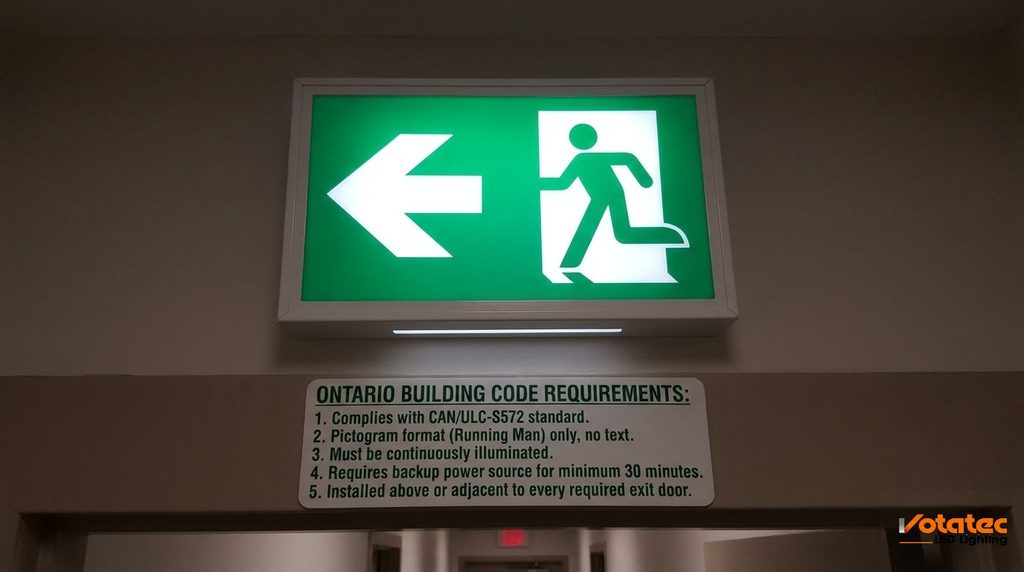
The green running man exit sign replaced text-based signage because a pictogram doesn’t need a language. Ask for an emergency exit sign in Ontario today and this is what you’ll be shown. Someone who reads neither English nor French still reads a figure moving through a door. That’s the whole design argument, and it’s why the symbol is standardised internationally rather than invented locally.
One clarification worth making, because AI search results currently get it wrong. Google’s AI Overview on this topic says the running man is “required under the National Building Code of Canada.” Ontario doesn’t enforce the National Building Code directly. Ontario enforces the Ontario Building Code, which adopts the National Building Code of Canada 2020 with provincial amendments. The 2024 edition removed roughly 1,730 technical variations from the national code, so the two are closer than they’ve ever been. Your permit, your inspector, and your enforcement all still run through the OBC. Cite the OBC article, not the NBC.
The four ISO 7010 symbols the Code names
Sentence (2) doesn’t just say “use a pictogram.” It names four registered symbols from ISO 7010:
- E001 emergency exit left
- E002 emergency exit right
- E005 90-degree directional arrow
- E006 45-degree directional arrow
This is why a good running man exit sign ships with an interchangeable pictogram set. The installer picks left, right, or straight at the door instead of ordering a separate part number per opening. It’s a code-anchored feature, not a marketing extra.
Green and white, and what “lightly tinted” allows
The sign has to be a green and white or lightly tinted graphical symbol meeting the colour specifications referenced in ISO 3864-1. Green means safe egress in that standard, which is why exit signage is green and fire equipment signage is red. If a supplier offers a black or brushed-steel running man exit sign, what’s being described is the housing, not the pictogram. The symbol itself stays green and white.
Illumination: Three Legal Ways to Light a Running Man Exit Sign
Ontario allows three approaches, each with its own conditions.
Internally illuminated LED running man exit signs
Sentence (3) requires internally illuminated signs to be continuously illuminated. Not motion-triggered, not switched with the room lights, not on a timer. Where the illumination runs off an electrical circuit, the sign must be built in conformance with CSA C22.2 No. 141, the Canadian standard for emergency lighting equipment.
An LED exit sign is the default choice here for a plain reason: continuous operation means the sign is lit every hour the building stands, so a few watts against a few dozen watts compounds over a 50,000 hour service life.
Externally illuminated signs
Sentence (4) permits a sign lit by a separate fixture, and that fixture must also keep the sign continuously illuminated from an electrical circuit. Less common in new work, still found in heritage and architectural applications.
Photoluminescent and self-luminous signs
Sentence (4.1) covers the non-electric options, and the conditions are tighter than people expect:
- Conform to CAN/ULC-S572 for photoluminescent and self-luminous signs
- Be labelled with the duration they’ve been tested and listed for
- Stay illuminated after a power failure for the duration in Clause 3.2.7.4(1)(b)
- Be continuously illuminated if the sign depends on an external light source to charge its coating
That third point is the one that catches people. A glow-in-the-dark running man exit sign still has to meet the same 30 minute, 1 hour, or 2 hour figure as a battery unit. Buying a cheap photoluminescent sign doesn’t sidestep the duration requirement, and the label has to prove the rating.
The circuit rule that fails inspections
Sentence (5) is short and it’s where field problems concentrate. Where an exit sign is lit from an electrical circuit, that circuit has to:
- Serve no equipment other than emergency lighting in the area where the exit signs are installed, and
- Be connected to an emergency power supply as described in Sentence 3.2.7.4(1)
So you can’t share the running man exit sign circuit with the corridor’s general lighting, a receptacle, or a rooftop unit. We’ve seen otherwise clean installations flagged for exactly this. The sign was right, the circuit wasn’t.
Directional Arrows: When a Plain Running Man Isn’t Enough
Sentence (6) handles wayfinding where the exit is out of sight. Where no exit is visible from a public corridor, from a corridor used by the public in a Group A or B major occupancy, or from principal routes serving an open floor area with an occupant load over 150, you need a running man exit sign with an arrow or other indicator pointing the way out.
These directional signs still have to meet the colour and symbol clauses, (2)(b) and (2)(c). That’s where E005 and E006 come in, the 90-degree and 45-degree arrows. A corridor that turns twice before reaching a stairwell needs signage at each decision point, not just at the door.
How Long Must a Running Man Exit Sign Stay Lit? The Real Numbers
Here’s the correction that matters most, because the wrong answer is everywhere.
Ontario’s duration comes from Article 3.2.7.4(1)(b), and it’s a ladder, not a single figure:
| Building | Required duration |
|---|---|
| Building within the scope of Subsection 3.2.6 (high buildings) | 2 h |
| Group B major occupancy, not within 3.2.6 | 1 h |
| Building containing a Group C retirement home, not within 3.2.6 | 1 h |
| Building within the scope of Article 3.2.2.51 or 3.2.2.60 | 1 h |
| Any other occupancy | 30 min |
Self-contained units have to conform to CSA C22.2 No. 141 under Sentence 3.2.7.4(2).
Why “90 minutes” keeps showing up, and why it’s wrong here
Search Ontario emergency lighting duration and you’ll be told the requirement is 90 minutes. We’ve seen it in fire-service blog posts and in a live Google AI Overview. It isn’t the Ontario Building Code figure for any occupancy.
Ninety minutes is a product rating, drawn from UL 924 and common US code language. It’s a perfectly good thing for a unit to be rated for, and buying a 90 minute unit for a 30 minute building gives you margin. It’s just not what the OBC asks for, and quoting it as the Ontario requirement leads to two bad outcomes: over-specifying a 30 minute building, or worse, under-specifying a high building that actually needs 2 hours.
If your project is within Subsection 3.2.6, a 90 minute unit does not meet code. You need 2 hours.
Emergency Lighting Levels That Go With Your Exit Signs
A running man exit sign doesn’t work alone. Article 3.2.7.3 sets the illumination for the route itself: an average of not less than 10 lx at floor or tread level, with Sentence (3) putting the minimum at not less than 1 lx.
That applies across a long list of spaces, including exits, principal routes to exit in open floor areas, public corridors, corridors serving classrooms, underground walkways, commercial kitchen food prep areas, public washrooms, and floor areas where the public congregates in assembly occupancies.
The 10 lx average and 1 lx minimum pair is what makes a manufacturer’s maximum mounting height meaningful. A remote head mounted too high stops delivering 10 lx at the floor, and the calculation, not the product sheet, is what an inspector checks. Our longer guide on emergency lighting and backup systems walks through how remote head wattage budgets work against these levels.
Dark Venues and Rooms Over 60 People
Sentence (7) adds a requirement that assembly occupancies routinely miss. In Group A, Division 1 occupancies, dance halls, licensed beverage establishments, and similar spaces that run lighting levels too low for easy identification of the egress doorway, an exit sign meeting Sentences (2) through (5) goes over or beside every egress doorway from rooms with an occupant load over 60.
Note the threshold change. It’s 60 here, not 150. A 75 seat licensed room with the lights down needs signage that the same room, brightly lit, wouldn’t. If you’re working on bars, clubs, or theatres in Ontario, check this sentence before you finalise the drawing.
Staying Compliant: What the Ontario Fire Code Requires After Installation
The Building Code gets the running man exit sign installed. The Fire Code, O. Reg. 213/07, keeps it working, and that obligation sits with the building owner. Article 2.7.3.3 is the one to know.
| Interval | What’s required |
|---|---|
| Monthly | Check pilot lights for operation |
| Monthly | Inspect terminal connections for cleanliness and corrosion, clamps for tightness, electrolyte level and specific gravity, battery surface clean and dry |
| Monthly | Test that the lights function on failure of primary power |
| Annually | Test for “a duration equal to the design criteria under simulated power failure conditions” |
| After annual test | Verify charging voltage, current, and recovery period against the manufacturer’s specification |
That quoted phrase is the one to hold onto. “Design criteria” means your building’s OBC duration, the 30 minutes, 1 hour, or 2 hours from the ladder above. It does not mean 90 minutes. A 2 hour building gets a 2 hour annual test, and a technician who runs 90 minutes and signs off hasn’t completed it.
Keep the records. A missing log is the most common deficiency written up on otherwise compliant systems.
Spec Checklist: Choosing a Compliant Running Man Exit Sign
Before you release a purchase order, confirm the sign:
- Carries the ISO 7010 pictogram set (E001, E002, and the E005/E006 arrows) so one part number covers left, right, and straight
- Uses a green and white symbol to ISO 3864-1 colour specs, whatever the housing finish
- Is built to CSA C22.2 No. 141 if it’s internally illuminated from a circuit
- Meets CAN/ULC-S572 and carries a duration label if it’s photoluminescent or self-luminous
- Delivers battery duration at or above your building’s OBC figure, not the marketing figure
- Suits the environment, with a damp or wet location rating for parkades, loading docks, and exterior openings
- Has a self-diagnostic function if you want the monthly Fire Code test to be manageable across a portfolio
- Can be circuited on its own emergency lighting circuit per Sentence (5)
Votatec stocks the full range through our LED emergency lights and exit signs category, including a steel-housing running man sign for damp locations, a remote-capable steel running man combo where one unit has to carry remote heads as well as the pictogram, an AC-only running man sign for buildings on central battery or generator backup, and a weatherproof running man sign for exterior and washdown openings. For route illumination alongside the signage, see our dual-head emergency lights. More technical guides are on the Votatec blog.
Five Compliance Mistakes We See Most Often
- Quoting 90 minutes as the Ontario requirement. It’s a product rating. Use the 3.2.7.4 ladder.
- Sharing the exit sign circuit. Sentence (5) allows emergency lighting only on that circuit.
- Switching an internally lit sign. Continuous illumination means continuous.
- Treating photoluminescent signs as a duration shortcut. They carry the same duration obligation, plus a labelling requirement.
- Running the annual test to the wrong length. Design criteria means the building’s figure, not a default.
One more, worth its own line: a compliant sign fitted at the wrong height or around a corner from the decision point satisfies the product clauses and still leaves people guessing. Sentence (6) exists because visibility is the actual objective. A companion article, OBC 3.4.5.2, covers exit signs with tactile information, so check that one too where it applies.
Frequently Asked Questions
Is a running man exit sign required in every Ontario building?
No. Under OBC 3.4.5.1(1), an exit sign is required where the exit serves a building over 2 storeys in height, a building with an occupant load over 150, or a floor area with a fire escape in its required means of egress. Small single-storey buildings under those thresholds often need none. Hotels are the exception under Sentence (8): every exit needs a sign regardless of occupant load, apart from suite doors opening directly outside.
How long does a running man exit sign have to stay lit during a power failure?
Between 30 minutes and 2 hours, depending on the building. Article 3.2.7.4(1)(b) requires 2 hours for high buildings within Subsection 3.2.6, 1 hour for Group B major occupancies and buildings containing Group C retirement homes outside that subsection, and 30 minutes for any other occupancy. The widely quoted 90 minute figure is a UL 924 product rating, not an Ontario Building Code requirement.
Do running man exit signs need battery backup?
Not necessarily a battery, but they do need emergency power. Sentence 3.4.5.1(5) requires the sign’s circuit to connect to an emergency power supply per 3.2.7.4(1), which the Code describes as batteries or generators. A self-contained battery unit is the common solution, and it has to conform to CSA C22.2 No. 141. Buildings with a central battery bank or generator can use AC-only signs instead.
Can I still use an old red “EXIT” text sign in Ontario?
Not for new work. Sentence 3.4.5.1(2) requires a green and white graphical symbol conforming to ISO 7010, so a text-based sign doesn’t meet the current Code. Existing signage installed under an earlier code edition is generally governed by the Fire Code maintenance obligations rather than retroactive replacement, but once you alter or replace a sign, the current Code applies. Confirm the scope with your authority having jurisdiction before planning a retrofit.
What colour is the green running man exit sign, and why green?
Green with a white pictogram, to the colour specifications referenced in ISO 3864-1. Green is that standard’s safe-condition colour, which is why it marks escape routes while red marks fire equipment and prohibition. The Code permits a lightly tinted version. Housings come in white, black, and steel finishes, but the symbol itself stays green and white.
What to Do Next
Ontario’s running man exit sign rules come down to four questions. Does this exit trigger 3.4.5.1(1)? Does the sign carry the right ISO 7010 symbols in the right colours? Is it lit continuously on a dedicated emergency circuit? And does its backup duration match the 3.2.7.4 ladder for this specific building?
Answer those four honestly and you’ll pass inspection. Get the duration wrong, and you’ve either wasted money or created a real safety gap.
If you’re specifying signage for an Ontario project and want the duration and location ratings checked against your occupancy before you order, contact the Votatec team with your building type and occupant load. We’ll match the unit to the article.