










 (+1) 905 597 5955


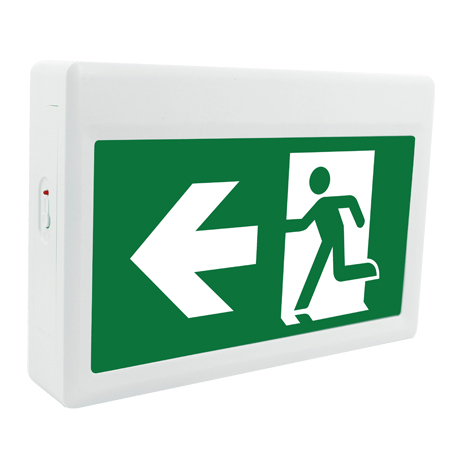
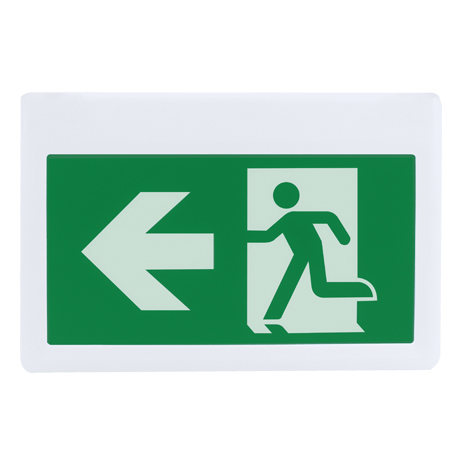


The No Battery Running Man is an AC-only green running man exit sign for buildings that already have emergency power. No internal battery means nothing to test, replace, or fail.
4.5W runs off any supply between 120V and 347V. 6500K LEDs, 50,000 hour rated life, three interchangeable arrow pictograms in the box.
White flame-rated thermoplastic housing, cULus Listed, built to CSA C22.2 No. 141-15, damp-rated for indoor locations, 5 year warranty.
What is the Canadian emergency exit sign?
It's the green and white running man pictogram, not the word EXIT. Ontario's Building Code, Article 3.4.5.1, calls for a graphical symbol meeting the colours of ISO 3864-1 and conforming to ISO 7010 for E001, E002, E005 and E006: exit left, exit right, and the 90 and 45 degree arrows. It ships all three arrow pictograms, changed on site, so one part number covers left, right and straight runs. That same article requires internally illuminated signs to stay lit continuously.
Why are emergency exit signs green?
Green reads as go. Red reads as stop or danger, the wrong instruction when you want people moving toward a door. The running man is a pictogram rather than a word, so it works whatever language someone reads. Canada adopted it for both reasons.
When does a no-battery exit sign make sense?
Only when the building already feeds emergency power to the exit sign circuit, from a generator or a central inverter. CSA C22.2 No. 141 expects emergency lighting to energise on loss of normal supply and run at least 30 minutes. With no battery in the housing, that has to come from the building. Ontario asks 2 hours in high buildings, 1 hour for several Group B and C cases, 30 minutes elsewhere. No central system? Order a self-powered unit instead.
Mounting, double face, and what the manual requires
Wall, ceiling and end mounting, canopy and crossbar included. Double face is ceiling and end mounting only, so a wall-mounted sign can't be read from both sides. Check that before you order. Wiring is dual lead: black to hot at 120V, red to hot at 347V, cap the rest. The canopy locks with a 20 degree twist and won't come out undamaged, so line it up first. Indoor only, 0C to 40C.
For the wiring diagram, the double-face swap and the pictogram change, open the Manual (PDF), and take the IES file if your designer needs photometrics. Send us your door count and whether the exit circuit sits on a generator or central inverter, and we'll come back with a wholesale quote and a mounting check.