












 (+1) 905 597 5955



Picking the wrong tube type can double your labour bill or void a rebate. So before you spec a single 4-foot LED tube for your next retrofit, know which of the three install types fits your fixtures, your budget, and your maintenance plan.
Here’s the short version. Type A tubes plug into your existing fluorescent ballast with zero rewiring. Type B tubes bypass the ballast and wire straight to line voltage, so they need an electrician but cut a failure point. Hybrid (Type A/B) tubes do both, letting you install fast today and convert later when the ballast dies.
The verdict: buy Type A for fast swaps on healthy ballasts, Type B for the lowest lifetime cost in warehouses, and hybrid when you’re rolling out across many sites over time.
This guide breaks down all three for facility and procurement teams across Canada. You’ll see the trade-offs on watts, lumens, cost, install time, safety, and rebate eligibility. There’s a procurement checklist at the end you can hand to your contractor
Quick answer: which LED tube type should you buy?
| Factor | Type A (Plug-and-Play) | Type B (Ballast Bypass) | Hybrid (Type A/B) |
|---|---|---|---|
| Install | Swap the tube, done | Rewire fixture, remove ballast | Swap now, rewire later |
| Electrician needed? | No | Yes | Only for bypass mode |
| Energy use | Tube + ballast loss | Lowest (no ballast) | Lowest in bypass mode |
| Future maintenance | Ballast can still fail | No ballast to fail | No ballast once converted |
| Upfront tube cost | Lower | Higher | Highest |
| Best for | Quick swaps, newer ballasts | Warehouses, old ballasts | Phased, multi-site rollouts |
If your ballasts are recent and you want speed, go Type A. If you’re retrofitting a warehouse with tired ballasts and want the lowest lifetime cost, go Type B. If you’re rolling out across many sites over months or years, hybrid buys you flexibility.
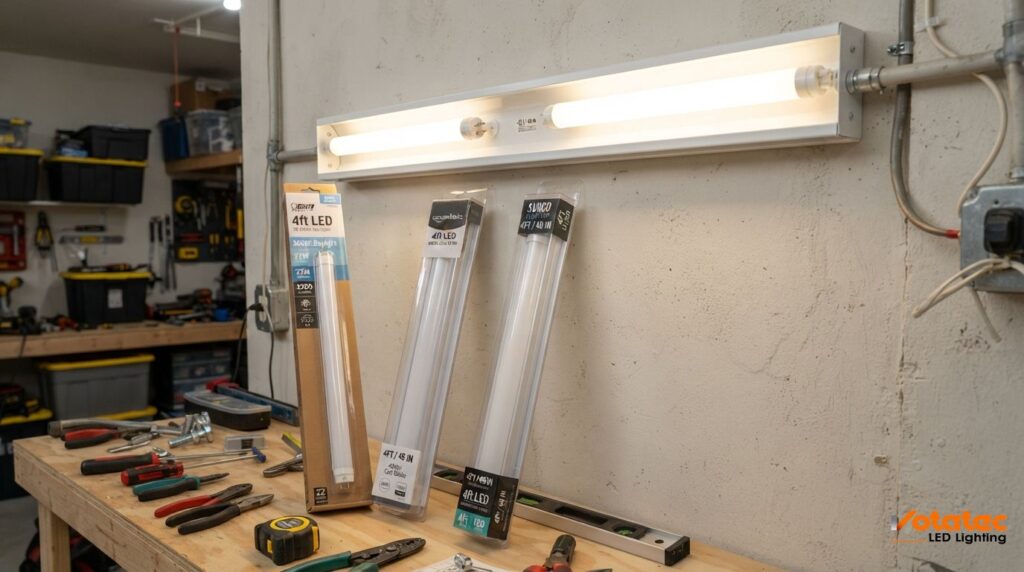
What 4ft LED bulb replaces a fluorescent tube, and do I bypass the ballast?
A 4-foot LED tube replaces the standard F32T8 fluorescent lamp. Whether you bypass the ballast depends on the type you buy. Type A keeps the ballast and needs no bypass. Type B and Type C require you to remove or bypass the ballast and wire to line voltage. Hybrid lets you start without a bypass, then bypass later.
So the answer is: it’s your call, set by the tube type you choose. Want the fastest possible swap with no electrician? Pick Type A and leave the ballast alone. Want the lowest energy use and one less part to fail? Pick Type B and bypass the ballast. Not sure which way you’ll go? A hybrid tube keeps both doors open.
One rule holds across all of them. The replacement tube must fit the same G13 bi-pin sockets your fluorescent lamp uses, and it must carry CSA or cETL certification to be legal for sale in Canada.
What is a 4-foot LED tube, and why does the type matter?
A 4-foot LED tube replaces the standard F32T8 fluorescent lamp found in offices, schools, hospitals, and warehouses right across the country. It drops into the same G13 bi-pin sockets. The catch is power. A fluorescent tube needs a ballast to regulate current. An LED tube does not work the same way, so manufacturers built three approaches to handle the power supply.
That single design choice drives everything else. Install labour, rebate eligibility, safety, and how often you’ll send a tech back up a ladder all trace back to which type you bought.
The timing matters more than ever. As of 2025-12-31, Canada prohibits the manufacture and import of 4-foot T8 fluorescent lamps under the federal mercury-lamp regulations. So if your building still runs fluorescent, you’re now on a clock. More on that below.
How many watts is a 4 foot LED bulb and what does it replace?
Most 4-foot LED tubes run between 9 and 18 watts and replace a 32-watt F32T8 fluorescent. The exact wattage you pick sets the brightness. A standard F32T8 puts out roughly 2,600 to 2,950 lumens when new, and a 15W to 18W LED matches that output while drawing about half the power.
Use this table to match LED wattage to the fluorescent lamp you’re replacing.
| LED wattage | Lumen output (approx) | Replaces | Typical use |
|---|---|---|---|
| 9W | ~1,100 to 1,300 lm | Low-output / reduced-lumen T8 | Corridors, storage, low-traffic |
| 12W | ~1,600 to 1,800 lm | Reduced-output F25T8 | Offices with layered lighting |
| 15W | ~2,000 to 2,400 lm | Standard 32W F32T8 | Offices, retail, classrooms |
| 18W | ~2,400 to 2,800 lm | High-output F32T8 or older T12 | Warehouses, high bays, task areas |
A 32-watt F32T8 fluorescent draws about 32 watts plus ballast loss. A 4-foot LED replacement runs roughly 9 to 18 watts. That’s about 40% to 55% less energy per tube, and bypass types claw back a few extra points by dropping the ballast load. Don’t over-spec. Matching lumens to the space beats buying the brightest tube on the shelf.
Type A LED tubes (plug-and-play)
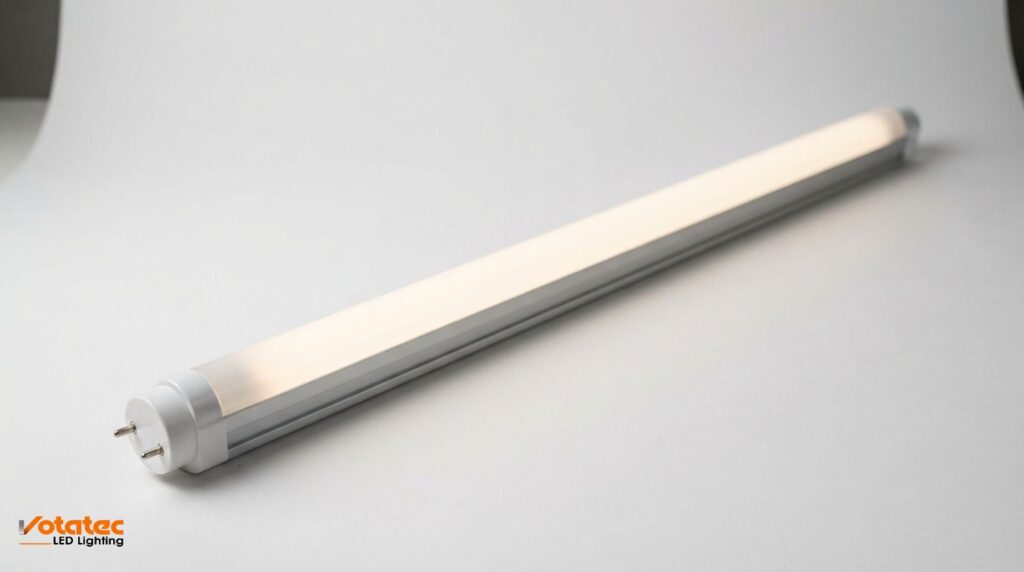
Type A tubes keep your existing fluorescent ballast and run off it directly. The tube has an internal driver tuned to accept the ballast’s output. You shut off the breaker, pull the old fluorescent lamp, and pop the LED tube in. No rewiring. No fixture surgery.
These are the easiest type to install, full stop.
Where Type A wins
- Speed. A maintenance tech can swap dozens of tubes an hour. No electrician required.
- Lower upfront cost on the tube itself, and near-zero install labour.
- Safer install than Type B, because you never expose sockets to line voltage during the swap.
Where Type A costs you later
- The ballast stays in the circuit. It still draws a small amount of power, and it’s still a part that can fail. When it does, the light goes dark and you’re back up the ladder. Facility teams call this the “double maintenance” risk.
- Compatibility is not universal. Not every Type A tube works with every ballast. You have to check the manufacturer’s compatibility list against your ballast model number before you buy.
Type A suits offices, retail, and institutional spaces with newer electronic ballasts where speed and low disruption matter most. Votatec stocks 4-foot Type A tubes built for exactly this kind of low-labour swap. See the 4ft T8 Type A glass LED tube.
Type B LED tubes (ballast bypass)
Type B tubes skip the ballast entirely. An electrician removes or bypasses the ballast and wires the tube’s sockets straight to 120V or 277V line voltage. The driver lives inside the tube. There is no ballast left in the circuit.
This is the type most professional contractors reach for on bigger jobs.
Where Type B wins
- Lowest energy use. With the ballast gone, you stop paying for ballast loss. Every watt goes to light.
- One less point of failure. No ballast means nothing to replace down the road. That cuts long-term maintenance calls.
- Predictable performance. The tube controls its own output, so you’re not at the mercy of an ageing ballast.
What Type B asks of you
- You need a qualified electrician. Wiring sockets to line voltage is electrical work, not a lamp swap.
- Safety demands care. Type B is the type most often flagged on safety. Single-ended Type B tubes need non-shunted tombstones, and the install exposes live wiring. Done wrong, it’s a shock hazard. Done right by a licensed electrician, it’s safe and reliable.
- Higher upfront labour cost, offset over time by lower energy and maintenance.
Type B is the go-to for warehouses, industrial floors, and any building with old or failing ballasts. If you’re replacing the ballast soon anyway, why keep it? Votatec carries direct-wire Type B options, including the 8ft glass T8 Type B tube for larger fixtures.
Hybrid (Type A/B) LED tubes
A hybrid tube, also called Type A/B or universal, does both jobs. Out of the box it runs as a Type A on your existing ballast. Then, whenever that ballast finally fails, you have an electrician bypass it and the same tube runs as a Type B. No new tubes needed.
This is the flexible middle path.
Where hybrid wins
- Install fast now, upgrade later. You get plug-and-play speed today and a built-in escape route when the ballast dies.
- One SKU for mixed sites. Procurement teams managing many buildings can standardize on one tube instead of tracking which site needs which type.
- De-risks phased rollouts. Roll out across a portfolio over months without locking in a wiring decision on day one.
The trade-offs
- Highest upfront tube cost of the three. You’re paying for two modes.
- Ballast compatibility still applies in Type A mode. Check the compatibility list, same as a pure Type A.
- You still need an electrician for the eventual bypass.
Hybrid tubes shine for multi-site organisations, school boards, municipalities, and property managers who want one product line and the freedom to convert on their own schedule.
What about Type C? A fourth type, Type C, uses a separate external LED driver wired into the fixture. It delivers the best efficiency and the smoothest dimming, which makes it a strong pick for spaces that need lighting controls. The trade-off is more wiring and higher install cost. Most retrofits land on A, B, or hybrid, so this guide focuses there.
Type A vs Type B vs Hybrid: the full comparison
| Criteria | Type A | Type B | Hybrid (A/B) |
|---|---|---|---|
| Uses existing ballast | Yes | No | Yes, then no |
| Rewiring required | None | Full bypass | Only to convert |
| Install skill level | Any maintenance tech | Licensed electrician | Tech now, electrician later |
| Relative install time | Fastest | Slowest | Fast now |
| Energy efficiency | Good | Best | Best after conversion |
| Ongoing failure points | Ballast | None | Ballast until converted |
| Tube unit cost | $ | $$ | $$$ |
| Total install cost | Lowest | Highest | Medium |
| Ballast compatibility check | Required | Not needed | Required (Type A mode) |
| Ideal setting | Offices, retail, schools | Warehouses, industrial | Multi-site, phased rollouts |
How do I install 4 foot LED bulbs in an old fluorescent fixture?
Start by killing power at the breaker. Never trust the wall switch alone. Then the steps depend on the type.
Type A (plug-and-play): Remove the old fluorescent tube, check the ballast model against the tube’s compatibility list, and slot the LED tube into the same sockets. That’s it. Power back on, test, done.
Type B (ballast bypass): This is electrician work. The ballast gets removed or bypassed, and line voltage is wired to the sockets. Single-ended Type B tubes need non-shunted tombstones, so the electrician may swap the sockets. Each tube usually ships with a wiring diagram and a label marking the live and neutral ends.
Hybrid (Type A/B): Install it like a Type A today, no rewiring. When the ballast eventually fails, bring in an electrician to bypass it and run the same tube as a Type B.
Two safety notes for every job. Always confirm the fixture is de-energized with a tester before touching sockets. And recycle the old fluorescent tubes properly, because they contain mercury and can’t go in regular waste.
Which LED tube type is right for your facility?
Match the type to your situation, not the other way around.
- Newer electronic ballasts, want speed, low disruption. Choose Type A. Schools and offices during a summer shutdown are the classic case.
- Old or failing ballasts, high ceilings, long run hours. Choose Type B. Warehouses and plants get the biggest lifetime payback here.
- Many sites, phased budget, want one product line. Choose Hybrid. Property portfolios and municipal fleets benefit from the flexibility.
- Need dimming or advanced controls. Look at Type C with your electrical contractor.
When you’re not sure about ballast age, hybrid is the safe hedge. You install at Type A speed and keep the bypass option in your back pocket.
What are the best 4 foot LED bulbs for a warehouse or office?
The best tube depends on the room. Warehouses and offices pull in opposite directions on brightness, install type, and run hours.
For a warehouse: Go brighter and go Type B. High ceilings and long operating hours reward an 18W tube near 2,800 lumens, often at 5000K for a crisp, alert workspace. Type B bypass makes sense because warehouse ballasts tend to be old, run hours are long, and the energy and maintenance savings add up fast. If the facility runs around the clock, the case for ditching the ballast only gets stronger.
For an office: Aim for comfort and speed. A 15W tube around 2,000 to 2,400 lumens at 3500K to 4000K gives even, glare-free light over desks. Type A plug-and-play is usually the right call, since office ballasts are often newer and you can swap tubes over a weekend with no electrician and no downtime. Layered spaces with task lighting can drop to 12W.
Across both, confirm the model is DLC listed before you buy, so the rebate stays on the table. Votatec stocks tubes tuned for each setting in its 4ft and 8ft T8 LED tube range, and for very high ceilings, linear high bay fixtures often beat tube retrofits outright.
How does LED tube type affect your rebate?
This is where procurement teams lose money they didn’t have to.
Most Canadian utility rebate programs require products to be DLC listed. The DesignLights Consortium runs the Qualified Products List, and roughly 70% of North American energy-efficiency programs, close to 700 in total, tie rebates to it. If the tube isn’t on the QPL, the rebate often doesn’t apply.
A few facts worth holding onto:
- CSA or cETL certification is mandatory for any electrical product sold in Canada. It’s also a prerequisite for DLC listing, so it comes first.
- DLC released Version 6.0 of its solid-state lighting requirements in November 2025 and began accepting applications on 2026-01-05. Products on the older V5.1 list stay valid until 2026-12-15, then only V6.0 products remain qualified. Spec to V6.0 where you can to avoid buying soon-to-be-delisted stock.
- Some programs pay up to $3 per qualifying T8 or T5 tube through instant-discount channels like Ontario’s Save on Energy, though terms vary by province and program.
The type you pick interacts with rebates in a practical way. Ballast-bypass tubes (Type B) and external-driver tubes (Type C) tend to post higher system efficacy because there’s no ballast loss, which can matter when a program sets efficacy thresholds. Whichever type you choose, confirm the exact model is DLC listed before you order. Our explainer on DLC certification and why it matters walks through how to read a listing.
The Canadian fluorescent phase-out: why timing matters now
Canada is phasing out mercury-containing lamps under its federal regulations, in step with the global Minamata Convention on Mercury. Environment and Climate Change Canada leads the rollout.
Here’s what changed and what’s coming:
- As of 2025-12-31, the manufacture and import of 4-foot T8 fluorescent lamps is prohibited. Eight-foot T12 lamps are covered too.
- A transition window lets some replacement fluorescent lamps stay available for a limited time, but that runway is closing.
- Sale of affected replacement lamps is set to end later this decade.
Translation for procurement: the supply of fluorescent tubes is drying up, and prices on what’s left will climb. Buildings that wait will get stuck paying premiums for old technology or scrambling during an outage. Planning the LED switch now, on your own timeline, beats reacting to an empty shelf. For the bigger picture, see our commercial LED lighting buyer’s guide for Canada.
Procurement checklist: specifying 4-foot LED tubes
Hand this to your contractor before you order.
- Confirm the install type (A, B, or hybrid) against fixture and ballast condition
- Pull ballast model numbers and check the compatibility list for Type A or hybrid
- Verify CSA or cETL certification on every model (legally required in Canada)
- Confirm DLC listing, ideally to V6.0, and check it against your utility’s rebate program
- Match wattage and lumen output to the space (9W to 18W covers most 4-foot needs)
- Specify colour temperature by application (3500K to 5000K for most commercial spaces)
- Check the warranty (Votatec backs its commercial tubes with a 5-year warranty)
- For Type B, schedule a licensed electrician and confirm non-shunted tombstones
- Plan disposal of old fluorescent tubes (they contain mercury and need proper recycling)
You can spec across all three types from one source. Browse Votatec’s full 4ft and 8ft T8 LED tube range to compare options.
Common mistakes to avoid
- Skipping the ballast compatibility check. A Type A tube on the wrong ballast may flicker, underperform, or fail early. Always cross-check the model number.
- Treating a Type B swap as a lamp change. It’s electrical work. Use a licensed electrician, every time.
- Ignoring DLC status. A great tube that isn’t DLC listed can cost you the entire rebate. Confirm before you buy.
- Buying to the old V5.1 standard late in the cycle. With V5.1 products delisting on 2026-12-15, you risk stranded inventory. Spec V6.0.
- Waiting out the fluorescent ban. Supply is shrinking. A planned switch is cheaper than an emergency one.
Frequently asked questions
What is the difference between Type A and Type B LED tubes?
Type A tubes use your existing fluorescent ballast and install with no rewiring, like a normal lamp swap. Type B tubes bypass the ballast and wire directly to line voltage, which needs an electrician but removes the ballast as a failure point and lowers energy use.
Do Type B LED tubes need a ballast?
No. Type B tubes are direct-wire. The ballast is removed or bypassed, and the tube connects straight to mains voltage. The driver that regulates power sits inside the tube itself.
Are Type B LED tubes safe?
Yes, when installed correctly by a licensed electrician. Type B carries more risk than Type A because the install wires sockets to line voltage and often requires non-shunted tombstones. Proper installation makes it safe and reliable, which is why warehouses and industrial sites use it widely.
How do I know if I need a Type A or Type B tube?
Check your ballast. If it’s recent and on the tube maker’s compatibility list, Type A gives you the fastest install. If the ballast is old, failing, or you want the lowest long-term cost, choose Type B. If you’re unsure or rolling out across several sites, a hybrid tube covers both.
What is a hybrid (Type A/B) LED tube?
A hybrid tube works on the existing ballast as a Type A, then converts to direct-wire Type B operation once the ballast fails. One tube, two modes. It gives procurement teams flexibility for phased or multi-site rollouts.
Will switching to LED tubes qualify for a rebate in Canada?
Often yes, if the tube is DLC listed and your provincial utility runs a program. Most programs require DLC listing, and CSA or cETL certification is mandatory to sell the product in Canada. Confirm the exact model against your program’s qualified products list before ordering.
The bottom line
Three types, three jobs:
- Type A for fast, low-labour swaps where the ballast is healthy.
- Type B for the lowest lifetime cost in warehouses and industrial spaces.
- Hybrid for flexibility across multi-site, phased rollouts.
Whatever you choose, confirm CSA certification and DLC listing before you order, match the wattage to the room, and plan your switch ahead of Canada’s tightening fluorescent supply. The buildings that move on their own schedule pay less than the ones that wait.
Ready to spec your retrofit? Compare Votatec’s Canadian-stocked 4-foot LED tube range or request a wholesale quote for your project.
Sources: Government of Canada, mercury-containing lamp phase-out; ECCC overview of the mercury products regulations; Save on Energy Instant Discounts Program; DLC SSL V6.0 guidelines coverage, inside.lighting.