










 (+1) 905 597 5955




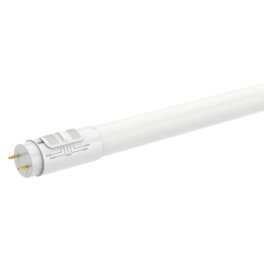
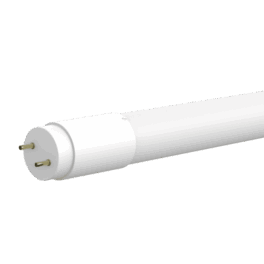
This 2ft T8 glass tube installs two ways. Leave the existing ballast in place for a plug-and-play swap, or bypass it and wire straight to line voltage. One part number covers both.
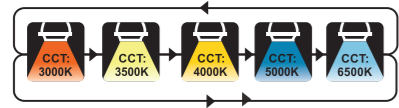
8W puts out 1080 lumens at 135 lm/W, replacing a 17W F17T8 fluorescent. Five colour temperatures select on the tube itself: 3000K, 3500K, 4000K, 5000K and 6500K.
Glass with a PET coating holds the shards if it ever breaks. cULus listed, AC120-347V, 5 year warranty.
What's the difference between a Type A and Type B LED tube?
Type A runs on your existing fluorescent ballast. Type B bypasses that ballast and wires direct to line voltage. This tube does both, which is what the A+B designation means.
Check your ballast before you decide. The spec sheet tables 143 ballasts at 120-277V and 20 more at 347V, marked per lamp count and per voltage, across instant-start, program-start and rapid-start types. If yours isn't on the list, the manual is blunt about the next step: bypass the fixture and install as Type B instead. Don't gamble on an untested ballast.
Do you need to change the lamp holders?
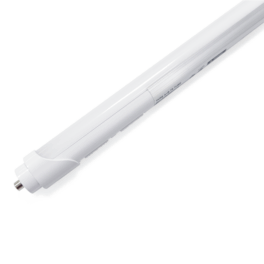
Only for single-ended wiring. Double-ended installs keep the existing sockets if they're in good condition, whatever type they are. Single-ended installs need un-shunted lamp holders, and the feed has to land on the end without the CCT switch. Wire it into the switch end and the tube won't light.
Setting the colour temperature
The selector sits on the tube base, and it moves between 3000K, 3500K, 4000K, 5000K and 6500K. Cut power first. Moving the selector while the lamp is energised can damage it.
One part number across five colours means one line item on the truck for a warm-white office and a cool-white shop floor. Less stock sitting still, fewer wrong-colour callbacks.
Where it fits, and where it doesn't
The manual asks for a lamp compartment of at least 623 x 563 x 67mm, taking up to four lamps. It's written for retrofitting surface-mount fixtures with a diffuser, plus IC and non-IC recessed troffers.
Dimming is 120V reverse-phase (ELV) only. A standard incandescent dimmer won't drive it properly. It isn't intended for emergency exit fixtures. Type B conversion is one-way too: once that ballast is out, the fixture won't take a fluorescent lamp again, so the supplied marking label needs to go somewhere the next person will actually see it.
For the ballast tables, the wiring diagrams and the named ELV dimmer models, open the Manual and Spec sheet in the Related documents panel, and pull the IES file if your designer needs photometrics. Send us your fixture count and how many still run on a ballast, and we'll come back with a wholesale quote and a read on whether Type A or Type B suits the job.