










 (+1) 905 597 5955


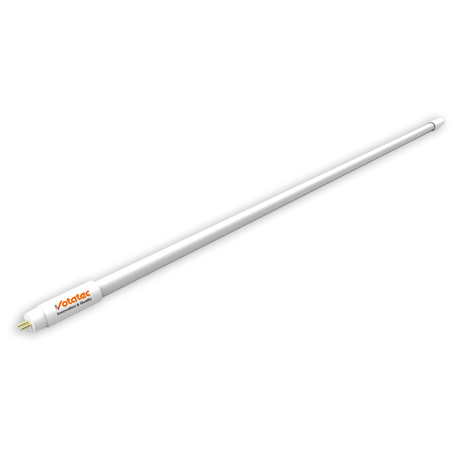
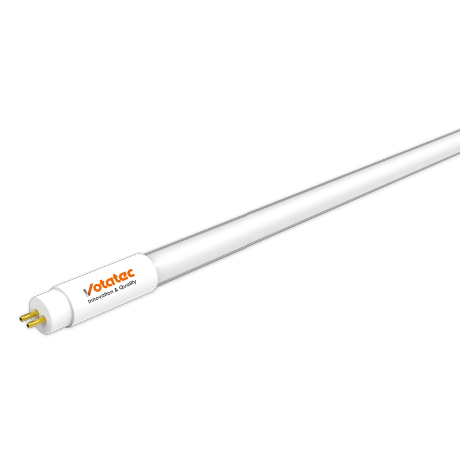


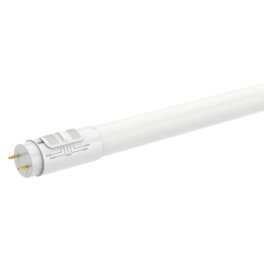
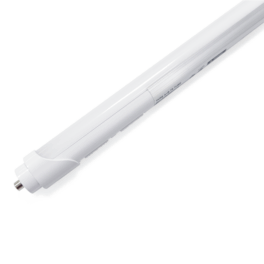
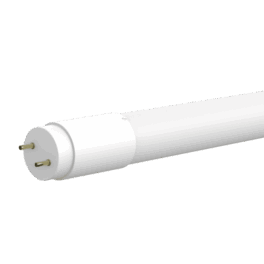
This 4ft T5 LED tube is UL Type A+B, so it runs on your existing fluorescent ballast or wires direct to line voltage once the ballast is bypassed. One SKU covers both retrofit methods, single-ended or double-ended.
It draws 24W on 120-277VAC. IES-tested output is 2,645 lm at 4000K and 2,707 lm at 5000K, CRI above 83, G5 bi-pin base.
Glass body with a shatterproof PET film, cULus listed, NSF component rated, five-year warranty.
What are Type A+B LED tubes?
A Type A+B tube installs two ways. Drop it into a working fluorescent fixture and it runs on the existing ballast, like a Type A lamp. Bypass the ballast, wire the sockets to line voltage, and it runs as a Type B lamp. You decide per fixture, on site, from one box.
That matters on a phased retrofit. Healthy ballast, drop it in. Dead ballast, rewire that fixture and it never needs one again. No stocking two part numbers, no returns because a ballast turned out wrong.
What happens if you put a LED tube in a fluorescent fixture?
With this tube in Type A mode, it lights. The ballast has to be on the compatibility list, so check the Spec sheet and Manual first, because a few listed ballasts work at two lamps but not at one. Not on the list, and you wire it as Type B instead.
One thing before you bypass. Once a fixture is converted to Type B, it won't run fluorescent lamps again. That's permanent, and the manual requires a cautionary label on the luminaire where the next electrician will see it.
Are T5 fluorescent tubes being discontinued in Canada?
Manufacture and import of T5 and T8 linear fluorescents stopped on 2025-12-31 under Canada's Products Containing Mercury Regulations. Existing stock can be sold through to the end of 2029, and a replacement-lamp exemption runs to 2027-12-31. So your T5 fixtures keep working, but the lamps get harder to source every year.
Will it fit your fixture?
The lamp compartment needs 45.7in of length and 0.6in of width. Dry and damp locations only, not outdoors, not water tight, rated -20C to 45C. The NSF component listing covers splash and non-food zones, so commercial kitchens are in scope. Either pin takes either leg, so there's no polarity to get wrong.
For both ballast compatibility lists, the per-lamp rewiring diagrams and the label step, open the Manual and Spec sheet, and pull the IES files if your designer needs measured photometry. Send us your fixture count and lamps per fixture, and we'll come back with a wholesale quote plus a check on whether your ballasts are on the compatible list.