













 (+1) 905 597 5955


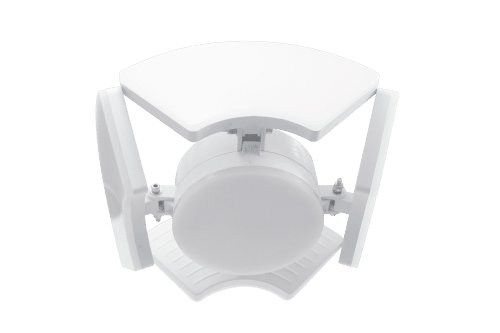

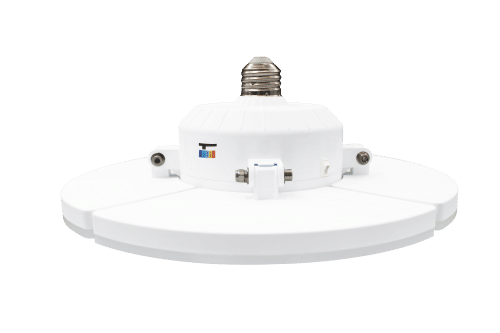
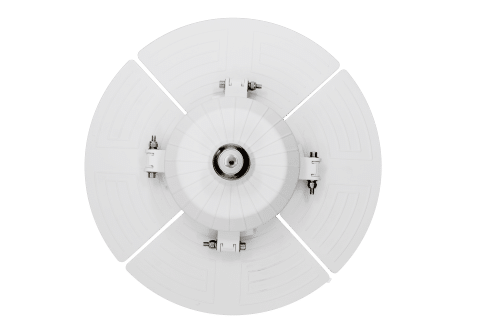


Screws into any E26 socket, then unfolds five light heads. Four of them tilt to 110 degrees, so you aim light at the bench, not just the floor. No wiring, no bracket, no tools.
Set output at 20W, 30W or 40W. Set colour on the same unit: 2700K, 3000K, 3500K, 4000K or 5000K. Tested output is 2,008 to 4,360 lumens, CRI above 80.
IK10 housing, 2.5kV surge protection, cULus listed, five-year warranty.
How many lumens do you need for a garage?
Work from floor area, not the biggest number on the box. IES puts a storage garage at 5 foot-candles and a service garage at 10 to 20. A single-car bay runs about 240 sq ft, so you want 1,200 to 4,800 lumens on the floor. One unit at 40W delivers 4,070 to 4,360 lumens, enough for a single bay used for storage and general work. A repair area wants 50 foot-candles and up, so budget two or three units for a double garage, or ask about the 80W version on the same spec sheet.
What's the best type of LED light for a garage?
It comes down to the ceiling. A screw-in multi-head lamp wins where a socket already exists and there's no electrician budget. Five-minute swap, no wiring, no drilling. Linear strips and high bays win on long spans and ceilings over 12 ft. Four folding heads cover a bench and a floor from one central socket, which a flat panel can't do.
Why five colour temperatures matter here
Most garage lights ship locked at 6500K. That suits a shop and reads harsh in an attached garage that doubles as a mudroom. One SKU spanning 2700K to 5000K means one line on the shelf instead of five, and no guessing at the counter. Both switches sit inside the driver housing, set before you screw it in.
Where it fits, and where it doesn't
Dry locations only, per the cULus listing. An unheated garage that takes on moisture needs a different product. It isn't rated for enclosed fixtures, and at 9.84 in unfolded it won't fit a globe anyway. Keep the heads clear of insulation and stored material, and check the host fixture's wattage label before swapping. Skip garage door opener sockets: an LED driver that close to the opener's antenna is a known cause of lost remote range.
For the installation sequence, safety warnings and the full lumen table by colour temperature, open the Spec sheet and Manual in the Related documents panel, and pull the IES file if your designer needs distribution curves. Send us your bay count and ceiling height and we'll come back with a wholesale quote and a layout check.