












 (+1) 905 597 5955




A photocell is a small light sensor that switches outdoor lights on at dusk and off at dawn, with no timer to set. When daylight falls to roughly 10 to 20 lux, it closes a switch and the fixture comes on. When morning light climbs back to 30 to 60 lux, it opens the switch again. Those are the published thresholds on Votatec’s JL-103 photocells, and most lighting controls of this kind work in the same range.
Wiring one is simple: black to line, white to neutral, red to the load. Two things trip people up. The first is voltage, because a 120V photocell won’t survive on a 347V commercial lighting circuit. The second is failure, which usually shows up as lights burning all day, lights that never come on, or lights that blink all night.
Below: how a photocell works, the main types, step-by-step wiring, 120V vs 347V, and how to test one before you replace it.
What Is a Photocell and How Does It Work?
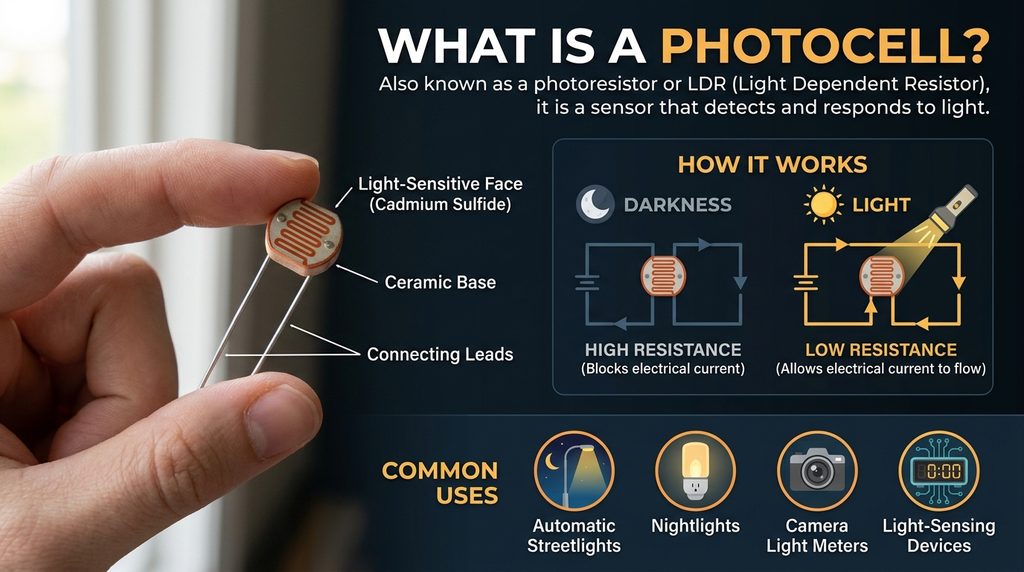
A photocell (also sold as a photocell switch, photocontrol, photoelectric sensor or dusk to dawn sensor) is a light-activated switch for lighting circuits. A light-sensitive element inside reacts as daylight rises and falls. Once the light passes a set threshold, it opens or closes the contacts that feed power to the fixture.
That’s the whole job. Dark means on. Light means off.
So where are photocells used? Parking lot poles, wall packs over entrances and loading docks, walkways, signs and streetlights. Anywhere lights should run from dusk to dawn without someone flipping a switch.
Because it reacts to real daylight, a photocell follows the seasons on its own. In Toronto, sunset moves from after 9 p.m. in late June to before 5 p.m. in December. A timer needs resetting for that. A photocell doesn’t.
It’s also the baseline control Canada’s federal energy guidance expects. Natural Resources Canada’s Major Energy Retrofit Guidelines for commercial buildings put it plainly: “At a minimum, exterior lighting should be controlled by a photocell that shuts it off during daylit hours.” If you’re weighing this against a motion sensor or a timer, our dusk to dawn outdoor lights guide compares all three.
Photocell vs Photoresistor: One Word, Two Meanings
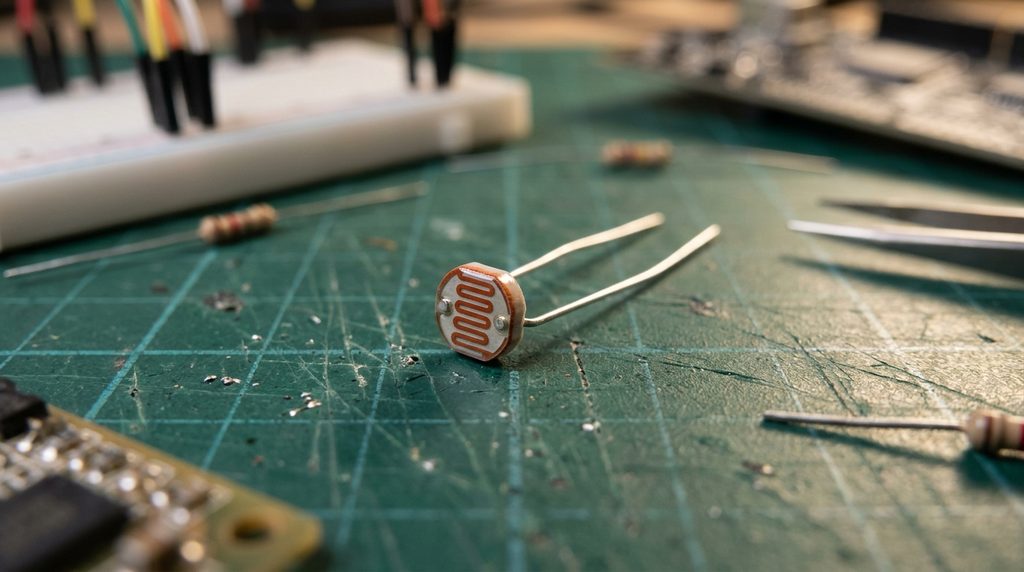
In electronics, a photocell is a light-dependent resistor (LDR), the tiny part in hobby kits whose resistance drops as light increases. In lighting, the word means the complete control: the sensor, a switch, a weatherproof housing and leads rated for line voltage.
The two are related. Votatec’s JL-103 and JL-106 models use a 1/2-inch cadmium sulfide (CdS) cell as the eye. Newer electronic photocontrols often use a silicon photodiode instead.
Inside a Dusk to Dawn Sensor: Eye, Switch and Delay
A typical photocell sensor for outdoor lights has three working parts:
- The eye. A CdS cell or photodiode behind a clear lens reads ambient light.
- The switch. In a thermal photocell, daylight lets current flow through a tiny heater, which bends a bimetal strip and opens the contacts. Electronic models drive a relay from a small circuit board.
- The delay. A built-in lag stops headlights, lightning or a flashlight beam from switching the lights. In a thermal unit, the delay is the time the bimetal strip takes to heat and cool.
Notice the gap between the on level (10-20 lux) and the off level (30-60 lux). It’s deliberate. Without it, a sensor sitting right at the threshold on a grey evening would chatter on and off. Utility-grade twist-lock photocontrols are commonly specified to turn on at about 1.5 foot-candles, roughly 16 lux, which lands in the same range.
Types of Photocells for Outdoor Lights
Four mounting styles cover almost every commercial job.
| Type | How it mounts | Where you’ll see it |
|---|---|---|
| Button (built-in) | Sits inside the fixture housing | Wall packs, flood lights, security lights |
| Knockout (stem) | Threads into a 1/2-inch knockout on a junction box | One control switching a whole circuit of fixtures |
| Swivel | Knockout mount with an adjustable head | Boxes where a fixed eye would face the sun or another light |
| Twist-lock | Plugs into a receptacle on top of the fixture | Streetlights and pole-mounted area lights |
Button Photocells (Built Into the Fixture)
There’s nothing extra to wire, and each fixture switches itself. Our mini wall pack with photocell works this way and runs on 120V to 347V. It also has an on/off switch for the sensor, so the fixture can move to a timer or panel control later. Several of our LED wall packs and LED area lights carry one built in, too, with a cap or switch to turn it off.
Knockout and Swivel Mounts
A knockout photocell lives on a junction box and switches every fixture wired after it, which makes it the go-to choice for a row of wall packs or bollards on one circuit. The JL-103AG 120V photocell and the JL-103EE 347V photocell are both this type.
A swivel photocell lets you aim the eye. The JL-106AV swivel photocell also ships with a field-adjustable shield, handy when the box sits near a sign, a window or a neighbour’s floodlight.
Twist-Lock Photocontrols (ANSI C136.10)
So what is a streetlight photocell? It’s a twist-lock photocontrol that plugs into a receptacle on top of the fixture, used on streetlights and many pole-mounted area lights. The 3-pin version is a power-only on/off control. Five-pin and seven-pin receptacles add signal contacts for 0-10V dimming or networked controls. Our LED street light buying guide covers the options.
Photocell Wiring: How to Wire a 3-Wire Photocell
Almost every knockout and swivel model uses three leads. Once you know what each one does, photocell wiring takes about 10 minutes.
What the Black, White and Red Wires Do
- Black (line): connects to the incoming hot wire from the breaker.
- White (neutral): connects to the circuit neutral and powers the sensing circuit.
- Red (load): the switched output. It connects to the fixture’s hot lead.
The fixture’s own neutral joins the same neutral bundle as the white lead. The control sits between the supply and the light, like a wall switch that flips itself.
How to Wire a Photocell, Step by Step
Votatec’s installation sheets recommend a licensed electrician, and on any commercial or 347V circuit it isn’t optional. If you’re qualified, here’s the sequence:
- Kill the power. Switch off the circuit at the breaker and confirm it’s dead with a voltage tester.
- Check the label. The rated voltage has to match the circuit, 120V or 347V. It’s an easy mistake on commercial sites, where both voltages often share one building.
- Pick the knockout. Face the eye north if you can. On a south wall, aim it east or west, or point it down toward the ground.
- Mount it. Feed the leads through the knockout, fit the rubber gasket and tighten the locknut. Outdoors, the connection has to be watertight.
- Connect it. Black to line, white to neutral, red to the fixture’s hot lead, fixture neutral to the neutral bundle.
- Restore power. In daylight, the lights should come on briefly and switch off within a few minutes. That’s normal on first power-up.
- Test it with the black tape test described below.
Wiring One Photocell to Several Fixtures
One knockout photocell can switch a whole run of fixtures, as long as the total load stays inside its rating:
- JL-103AG (120V): 1,800W tungsten or 1,100VA ballast
- JL-106AV (120V swivel): 2,000W tungsten or 2,000VA ballast
- JL-103EE (347V): 2,000W tungsten or 2,000VA ballast
For LED fixtures, size against the ballast (VA) rating, not the tungsten watts. LED drivers are electronic loads, like ballasts, and they pull a short inrush spike at switch-on. That spike is what welds relay contacts shut. The troubleshooting chart for our JL-103 units lists “contacts are welded due to excessive load” as a cause of lights that won’t turn off.
Here’s the math. VA equals watts divided by power factor. A 100W LED wall pack with a 0.9 power factor draws about 111VA. Ten of them add up to 1,110VA, already past the JL-103AG’s 1,100VA rating. We’d keep that circuit to five or six fixtures. For bigger loads, let the photocell switch the coil of a lighting contactor rated for the full circuit.
What About 2-Wire Photocells?
A 2-wire photocell has no neutral lead. It wires in series with the fixture, so it fits an old box with no neutral. The catch: it powers itself with a small current that flows through the fixture even when the lights are “off”. With an LED driver, that trickle can cause flicker or a faint glow. Check the label for LED compatibility, or run a neutral and use a 3-wire unit.
Where to Mount It (and Where Not To)
Location matters as much as wiring. And it’s easier to get wrong. Follow these rules from our installation sheets:
- Face north where possible, so the eye reads sky brightness without staring into the sun.
- Keep it out of its own beam. If it sees its fixture’s light, directly or off a wall, it’ll cycle all night.
- Avoid other light sources like windows, signs and street lights.
- Don’t mount it wires-up unless water can’t possibly get in.
- Keep the lens clear of eavestrough drip, snow and paint overspray.
120V vs 347V Photocells: Which One Do You Need?
Match the photocell to the circuit voltage. Homes and small commercial spaces run lighting at 120V. Larger commercial, industrial and institutional buildings with a 600V service often run exterior lighting at 347V. A unit rated for the wrong one will fail, sometimes on the first night.
Why Canadian Buildings Use 347V Lighting
A 600Y/347V service is a three-phase, four-wire system, and 347V is the voltage from any one phase to neutral. It’s Canada’s equivalent of the 480Y/277V systems common in the US.
Why bother with 347V at all? It comes down to current. A 1,000W block of LED lighting draws about 8.3 amps at 120V, but only about 2.9 amps at 347V. Less current means smaller conductors, fewer circuits and less voltage drop on long runs out to parking lot lighting poles. That’s why plazas, warehouses, schools and hospitals so often light their exteriors at 347V. The Canadian Electrical Code caps lighting circuits in dwelling units at 150 volts to ground, so you won’t find 347V lighting inside a house.
120V vs 347V Comparison
| 120V photocell | 347V photocell | |
|---|---|---|
| Typical building | Homes, small retail, offices on a 120/208V service | Plazas, warehouses, schools, hospitals on a 600Y/347V service |
| Votatec model | JL-103AG (fixed), JL-106AV (swivel) | JL-103EE (fixed) |
| Load rating | 1,800W/1,100VA (AG), 2,000W/2,000VA (AV) | 2,000W tungsten/2,000VA ballast |
| Operating voltage | 110-130VAC | 347VAC |
| On/off levels | 10-20 lux on, 30-60 lux off | 10-20 lux on, 30-60 lux off |
| Temperature range | -40°C to +70°C | -40°C to +70°C |
What Happens If You Use the Wrong Voltage?
Our troubleshooting chart lists “photo control is not rated at voltage being used” as a cause of lights stuck on and lights stuck off. In practice:
- A 120V photocell on a 347V circuit sees almost three times its rated voltage. Expect it to burn out fast, often at first power-up.
- A 347V photocell on a 120V circuit doesn’t get enough voltage to switch properly. The same chart links “line voltage exceptionally low” to lights that stay on.
Watch Out for 277V “Multi-Volt” Controls
Many US catalogues sell 120-277V “multi-volt” photocells. 277V is an American lighting voltage, and those units don’t cover 347V. Check that the label reads 347V or a range that includes it. Or pick fixtures with a built-in sensor rated 120-347V, so one SKU works on either service.
7 Signs Your Photocell Is Failing
Most photocell problems look like one of these seven symptoms.
1. Lights Stay On During the Day
What would cause a photocell to stay on all day? This is the classic failure, often called day burning. Common causes are contacts welded by overload or LED inrush, a lens covered by dirt, snow or paint, low line voltage, or a dead cell. Utility-grade twist-lock photocontrols are often designed to fail on, so a dead unit shows up as a light burning at noon instead of a dark street.
2. Lights Won’t Come On at Night
Is it the photocell or the fixture? Rule out the fixture first. Our chart puts “lamp and/or ballast is burned out” at the top of the list. If the fixture works, look for new light reaching the eye at night, like a neighbour’s floodlight or a new sign. High line voltage and a wrong-voltage unit are the other suspects.
3. Lights Cycle On and Off All Night
The sensor is seeing its own light. When the fixture comes on, light bounces off a white wall, glass or fresh snow, and the photocell thinks it’s daytime. It switches off, the light goes away, and the loop repeats. Sound familiar? Re-aim it, move it or shield it.
4. Lights Blink During the Day but Stay On at Night
According to the manufacturer’s chart, this pattern points to a wiring error, not a dead unit. Kill the power and check the black, white and red connections against the diagram.
5. Lights Switch On Too Early or Too Late
A photocell that switches at 3 p.m. or waits until full dark usually has a dirty, yellowed or cracked lens, or it sits in a new shadow from a tree or a building addition. Clean the lens, then check the aim.
6. Visible Damage: Cracked, Cloudy or Scorched
A crazed lens, water inside the housing, melted leads, scorch marks or a buzzing sound all mean replacement, not repair. Outdoor units sit in UV, rain and freeze-thaw cycles, and the plastic ages.
7. The Breaker Trips at Dusk
If the breaker trips when the lights come on, the load may exceed the breaker rating, or there’s a short in the wiring. Call an electrician, and check whether someone added fixtures to the circuit.
What Causes a Photocell to Fail?
Photocells rarely fail at random. The usual causes:
- Overload and LED inrush, which weld the contacts closed
- Wrong voltage, which burns out the switching circuit
- Constant cycling, which wears the contacts out early
- Water entry from a cracked lens, a missing gasket or a wires-up mount
- UV and weather, which yellow the lens and crack the housing
Cycling deserves a closer look. Our JL-103 photocells are rated for 6,500 switching cycles. At one cycle a night, that’s almost 18 years. A unit cycling 20 times a night because it sees its own light uses up the same rating in less than a year.
How to Test a Photocell Before You Replace It
You can confirm a bad photocell in a few minutes. Start at the top.
- The tape test (daytime). Cover the photocell’s eye completely with black electrical tape or an opaque cap. Don’t use your finger, because light passes through it. Wait about two minutes. The lights should come on. Remove the tape, and they should switch off after the delay.
- The flashlight test (night). Shine a strong flashlight straight at the photocell. After the delay, the lights should switch off.
- The bypass test (electricians only). With the power off, connect the fixture’s hot lead straight to line, skipping the control. If the light works, the photocell is the problem. If it doesn’t, look at the fixture, driver or supply.
- The meter test (electricians only). With the eye covered, measure between the red lead and neutral. You should read full line voltage. In daylight, you should read zero.
If the lights fail both the tape test and the bypass test, the photocell isn’t your problem. Check the breaker, the supply and the fixture.
Replacing a Photocell: What to Check Before You Buy
- Voltage: 120V or 347V, matched to the circuit.
- Load: total VA well under the ballast rating, with headroom for LED inrush.
- Mount: button, knockout, swivel or twist-lock.
- Cold rating: -40°C for most of Canada. Our JL-103 and JL-106 units are rated -40°C to +70°C.
- Certification: a cUL or CSA mark.
- Override: a way to switch the lights off when you need to.
Our photoelectric sensor range covers 120V and 347V photocells in fixed and swivel styles.
Can You Turn Off Lights With a Dusk to Dawn Sensor?
Yes, three ways. Add a secondary switch or timer between the red lead and the load, which our installation sheet allows for switching lights off at set times after dark. Use a fixture with a sensor on/off switch, like our mini wall pack. Or switch the whole circuit off upstream with a timer or contactor at the panel. If your fixture also has a motion sensor, see how to turn off a motion detector light.
Who Can Replace One in Canada?
In Ontario, homeowners can do electrical work in their own home, but almost all of it has to be reported to the Electrical Safety Authority with a notification of work. If you hire someone, it has to be a Licensed Electrical Contractor. See ESA’s do-it-yourself electrical work guidance for details.
On a commercial property, and on any 347V circuit, hire a licensed electrician. Elsewhere, check with Technical Safety BC, the Régie du bâtiment du Québec or your provincial authority.
Frequently Asked Questions About Photocells
How do you tell if a photocell is bad?
Cover the photocell’s eye with black tape during the day and wait about two minutes. If the lights stay off, but work when an electrician bypasses the control, the photocell is bad. Daytime burning and nightly cycling are other signs.
Is a photocell the same as a dusk to dawn sensor?
Yes. “Dusk to dawn sensor”, “photocontrol”, “photoelectric sensor” and “photo eye” all describe the same lighting device. Each turns lights on at dark and off at daylight. A motion sensor is different: it reacts to movement, not light.
Which way should a photocell face?
North, where you can, so the eye stays out of direct sun. On a south wall, aim it east or west or point it down. Never aim it at its own fixture or another light source.
How long does a photocell last?
Photocells are rated in switching cycles. Votatec’s JL-103 units are rated for 6,500 cycles, almost 18 years at one cycle a night under rated load. Real life is often shorter, because overload, LED inrush, cycling, water and UV all wear one out faster.
Can I use a 120V photocell on a 347V circuit?
No. A 120V photocell on a 347V circuit sees almost three times its rated voltage and fails quickly. Use a 347V photocell, such as the JL-103EE, or a fixture with a built-in sensor rated 120-347V.
Key Takeaways
- A photocell switches outdoor lights on at dusk and off at dawn, based on real light levels.
- Photocell wiring is three leads: black to line, white to neutral, red to the load.
- Match the voltage. Use a 347V photocell on 600Y/347V lighting circuits and a 120V unit on 120V circuits.
- Size LED loads against the VA rating and leave headroom for inrush.
- Test before you replace. A tape test plus a bypass test tells you whether the photocell or the fixture is at fault.
Need photocells for a 120V or 347V project, or fixtures with one built in? Votatec supplies contractors, facility managers and procurement teams across Canada. Contact us for a quote, or browse more lighting guides on the Votatec blog, including wall pack vs area light under Canadian dark sky bylaws.