











 (+1) 905 597 5955



Short answer, because you’re probably speccing a job right now.
Cove lighting belongs where you want the room to feel bright without anything looking bright. Recessed downlights belong where you need measured light levels on a floor or a work surface. Track lighting belongs where the thing you’re lighting will move. Most spaces need two of the three, and the choice usually isn’t decided by taste. It’s decided by your ceiling cavity depth, your aiming requirement, your energy code budget and whether the fixture qualifies for a rebate.
That last one catches people. Cove lighting built from LED tape earns no utility incentive in most Canadian programmes, while a linear strip fixture producing the same lumens usually does. More on that below, with the source.
Cove Lighting vs Recessed Downlights vs Track Lighting at a Glance
| Cove lighting | Recessed downlights | Track lighting | |
|---|---|---|---|
| Light direction | Indirect, bounced off ceiling or wall | Direct, straight down | Direct, aimable |
| Primary layer | Ambient | Ambient and task | Accent |
| Fixture visible? | No, concealed | Aperture only | Fully visible |
| Can you re-aim it? | No | Only with a gimbal trim | Yes, any time |
| Needs ceiling cavity | No, needs a ledge or recess | Yes, 60 to 150 mm typical | No, surface mounts |
| Glare risk | Very low | Medium to high | High if aimed poorly |
| Lumens reaching the room | Reduced by every bounce | Highest of the three | High, but narrow |
| Rebate eligible (DLC) | Not eligible as cove | Yes, as a luminaire | Yes, Interior Directional |
| Maintenance access | Poor, often needs scaffold | Good, drop from below | Excellent |
| Best for | Lobbies, corridors, boardrooms, tray ceilings | Offices, retail floors, kitchens | Galleries, retail displays, feature walls |
Read the table as three tools, not three rivals. A hotel lobby with cove lighting in the perimeter, downlights over reception and track lighting on the art wall isn’t overspecced. It’s three layers doing three jobs.
What Is Cove Lighting, Exactly?
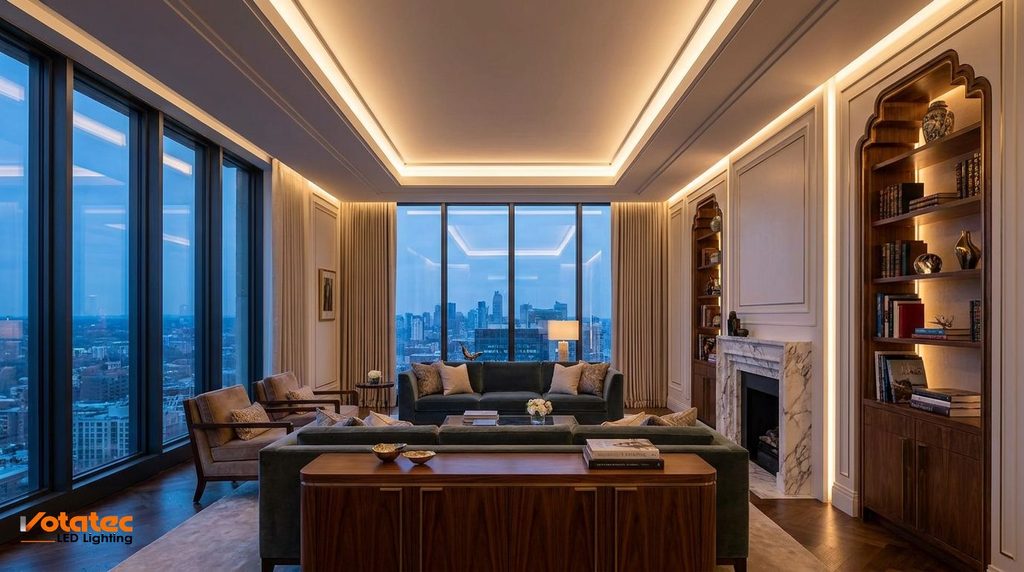
Cove lighting is indirect illumination from a light source hidden inside a ledge, recess, valance or crown moulding, aimed at the ceiling or an upper wall so the surface itself becomes what you see glowing. You never see the lamp. You see the light it throws.
That definition matters because it describes a technique, not a product. You can build ceiling cove lighting from LED tape, flexible neon rope, a linear strip fixture laid on its back, or a purpose-built cove luminaire. The technique stays the same. The spec sheet, the certification and the rebate eligibility change completely with the product you pick.
Recessed downlights and track lighting are the opposite. Both are products first. A downlight is a fixture set into the ceiling plane, throwing a defined beam down. Track lighting is a powered rail with movable heads. You buy the product, then decide where it goes.
Why the distinction changes your spec
Nobody hands you a photometric file for “the cove”. You get a file for the strip inside it, and the cove geometry then eats an unpredictable share of those lumens. A downlight’s IES file already accounts for trim and reflector, so the file is close to what you get. That’s why cove lighting projects get underlit and downlight projects rarely do.
The Three Lighting Layers, and Which Fixture Owns Each
Layered lighting is the framework that resolves most of these arguments before they start. Three layers, three jobs.
- Ambient layer. General light so people can move safely and read faces. Cove lighting is excellent here. So are recessed downlights on a wide spacing.
- Task layer. Measured light on a defined surface: a desk, a counter, a checkout. Recessed downlights own this. Cove lighting cannot deliver it.
- Accent layer. Light that makes something stand out, at three to five times the surrounding level. Track lighting owns this. LED cove lighting can grade a wall, but it can’t put a beam on a single object.
Sort the requirement into layers and the fixture mostly picks itself. Cove lighting is an ambient tool that happens to look architectural. Treat it as decoration and your light meter will surprise you.
The ratio worth knowing
Lighting practice suggests roughly a 1:3:10 relationship between ceiling, wall and task illuminance. If a desk sits at 500 lux, the walls want around 150 lux and the ceiling around 50 lux. Indirect systems also carry a ceiling uniformity limit: the recommendation for indirect fixtures is no more than an 8:1 contrast between the brightest and darkest points of the ceiling. That number is the single best test of whether cove lighting was designed or just installed. Scalloped hot spots above a cove mean the strip sat too close to the ceiling.
Where Cove Lighting Belongs
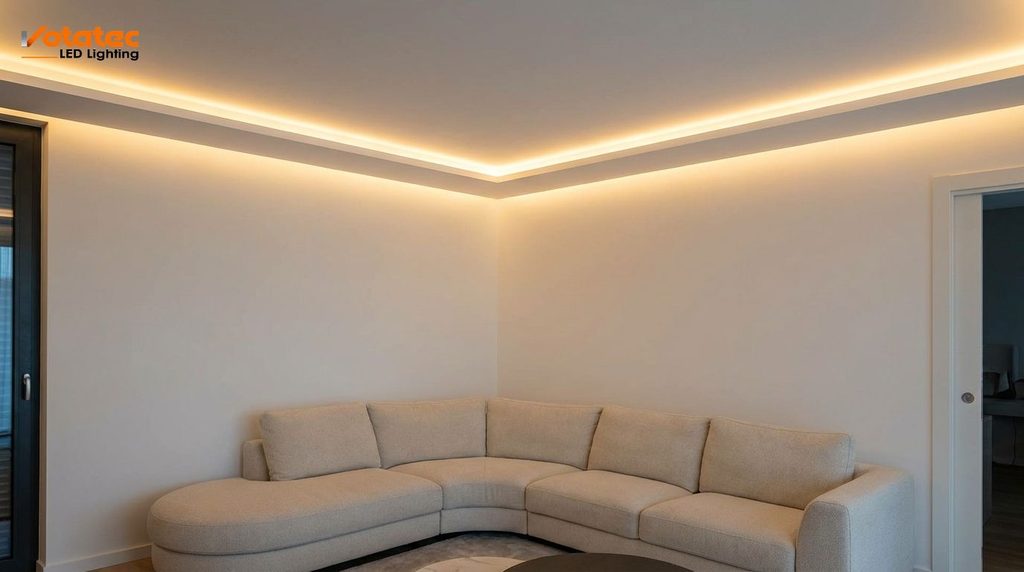
Cove lighting earns its place in spaces where people look up, where the ceiling is a design feature, and where nobody has to perform close work.
Strong candidates:
- Hotel and office lobbies. The perimeter cove reads as premium and hides the hardware. Good ceiling cove lighting here does the whole ambient job.
- Corridors. A continuous cove gives even brightness with no repeating glare bars overhead, which matters when the ceiling is what people stare at while walking.
- Boardrooms and training rooms. Cove lighting keeps ceiling brightness up while screens stay readable. Downlights alone create a cave effect around a projector.
- Tray ceilings and coffered ceilings. The recess already exists. Our deeper breakdown of that specific case sits in tray ceiling lighting compared.
- Retail perimeter walls. Cove lighting grades the wall, then track lighting picks out the merchandise.
Where cove lighting is the wrong answer:
- Ceilings under about 2.6 m. The bounce needs throw distance. A low ceiling turns cove lighting into a visible bright line.
- Any space with a measured task requirement. Machine shops, kitchens, labs, inspection benches.
- Warehouses and anything over roughly 6 m. Bounced light dies over distance and the ceiling is usually dark deck anyway.
- Wet or damp locations, unless the concealed product carries the listing itself. Dry-rated tape doesn’t become damp-rated by being hidden.
- Buildings with no scaffold access and a tight maintenance budget.
Where Recessed Downlights Belong
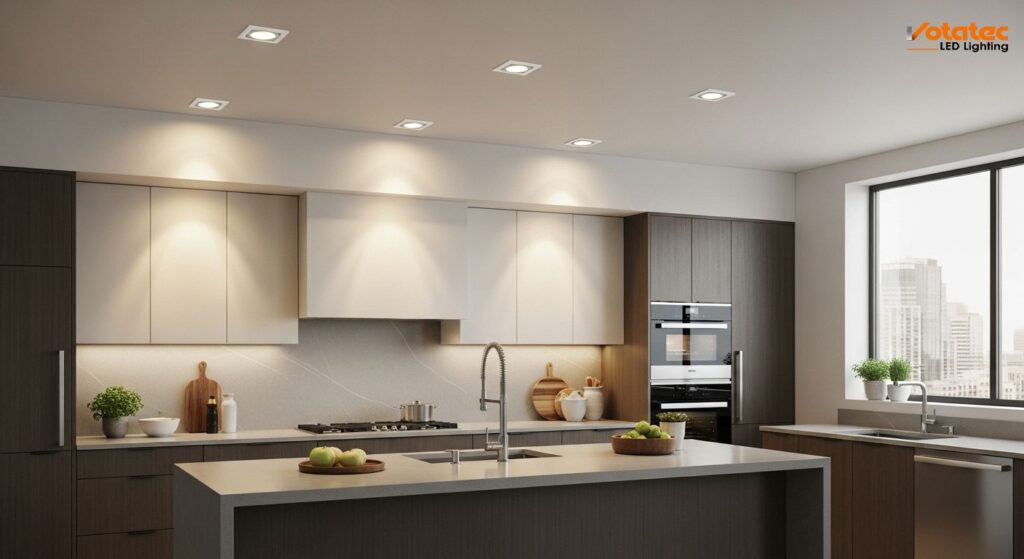
Recessed downlights are the workhorse. They put the most lumens on the floor per watt of the three, disappear into the ceiling plane, and their photometry is predictable enough to design against.
Use them when:
- You have a numeric illuminance target. Office desks, retail sales floors, classrooms, corridors with code minimums.
- The ceiling cavity allows it. Slim panels and wafer-style recessed downlights need only 40 to 60 mm, which is why they’ve largely replaced traditional cans in renovations. Check our trimless recessed downlights sizing guide before you commit to an aperture.
- You want a clean ceiling with nothing projecting below the plane.
- Maintenance access has to be quick. A trim drops from below in under a minute.
Where they struggle: used alone they create the “cave effect”, because all the light goes down and the walls and ceiling stay dark. That’s the exact deficiency cove lighting fixes, which is why the two pair so well. Downlights also carry glare risk under the aperture, and a fixed one can’t follow a display that moves next quarter.
If you’re new to the category, what is a recessed downlight covers housings, IC ratings and the pot light naming question that trips up Canadian buyers. For aimable versions, gimbal recessed lights sit halfway between a downlight and a track head. Browse the full range in the LED downlight category.
Where Track Lighting Belongs
Track lighting wins one argument outright: flexibility. Nothing else lets you move, add, remove or re-aim light after the ceiling closes.
Specify track lighting when:
- The target moves. Retail merchandising resets, gallery rotations, showroom layouts, seasonal displays.
- You need accent ratios. A 15 degree spot on a feature wall at four times ambient is a track head’s job, not a downlight’s.
- The ceiling is concrete, exposed deck or heritage plaster and cutting holes isn’t happening.
- Circuit count is limited and you want several heads off one feed.
Track lighting’s weakness is its own visibility. It’s exposed hardware, and aimed badly it produces the worst glare of the three. Rail systems also aren’t interchangeable, which is the most common return reason we see. Our H, J and L track comparison explains why a head from one system won’t seat in another, and how to choose track lighting walks through beam angles and finishes. The track lighting category carries the rails and heads.
The Efficiency Penalty Nobody Publishes About Cove Lighting
Here’s the part most cove lighting articles skip. Indirect light costs you lumens, and you can calculate roughly how many.
Every bounce multiplies by surface reflectance. A good white ceiling returns maybe 70 to 80% of what hits it, so a cove aimed at an 80% ceiling loses about 20% at the first bounce, before counting what the cove walls absorb, what the lip blocks and what never escapes the channel. Real coefficient of utilisation for a cove lighting run lands well below a downlight’s on the same ceiling.
Practical consequence: budget meaningfully more source lumens for cove lighting than for downlights at the same floor illuminance. A rough planning band for ambient ceiling cove lighting is 400 to 800 lumens per metre of run, but that’s a starting point for a photometric calculation, not a spec. It shifts with cove depth, ceiling height and ceiling colour.
Three design levers actually move that number:
- Ceiling reflectance. A dark or textured ceiling can gut a cove lighting design. Get the reflectance before you size anything.
- Setback from the ceiling. Too close and you get scallops. Roughly 100 to 150 mm of clearance above the source is a sane starting geometry.
- Lip height. The lip must hide the source from every normal sightline, and nothing more. Every extra millimetre of lip is lumens you paid for and threw away.
Natural Resources Canada puts lighting at about 13% of the energy used in a commercial or institutional building. Indirect systems spend a share of that heating a ceiling. Worth knowing before you run cove lighting down 200 m of corridor.
The Rebate Rule That Costs Canadian Projects Real Money
This is the finding that should change your spec, and almost nobody publishes it.
The DesignLights Consortium maintains the Qualified Products List that most North American utility rebate programmes gate incentives on. Under the Linear Ambient primary use designation, utilitarian strip-style fixtures are eligible. But the DLC’s own product eligibility page states plainly that products intended for cove lighting are not currently eligible. The same exclusion repeats under Linear Ambient Luminaires with Indirect Component.
LED tape and flexible strip aren’t on the eligible list at all, because the DLC qualifies complete luminaires, retrofit kits and replacement lamps. Tape is a component.
So the arithmetic runs like this. Build your ambient layer from cove lighting fed by LED tape and you claim nothing. Build the same lumens from a linear strip fixture and you’re usually in the rebate. On a large project that swing dwarfs the fixture price gap, and it’s the cheapest spec change available.
Two more dates for anyone holding V5.1 paperwork: 2026-10-09 is the deadline to submit applications updating V5.1 listings to V6.0, and on 2026-12-15 anything not updated gets delisted. Efficacy bars under V6.0 for indoor linear ambient product sit at 125 lm/W standard and 140 lm/W premium, so plenty of currently-premium product will land as standard. Our Canadian LED rebate guide tracks the provincial programmes.
None of this makes cove lighting a bad idea. It makes cove lighting a design expense rather than an energy-efficiency measure, a different line on a different budget. Say that out loud in the design meeting and you’ll skip an awkward conversation later.
The Four Constraints That Actually Decide Placement
Strip away aesthetics and the decision comes down to four questions. Answer them in order.
1. How deep is the ceiling cavity? Under 40 mm of usable plenum and recessed downlights are off the table without a surface-mount alternative. Cove lighting and track lighting don’t care, because both live below the ceiling plane.
2. Will the target move? Yes means track lighting, or gimbal downlights as a compromise. No means fixed downlights or cove lighting.
3. Is there a measured illuminance requirement on a surface? Yes means recessed downlights carry the load, with cove lighting as the softener. No means cove lighting can do the whole ambient job on its own.
4. Who services it in year six? Cove lighting on a 4 m lobby ceiling means scaffold or a lift. If the facility has neither, that spec carries a hidden operating cost. Track lighting is the easiest of the three to service, downlights next.
Room-by-Room: Which Belongs Where
| Space | Ambient | Accent or task | Skip |
|---|---|---|---|
| Hotel or office lobby | Cove lighting, perimeter | Track lighting on art, downlights at reception | Downlight-only grid |
| Open-plan office | Recessed downlights or linear | Cove lighting on the perimeter wall | Track lighting overhead |
| Corridor | Cove lighting, continuous | Downlights at doors and junctions | Track lighting |
| Retail sales floor | Recessed downlights | Track lighting on displays | Cove lighting as the only source |
| Boardroom | Cove lighting plus dimmed downlights | Downlight on the table | Undimmable anything |
| Gallery or showroom | Cove lighting for wash | Track lighting, full stop | Fixed downlights |
| Commercial kitchen | Sealed recessed or surface fixtures | Task lighting at stations | Cove lighting |
| Residential tray ceiling | Cove lighting in the tray | Downlights on the flat | Both at full output |
| Warehouse | High bay | none | Cove lighting, downlights |
| Washroom | Downlights | Cove lighting above the vanity mirror | Bare aperture over the mirror |
Canadian Code and Certification: What Applies to All Three
Three rules cover every fixture here, cove lighting included.
Certification isn’t optional, and CE doesn’t count. Ontario Electrical Safety Code Rules 2-022 and 2-024 require equipment to be approved to a recognised Canadian standard by an SCC-accredited body before it can lawfully be advertised, sold or used. The CE mark is a manufacturer’s self-declaration and isn’t recognised here. The Electrical Safety Authority publishes the list of recognised certification marks. This bites hardest on cove lighting, because concealed tape from an overseas marketplace is the most commonly uncertified product in a Canadian ceiling. Hidden doesn’t mean exempt.
Your cove counts against the energy budget. The National Energy Code of Canada for Buildings sets interior lighting power density limits by space type. Connected load is connected load. Decorative cove lighting draws on the same allowance as the downlights, which surprises design teams who filed the cove under millwork.
Controls requirements follow the space, not the fixture. NECB 2020 Article 4.2.2.1 wants at least one readily accessible manual control per area, automatic shut-off within 20 minutes in the applicable space types with each device covering no more than 50 m2, and bi-level control offering an intermediate step between 30% and 70% of full power. Cove lighting has to dim to satisfy that, and plenty of low-cost tape doesn’t dim at all. Check the driver, not the marketing.
Spec Checklist Before You Order
Run this before any cove lighting purchase order goes out.
- Location listing on the actual concealed product: dry, damp or wet. Not the assumption.
- Certification mark from an SCC-accredited body, verified against the ESA list.
- Lumens per metre, and whether that figure is measured or calculated from watts times efficacy.
- CRI, and R9 if colour matters. Ra above 90 with R9 above 50 for skin tones, food or merchandise.
- Binning tolerance. Three-step MacAdam or tighter, or your continuous cove lighting run will shift colour visibly along its length.
- Dimming protocol and named tested dimmers. 0-10V for commercial, and confirm the minimum dim level against the NECB bi-level requirement.
- Voltage. Canadian commercial buildings run 347V more often than buyers expect. Check the driver range.
- Cove geometry drawing with source setback and lip height dimensioned.
- Rebate position confirmed in writing before you count it in the payback.
For linear options that satisfy both the look and the QPL question, the architectural linear LED lighting and linear strip fixture ranges are the two to compare. If flexible product is genuinely the right call, the strip light category carries wet-rated neon rope, and cutting LED strip correctly covers the field modification question.
Five Mistakes That Ruin Cove Lighting Installations
- Treating cove lighting as the only ambient source in a task space. It bounces beautifully and measures poorly. Pair it.
- Mounting the source too close to the ceiling. Scallops. Every time. Give it 100 to 150 mm.
- Mixing CCT between the cove and the downlights. A 3000K cove above 4000K downlights reads as a mistake, not a mood.
- Ignoring the rebate exclusion. Budgeting an incentive that the DLC eligibility rules already ruled out.
- No maintenance plan. Nobody costs the lift until the driver fails in year four.
Frequently Asked Questions About Cove Lighting
Is cove lighting a good idea?
Cove lighting is a good idea when you want soft, glare-free ambient light and the ceiling height supports the bounce. It’s a poor idea as a room’s only light source in any space with a measured task requirement, and it’s a poor idea if maintenance access is hard. Best practice is cove lighting for the ambient layer plus downlights or track lighting for task and accent work.
What is the difference between cove lighting and LED strip lights?
Cove lighting is the technique. LED strip is one of several products that can create it. You can build cove lighting from LED tape, flexible neon rope, a linear strip fixture or a purpose-built cove luminaire, and the result is still cove lighting. Confusing the two causes real errors: buyers assume any strip suits a cove, then discover their tape is dry-rated, uncertified in Canada, or won’t dim to the level the energy code requires.
Are LED strip lights good for cove lighting?
Good-quality LED tape works well in a cove, provided you check four things: the location listing matches the space, the product carries a certification mark from an SCC-accredited body, the binning is three-step MacAdam or tighter so colour stays consistent along the run, and the driver dims. What tape can’t do is qualify for a DLC-based utility rebate, because the DLC lists complete luminaires and tape is a component.
What is the best type of light for cove lighting?
For commercial work, a linear fixture with a defined photometric file usually beats tape, because you can design against real numbers and it can qualify for rebates. For residential and light commercial, high-CRI tape in an aluminum channel with a diffuser gives a smoother line at lower cost. Pick warm CCT around 2700K to 3000K for hospitality, and 3500K to 4000K where the cove sits alongside neutral downlights.
Which is better, cove lighting or recessed downlights?
Neither, because they solve different problems. Recessed downlights put measured light on a surface and cove lighting makes a room feel bright without visible glare. If you must pick one, pick downlights for anywhere with a numeric illuminance requirement and cove lighting for lobbies, corridors and feature ceilings where nobody performs close work. The strongest designs use both, with the cove carrying ambient and the downlights carrying task.
The Bottom Line
Cove lighting, recessed downlights and track lighting aren’t rivals. They’re three answers to three different questions.
- Cove lighting for ambient light with no visible source. Lobbies, corridors, boardrooms, tray ceilings.
- Recessed downlights for measured light on a surface. Offices, retail floors, task areas.
- Track lighting for anything that will be re-aimed. Galleries, displays, showrooms.
Decide with the four constraints: cavity depth, aiming requirement, measured illuminance target and maintenance access. Then check the rebate position before you count the incentive, because cove lighting sits outside DLC eligibility and that’s the one line item people get wrong.
Speccing a project across all three layers? Talk to our technical team with your ceiling section and space type, and we’ll come back with the fixture families that fit and the ones that don’t. Quotes inside 24 hours.