













 (+1) 905 597 5955



Short answer: in the aluminum vs copper wire decision, copper is the default for small branch circuits, the 15 A and 20 A lighting and receptacle circuits. It conducts better, takes up less space and forgives a sloppy termination. Aluminum is the standard choice for feeders, service entrances and long, heavy runs, because it’s about half the weight and far cheaper per amp. It has to be about two AWG sizes larger to do the same job. Modern aluminum building wire made from AA-8000 series alloy is legal and safe in Canada when it lands on lugs and devices rated for aluminum. The fire problems people remember trace back to 1960s and 70s branch-circuit wiring on copper-only devices.
That’s the whole debate in one paragraph. The rest of this guide covers the numbers behind the aluminum vs copper wire choice: sizing, 2026 metal prices, safety history, the code, and which Canadian cable types belong where.
Updated: 2026-10-07 · Read time: about 12 minutes
Aluminum vs Copper Wire at a Glance
Here’s the aluminum vs copper wire comparison most buyers actually need, in one table.
| Factor | Copper | Aluminum (AA-8000 alloy) |
|---|---|---|
| Conductivity | 100% IACS (the benchmark) | About 61% of copper |
| Size for the same load | Smaller | About 2 AWG sizes larger |
| Weight for the same load | Heavier | About half the weight of copper |
| Thermal expansion | Lower | About 40% higher than copper |
| Surface oxide | Not a connection problem in normal use | Non-conductive oxide; needs proper terminations |
| Metal cost per amp (2026-10-07 prices) | Baseline | Roughly one-tenth of copper’s metal cost |
| Typical home | 15 A and 20 A branch circuits, small appliances | Sub-panel feeders, service entrance, large loads |
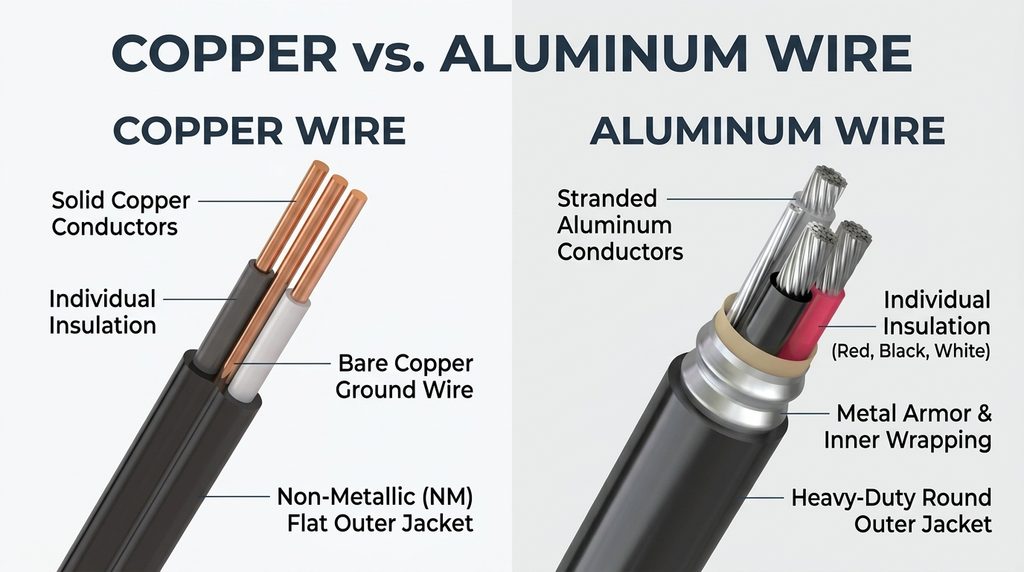
| Typical Canadian cable types | NMWU, AC90, TECK90, SOOW, LVT | NMD90 (aluminum), RW90, ACWU90 |
Simple rule: copper for the small stuff, aluminum for the big stuff. Not always. But usually.
How Do Copper and Aluminum Conductors Differ?
The physics drives everything else in the aluminum vs copper wire debate, so it’s worth five minutes.
Conductivity and Resistance
Copper is the reference metal for conductivity, rated at 100% on the International Annealed Copper Standard (IACS). Aluminum conductor alloys come in at about 61%. So, at the same cross-section, aluminum has about 1.64 times the resistance of copper.
More resistance means more heat at a given current. To carry the same load at the same temperature, the aluminum conductor needs more metal. That’s why the aluminum size is always larger in any aluminum vs copper wire size chart.
Weight and Handling
Here’s where aluminum wins big. Aluminum’s density is about 2.70 g/cm³. Copper’s is about 8.96 g/cm³. Even after you upsize aluminum to match copper’s conductance, the aluminum conductor weighs about half as much.
On a 300 metre reel of 4/0, that’s the difference between one person moving it and two. It also means lighter pulls, less strain on supports and cheaper shipping. Ask anyone who’s hand-pulled heavy copper feeder up three floors.
Expansion, Creep and Oxide: Why Terminations Matter
Three properties make aluminum fussier at the connection point:
- Thermal expansion. Aluminum grows and shrinks about 40% more than copper as it heats and cools. Under a screw that wasn’t designed for it, every load cycle loosens the joint a little.
- Creep (cold flow). Under steady clamping pressure, older aluminum alloys slowly deformed away from the screw. Less pressure, more resistance, more heat.
- Oxide. Aluminum grows a thin oxide skin within seconds of being stripped. That oxide doesn’t conduct well. Copper’s oxide doesn’t cause the same trouble.
And there’s galvanic corrosion: put bare aluminum against copper or brass in a damp spot and the joint slowly eats itself.
None of this makes aluminum dangerous. It makes the termination the part that matters. Get the lug, the torque and the alloy right, and an aluminum feeder runs cool for decades.
Aluminum vs Copper Wire Size: How Much Bigger Does Aluminum Need to Be?
Because aluminum carries about 61% of copper’s conductivity, it needs about 1.6 times the cross-sectional area. In AWG terms, that works out to roughly two sizes larger. Here are the common substitutions on Canadian jobs:
| Copper size | Typical aluminum size | Common use |
|---|---|---|
| #8 AWG | #6 AWG | Small sub-panel, range, dryer |
| #6 AWG | #4 AWG | 60 A sub-panel, EV charger feeder |
| #4 AWG | #2 AWG | Larger sub-panel |
| #3 AWG | #1 AWG | 100 A feeder or service |
| #2 AWG | 1/0 AWG | Heavier feeder |
| #1 AWG | 2/0 AWG | Commercial feeder |
| 1/0 AWG | 3/0 AWG | Commercial feeder |
| 2/0 AWG | 4/0 AWG | 200 A class service conductors |
| 4/0 AWG | 300 kcmil | Large service or main feeder |
Treat this table as a starting point, not an answer. It’s based on conductor resistance. The legal size comes from the code.
Ampacity Tables Get the Final Word
In Canada, conductor ampacity comes from the Canadian Electrical Code, Part I (CSA C22.1). Table 2 covers copper and Table 4 covers aluminum for conductors in raceway or cable. Your provincial code, like Ontario’s OESC, adopts it with local amendments.
Three things move the final size away from a rule of thumb:
- Termination temperature. A #2 aluminum conductor is listed in Table 4 at 75 A (60°C column), 90 A (75°C) and 100 A (90°C). You’re limited by the lowest-rated part of the circuit, which is usually the breaker or lug, not the 90°C cable.
- Derating. More than three current-carrying conductors together, or a hot attic or rooftop, and the allowable ampacity drops.
- Voltage drop. On long runs, voltage drop (CEC Rule 8-102) often decides the size before ampacity does. Aluminum’s higher resistance makes that happen sooner.
So a run that’s fine on #4 aluminum at 15 metres may need #2 at 60 metres. Do the voltage-drop calculation every time.
Conduit Fill and Lugs
Bigger conductors take more room. Switching a copper feeder to aluminum can push you up a conduit trade size, which eats some of the savings. Check the lugs too. Breakers and panel lugs are marked for what they accept (often “AL/CU” or “AL9CU”). A lug sized for 2/0 copper might not accept the 4/0 aluminum that replaces it.
Aluminum vs Copper Wire Cost in 2026: Why Aluminum Wins on Big Runs
Metal prices explain why aluminum owns the large-conductor market. On 2026-10-07, Trading Economics showed copper at US$6.61/lb, about US$14.6K per tonne. Aluminum sat near US$3.1K per tonne.
Per kilogram, copper costs about 4.7 times as much. Factor in that aluminum needs only about half the weight for the same conductance, and the raw metal cost per amp is roughly one-tenth of copper’s. Big gap.
But finished cable isn’t just metal. Insulation, armour, jacket and manufacturing cost about the same (or a bit more, since aluminum cable is physically bigger). So the gap on a finished cable price is smaller than one-tenth. It’s still large on feeder sizes, and it widens as the conductor gets bigger. On #12 and #14 circuits, the metal is a small slice of the total cost, so the savings mostly disappear.
Other cost factors people forget:
- Labour. Lighter reels and easier pulls save time on long feeders. Extra care at terminations costs a little back.
- Hardware. Aluminum-rated lugs, connectors and anti-oxidant compound where the maker calls for it.
- Theft. Copper on an open job site walks. Aluminum is a much less tempting target.
- Price swings. Copper prices have been volatile through 2026. If you’re quoting a large job weeks ahead, aluminum’s lower base price shrinks your exposure.
There’s a Canadian angle too. According to Natural Resources Canada, Canadian smelters produced about 3.3M tonnes of primary aluminum in 2024. That makes Canada the world’s fourth-largest producer, with one of the lowest carbon footprints thanks to hydroelectric power.
Votatec doesn’t publish prices because we quote B2B by project. If you’re pricing a feeder in both metals, send us your takeoff and we’ll quote both.
Is Aluminum Wire Safe? What Went Wrong in the 1960s and 70s
This is the part of the aluminum vs copper wire story that worries building owners. Most of aluminum’s bad reputation comes from one era and one use.
When copper got scarce and expensive in the mid-1960s, builders started using aluminum for ordinary 15 A and 20 A branch circuits, the kind feeding outlets and light switches. The conductor was an older utility-grade alloy, AA-1350, and it landed on devices designed for copper.
The results were bad. Research done for the U.S. Consumer Product Safety Commission looked at homes built before 1972. Those wired with aluminum were 55 times more likely to have at least one outlet connection reach “Fire Hazard Conditions” than homes wired with copper (CPSC, Repairing Aluminum Wiring).
Old AA-1350 vs Modern AA-8000 Alloys
The industry fixed the metal. The first AA-8000 series conductor alloy was patented in 1972, and others followed through the 1970s. These alloys behave much more like copper mechanically: they creep far less and hold their strength through heat cycling. Termination devices changed too, with CO/ALR-rated switches and receptacles and connectors listed for aluminum.
Today’s Canadian aluminum building wire uses AA-8000 series alloy. That’s what’s inside Votatec’s NMD90 aluminum building cable, RW90 aluminum building wire and ACWU90 armoured cable.
So the honest answer to “is aluminum wire safe?” is: the modern alloy, at modern feeder sizes, on aluminum-rated terminations, has a solid track record. Old AA-1350 branch wiring on copper-only devices is a different story.
What If Your Building Has Older Aluminum Wiring?
Don’t panic, and don’t DIY it. Ontario’s Electrical Safety Authority says homes built between the mid-1960s and late 1970s may have aluminum wiring. It recommends a Licensed Electrical Contractor assess it, make repairs and have the work inspected. Some insurers won’t cover or renew a policy without that ESA inspection and a Certificate of Acceptance.
The common fixes, per the CPSC:
- Rewire with copper (most expensive, most permanent).
- Pigtail with COPALUM crimp connectors, installed only by trained electricians with the dedicated tool.
- Pigtail with AlumiConn-style connectors, listed by CPSC as an acceptable alternative.
Every connection counts, including outlets, switches, fixtures and panel terminations, not just the obvious ones.
Is Aluminum Wiring Legal in Canada?
Yes. The ESA states plainly that the Ontario Electrical Safety Code permits aluminum wiring. It adds that aluminum is safe when proper connections and terminations are made without damaging the wire, and that it’s widely used for commercial and industrial feeders. The CEC addresses termination and splicing of aluminum conductors in Rule 12-118.
In practice, that means:
- Use only devices and connectors marked for aluminum (AL/CU, CO/ALR, or listed for the conductor).
- Follow the device maker’s instructions, including torque values and whether anti-oxidant compound is needed.
- Don’t nick or ring the conductor when stripping.
Check your provincial code and your inspection authority, because local rules and amendments vary.
Where Each Belongs: Copper vs Aluminum Wire by Application
This is the part most aluminum vs copper wire articles skip. Here’s how the choice usually plays out on Canadian jobs.
| Application | Usual choice | Why |
|---|---|---|
| 15 A and 20 A branch circuits (lighting, receptacles) | Copper | Small sizes, lots of device terminations, little cost advantage for aluminum |
| Low-voltage lighting, thermostats, controls | Copper | Tiny conductors, many splices |
| Ranges, dryers, small sub-panels (#8 to #6 class) | Either | Cost-sensitive; aluminum works on rated terminals |
| Sub-panel and building feeders | Aluminum | Big conductors, real savings, lighter pulls |
| Residential and commercial service entrance | Aluminum | Industry standard at these sizes |
| Long outdoor runs, direct burial, detached garages | Aluminum (armoured or RW90 in conduit) | Cost and weight on long runs; size for voltage drop |
| Portable equipment, cords, motors with vibration | Copper | Flexibility and fatigue resistance |
| Industrial plants, heavy feeders | Both | Copper where space is tight, aluminum where the run is long |
Notice the split in our own catalogue. Votatec’s copper cables mostly stop at #6, while the aluminum cables mostly start there. That’s not an accident. It’s where the economics flip.
Copper Cable Types (and When to Pick Them)
- NMWU building cable: non-metallic sheathed copper in 14/2 and 12/2, for wet and underground general wiring.
- AC90 armoured cable: copper conductors in aluminum interlocked armour, #14 to #8, for commercial branch circuits.
- TECK90 industrial cable: copper with PVC inner and outer jackets over armour, #14 to #6, for industrial and commercial power.
- SOOW industrial cable: flexible copper cord for portable equipment.
- LVT building cable: copper low-voltage cable for thermostats and controls.
Aluminum Cable Types (and When to Pick Them)
- NMD90 aluminum building cable: AA-8000 conductor in a PVC sheath, #6, #4 and #2 3-conductor, for residential feeders and sub-panels.
- RW90 aluminum building wire: single-conductor XLPE wire, #2 up to 250 kcmil, for feeders and services in conduit.
- ACWU90 armoured cable: aluminum conductors in interlocked armour with a PVC jacket, 6/3 up to 250 MCM, for heavy feeders and outdoor runs.
You can see every option on our wire and cable category page, alongside wiring devices for the rest of the job.
Canadian cold tip: check the minimum installation temperature on the spec sheet before a winter pull. Ratings vary by cable type and maker, and a cable pulled below its rating can crack.
Aluminum vs Copper Wire for EV Chargers, Garages and Parking Lot Lighting
Three jobs bring up the aluminum vs copper wire question more than any others in Canada right now.
EV chargers. A Level 2 charger on a 60 A circuit is a common install. CEC Table 4 lists #4 aluminum at 65 A in the 75°C column, so #4 aluminum on 75°C-rated terminals is a common pairing, with #6 copper as the usual alternative. Check the charger’s own terminal rating first. Some only accept copper.
Detached garages and shops. These runs are often 20 to 50 metres, sometimes buried. Here voltage drop usually sets the size, and aluminum’s lower cost per amp lets you upsize for drop without blowing the budget. Armoured ACWU90 or RW90 in conduit are the usual picks.
Parking lot and site lighting. Long home runs to pole lights are classic aluminum vs copper wire territory. LED fixtures draw far less current than the metal halide they replace, so a retrofit can often reuse existing feeders. New runs are still sized for voltage drop over distance. Our LED parking lot lighting page and the outdoor area lighting spec guide cover the fixture side.
Installation Checklist for Aluminum Conductors
Most aluminum failures happen at the connection. Here’s a simple checklist:
- Confirm the alloy. Building wire should be AA-8000 series. It’s printed on the jacket or the spec sheet.
- Check every termination rating. Breakers, lugs, splices and devices must be marked for aluminum.
- Strip cleanly. Don’t nick the strands. A nick is a hot spot waiting to happen.
- Use compound where required. If the lug or connector maker calls for anti-oxidant compound, use it. Some pre-filled connectors already have it.
- Torque to spec. Use a torque screwdriver or wrench. “Good and tight” isn’t a number.
- Separate dissimilar metals. Use connectors listed for aluminum-to-copper joints. Never twist the two together under a standard wire nut.
- Size for voltage drop. Especially on long feeders to garages, outbuildings and parking lot lighting.
- Get it inspected. File the permit or notification with your inspection authority.
Want the protective side of the circuit covered too? Our guide to AFCI vs GFCI protection explains which breaker or device each circuit needs, and what a GFCI outlet actually does.
Common Mistakes When Choosing Copper vs Aluminum Wire
A few errors come up again and again:
- Copying a US chart. Many charts online come from the US National Electrical Code. Canadian sizing comes from CEC Tables 2 and 4 plus your provincial amendments.
- Swapping metals without checking the lug. The upsized aluminum conductor has to fit the terminal.
- Using the 90°C column. Cable rated 90°C doesn’t mean the breaker is. Size to the lowest-rated part of the circuit.
- Ignoring voltage drop. On a 50 metre run, voltage drop beats ampacity almost every time.
- Treating all aluminum as old aluminum. Modern AA-8000 feeder cable isn’t 1968 branch wiring.
- Saving money on #14. At small sizes, aluminum saves almost nothing and adds risk at dozens of device terminations.
Frequently Asked Questions
Is aluminum wire better than copper wire?
In the aluminum vs copper wire matchup, neither wins everywhere. Copper conducts better, takes less space and is more forgiving at terminations, so it’s better for small branch circuits. Aluminum is lighter and much cheaper per amp, so it’s better for feeders, services and long runs. Pick based on conductor size and application, not on reputation.
How much bigger does aluminum wire need to be than copper?
About two AWG sizes larger for the same load. Aluminum has about 61% of copper’s conductivity, so it needs roughly 1.6 times the cross-section. #3 copper is commonly replaced with #1 aluminum, and 2/0 copper with 4/0 aluminum. Always confirm the final size with CEC Table 4, termination temperature, derating and voltage drop.
Is aluminum wiring legal in Canada?
Yes. Ontario’s Electrical Safety Authority confirms the OESC permits aluminum wiring and that it’s widely used for commercial and industrial feeders. It must terminate on devices and connectors approved for aluminum and be installed to the code and the maker’s instructions. Other provinces follow the Canadian Electrical Code with their own amendments.
Can I get home insurance with aluminum wiring?
Often yes, but it depends on the insurer. Some won’t insure or renew a home with older aluminum branch wiring until a Licensed Electrical Contractor assesses and repairs it. In Ontario, ESA then inspects the work and issues a Certificate of Acceptance. Ask your insurer for their exact requirements before you buy or renew.
Why do power companies and service entrances use aluminum?
Weight and cost. At large conductor sizes, aluminum gives the same conductance as copper at about half the weight and a fraction of the metal cost. That matters on overhead lines, long feeders and service conductors. The larger diameter is easy to accommodate at those sizes, and modern alloys and rated lugs make the connections reliable.
Bottom Line: Which Wire Should You Use?
The aluminum vs copper wire question has a fairly clean answer in Canada:
- Copper for branch circuits, devices, controls and flexible cords.
- Aluminum (AA-8000) for feeders, service entrances and long, heavy runs, sized about two AWG sizes up and confirmed against CEC Table 4.
- Terminations decide safety. Aluminum-rated lugs and devices, clean stripping and correct torque.
- Older aluminum branch wiring needs a licensed contractor’s assessment, not a panic rewire.
Pricing a project? Votatec stocks both copper and aluminum building and industrial cable across Canada. Request a quote with your sizes and lengths, or browse more guides on the Votatec blog.