











 (+1) 905 597 5955


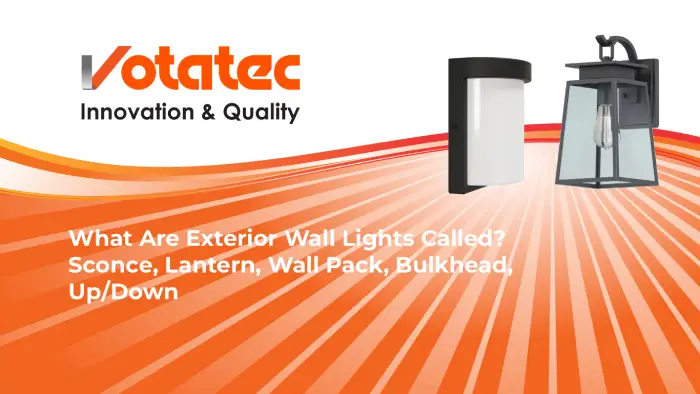

Exterior wall lights usually go by one of five names: sconce, lantern, wall pack, bulkhead or up/down light. A sconce is a decorative fixture that washes the wall. A lantern is a traditional enclosed fixture with glass, often holding a bulb. A wall pack is a high-output commercial fixture built to light the ground around a building. A bulkhead is a sealed, impact-resistant fixture (the word is mostly British). An up/down light throws two beams, one up the wall and one down.
That’s the short answer. The longer one matters more, because these names aren’t just vocabulary. Each one points to a different job, a different light output and a different set of rules. Pick the wrong name on a quote request and you’ll get the wrong fixture.
So let’s sort them out properly.
Why Exterior Wall Lights Have So Many Names
Here’s the thing. Most exterior wall lights are named by whoever sells them, not by whoever buys them.
A decor retailer calls a fixture a “sconce” because that sounds like home design. A factory catalogue calls the same fixture a “wall light” because that’s what the mould is. An electrical distributor calls a bigger version a “wall pack” because that’s what contractors search for. A UK supplier calls a sealed oval fixture a “bulkhead,” and a Canadian contractor calls it a “jelly jar” or a “vapour tight.”
Same wall. Same exterior wall lights. Different words.
Our own catalogue is a fair example. One family of exterior wall lights on votatec.ca is filed in the outdoor wall light category, carries “wall light” in the product title and is tagged “LED wall pack light.” Three names for one fixture. That’s how easily the language drifts.
There are also two kinds of buyers looking at exterior wall lights, and they use different words:
- Homeowners and designers search “outdoor wall sconce,” “porch light” and “wall lantern.” They’re buying a look.
- Contractors and facility managers search “wall pack,” “full cutoff” and “vapour tight.” They’re buying a light level and a code sign-off.
Neither group is wrong. But if you’re writing a spec for exterior wall lights, the trade name is the one that gets you the right fixture.

Quick Comparison: The 5 Main Types of Exterior Wall Lights
Here are all five types of exterior wall lights in one table.
| Name | What it does | Typical use | Light direction | Typical output |
|---|---|---|---|---|
| Sconce | Decorates and marks an entrance | Doors, patios, storefronts | Soft glow, often diffused | Low |
| Lantern | Traditional look, enclosed glass | Porches, heritage buildings, entries | All around | Low |
| Wall pack | Lights the ground around a building | Loading docks, parking edges, perimeters | Forward and down | High |
| Bulkhead | Sealed, tough general lighting | Stairwells, service doors, tunnels, marine | Diffused, forward | Low to medium |
| Up/down | Accent light on the façade | Columns, entrances, architectural walls | Two beams, up and down | Low to medium |
Notice the jump in the “Typical output” column. That’s the big divide in exterior wall lights. Sconces, lanterns and up/down lights are about how a building looks. Wall packs and bulkheads are about what a building needs.
What Is an Exterior Wall Sconce?
An exterior wall sconce is a decorative light fixture mounted flat to an outside wall, usually beside a door, that gives off a soft, diffused glow. It’s the most common name for residential and light-commercial exterior wall lights.
Sconce-style exterior wall lights come in every shape. Cylinders, flat discs, cubes, gooseneck barn lights. What they share is a modest light level. A sconce says “this is the door.” It doesn’t light a parking lot.
Where sconce-style exterior wall lights work best
- Main entrances and side doors
- Patios, decks and balconies
- Storefronts and restaurant façades
- Condo and townhouse corridors open to the weather
On the commercial side, these exterior wall lights show up on retail plazas, medical offices and multi-unit buildings. Our 8″ and 14″ LED wall lights are a good example: a clean round profile with a 3-way switch so you can set the colour temperature on site.
What to check on a sconce
The style gets the attention, but three specs decide whether exterior wall lights like these survive a Canadian winter:
- Wet location listing. Exterior wall lights that rain or snow can hit directly need a wet location listing, not just damp. A covered porch might only need damp.
- IP rating. IP65 is a solid baseline for exposed exterior wall lights. The International Electrotechnical Commission explains the IP code: the first digit is dust protection (6 means dust-tight), the second is water (5 means protected against water jets from any direction).
- Colour temperature. 2700K to 3000K reads warm and residential. 4000K reads clean and commercial. A selectable CCT fixture saves you from guessing.
Want the full breakdown of indoor vs outdoor sconce ratings? We covered it in sconce lighting: indoor vs outdoor, IP ratings and wattage.
What Is an Outdoor Wall Lantern?
An outdoor wall lantern is an enclosed fixture with glass panels and a frame, styled after old oil or gas lanterns, that usually takes a standard bulb. Lanterns are the traditional end of exterior wall lights. Think coach lights on a heritage home or a black steel lantern on a farmhouse.
Lanterns come in two mounting styles:
- Wall-mount (bracket) lanterns sit on an arm that holds the fixture off the wall.
- Hanging lanterns drop from a wall arm on a chain. They look great under a deep porch roof.
Most lantern exterior wall lights take a bulb rather than a built-in LED board. That’s a real upside: when the bulb fails, you swap the bulb, not the fixture.
Votatec’s RIO, SOL and MAR collections are lantern-style exterior wall lights. They’re steel, ETL-listed, and come in small, medium and large sizes, plus chain-hung versions for porches. The RIO sensor model adds a built-in motion sensor, which is handy at a side door where you don’t want the light running all night.
Lantern pitfalls
Honestly, lanterns are where buyers of exterior wall lights most often get caught out. Two things to watch:
- The bulb is the light source. A lantern rated for a 60W maximum doesn’t tell you how bright it’ll be. That depends on the LED bulb you put in it.
- Not all lantern exterior wall lights are wet-rated. Check the listing on each spec sheet. Damp-only fixtures belong under a roof.
Browse the full range of lanterns, sconces and decorative exterior wall lights in our outdoor wall light category.
What Is a Wall Pack Light?
A wall pack is a high-output commercial exterior wall light, usually a compact box-shaped fixture, mounted on the side of a building to light the ground, walkways and parking areas around it. If sconces are jewellery, wall packs are work boots.
You’ve seen them. Every warehouse, strip mall and loading dock in Canada has these exterior wall lights, typically mounted 3 to 6 metres up, throwing light forward and down.
This is where exterior wall lights get technical.
Types of wall packs
- Regular (forward-throw) wall pack. The classic box with a glass or polycarbonate lens on the front. Wide, bright spread. Some light escapes upward and sideways.
- Full cut-off wall pack. Shielded so no light goes above the horizontal. This is the one dark sky bylaws ask for.
- Mini wall pack. A smaller, lower-wattage version for doorways and pedestrian areas. Often comes with a photocell.
- Adjustable wall pack. The head tilts, so it works like a small flood light on a wall bracket.
Here’s how those break down in our own range of wall-mounted exterior wall lights:
| Votatec wall pack | Power | Distribution | CCT options | Notes |
|---|---|---|---|---|
| Full Cut-off Wall Pack | 60-120W selectable | Type III | 3000K, 4000K, 5000K | Photocell, IP65, 120-347V |
| Regular Wall Pack | 60-120W selectable | Type IV | 3500K, 4000K, 5000K | Photocell, IP65, 120-347V |
| Mini Wall Pack with Photocell | 18-30W selectable | 100° beam | 3500K, 4000K, 5000K | 2,160-3,600 lm, 120-347V |
| Adjustable Wall Pack | 30W, 50W, 80W models | Tilting head | 3000K, 4000K, 5000K | IP65, 120-347V |
The 120-347V input matters. Many Canadian commercial buildings run 347V lighting circuits, and exterior wall lights that only accept 120-277V (a common US range) won’t work on them without a step-down transformer.
Wall packs and dark sky bylaws
This is where exterior wall lights run into the law, and almost no guide to exterior wall lights mentions it.
A growing number of Ontario municipalities regulate outdoor lighting. The Town of Gravenhurst’s outdoor illumination by-law states plainly that all new wall-mounted commercial lighting shall be full cut-off fixtures. It also defines a wall pack as a flood light fixture on an exterior building wall. Read that twice. A bylaw that restricts flood lights may be restricting your exterior wall lights too.
The Town of Huntsville’s outdoor lighting by-law goes further and caps commercial and industrial security lighting below 2,000 lumens. That’s smaller than most wall packs on the market, including our own mini wall pack at its lowest setting (2,160 lm). In a municipality like that, a wall pack may be the wrong answer. Shielded, lower-output exterior wall lights could be the right one.
Two practical rules from this:
- Full cut-off + 3000K is the safest combination for commercial exterior wall lights under a bylaw. Only the full cut-off model in our wall pack range offers 3000K.
- Don’t tilt a full cut-off fixture. Gravenhurst’s definition requires it to be installed horizontally as designed. Angle it up and it stops being full cut-off.
We go deeper on fixture choice and bylaw compliance in wall pack or area light? A dark sky bylaw guide, and on wall packs versus floods in LED wall pack vs flood light. The full range lives in our LED wall pack lights category.
What Is a Bulkhead Light?
A bulkhead light is a sealed, impact-resistant wall or ceiling fixture with a tough lens, often oval or round, sometimes protected by a cage or grille. The name comes from ships, where these fixtures lit the bulkheads (internal walls) and had to survive water, vibration and knocks.
It’s a mostly British and Irish term. Search “bulkhead light” from Canada and most results are UK retailers. In North America, these exterior wall lights usually go by:
- Jelly jar light, the caged glass globe you see over service doors and in parking garages
- Vapour tight fixture, the sealed linear or round version used in wet, dusty or washdown areas
- Vandal-resistant wall light, when the selling point is impact resistance
- Utility wall light, in contractor shorthand
Bulkheads sit in the middle of exterior wall lights. They aren’t decorative like a sconce or high-output like a wall pack. They’re the dependable exterior wall lights over the back door, in the stairwell or by the garbage enclosure. Places where a fixture gets hit, splashed or ignored for years.
Our caged vapour-proof wall mount fixture is a textbook North American bulkhead: die-cast aluminium body, die-cast guard, frosted glass lens, wet location listing and a standard E26 base. For linear and higher-output sealed fixtures, see the vapour tight light fixture category.
If a UK spec or overseas drawing says “bulkhead,” we wrote a full translation guide: what is a bulkhead light?

What Is an Up/Down Wall Light?
An up/down wall light is one of the exterior wall lights, usually a cylinder or square box, that emits two beams: one up the wall and one down toward the ground. The result is two clean stripes of light on the façade, which is why architects love them.
Up/down exterior wall lights are accent lighting first. They frame columns, mark entrances and add rhythm along a long wall. They also put enough light at the door to do double duty at an entrance.
Up/down specs that matter
- Beam angle. Narrow beams make sharp, tall stripes. Wide beams make soft fans of light. Our Up/Down Cylinder Wall Light uses a 60° beam, which is a middle ground.
- Power. It’s selectable at 10W, 20W or 30W, so one SKU covers a low-key residential entry and a bright commercial column.
- Voltage and rating. 120-347V input and IP65 make it usable on commercial circuits and exposed walls.
- Spacing. Space up/down exterior wall lights so the beams read as a pattern. Mock up two before ordering twenty.
One honest caution. Up/down exterior wall lights send light upward by design. In a strict dark sky municipality, uplighting may be restricted, so check the local bylaw before you specify them on a commercial job.
For design ideas, see why cylinder outdoor wall lights are trending.
Other Names You’ll Hear for Exterior Wall Lights
The five names above cover most exterior wall lights. But you’ll run into a few more, and they’re worth knowing:
- Porch light. Any of the exterior wall lights by a front door. It describes the location, not the fixture.
- Barn light / gooseneck. A shade on a curved arm. Popular on signage and farmhouse-style buildings.
- Security light. Usually a flood or wall pack, often with a motion sensor. Describes the purpose.
- Dusk-to-dawn light. Any fixture with a photocell that turns on at dark and off at daylight, like our mini wall pack with photocell.
- Step light / brick light. Small recessed fixtures set low into a wall to light stairs. We cover those in how to choose stair wall lights.
See the pattern? Some names for exterior wall lights describe the shape (lantern, cylinder, bulkhead). Some describe the job (security, dusk-to-dawn). Some describe the location (porch, step). That’s why one fixture can carry three names.
How to Choose the Right Type of Exterior Wall Lights
Knowing the names is step one. Picking the right exterior wall lights for a building is step two. Work through these questions in order.
1. What’s the job: looks or light level?
Marking an entrance? Choose sconce, lantern or up/down exterior wall lights. Lighting a parking edge or loading area well enough to see faces and plates? You want a wall pack. A service door or wet, rough area? Look at a bulkhead or vapour tight fixture.
2. How high will it mount?
Decorative exterior wall lights generally sit around eye level beside a door. Wall packs go much higher, often 3 to 6 metres. Mounting high-output exterior wall lights at door height is a classic mistake. They blind people instead of lighting the ground.
3. What does the bylaw say?
Check the municipality before you order exterior wall lights. A dark sky bylaw likely means full cut-off fixtures, 3000K or warmer, and possibly a lumen cap. The RASC Canadian Guidelines for Outdoor Lighting is a useful reference for what these bylaws tend to ask for.
4. Is it a wet location?
Most exposed exterior wall lights need a wet location listing. Look for a recognised certification mark (CSA, cUL or cETL) on the fixture and the spec sheet, not just a claim in the product description.
5. What voltage is on site?
For commercial exterior wall lights in Canada, confirm whether the circuit is 120V, 208V, 277V or 347V. A 120-347V universal driver covers all of them.
6. How should your exterior wall lights switch?
- Photocell for dusk-to-dawn operation on perimeters
- Motion sensor for side doors and low-traffic areas (and if one ever needs overriding, here’s how to turn off a motion detector light)
- Timer or building automation for after-hours setbacks on commercial sites
Pretty simple once you’ve got the names of exterior wall lights straight.
Common Mistakes When Buying Exterior Wall Lights
We see the same handful of errors on exterior wall lights again and again:
- Buying decorative exterior wall lights to do a wall pack’s job. A 15W sconce won’t light a parking area, no matter how many you mount.
- Buying a wall pack for a residential entrance. Way too bright, way too much glare. Your neighbours will notice.
- Ignoring the wet vs damp rating. Damp-rated exterior wall lights on an exposed wall fail early and may not pass inspection.
- Specifying 5000K exterior wall lights everywhere. Crisp, but harsh on a façade and often in conflict with dark sky rules.
- Searching the UK term. “Bulkhead” gets you UK retailers. “Vapour tight” or “jelly jar” gets you Canadian stock.
- Not checking the voltage. 120-277V exterior wall lights on a 347V circuit are a return, not an install.
Avoid those and you’re ahead of most buyers.
Frequently Asked Questions About Exterior Wall Lights
What are exterior wall lights called?
Exterior wall lights are most often called sconces, lanterns, wall packs, bulkheads or up/down lights. Sconces and lanterns are decorative exterior wall lights for entrances. Wall packs are high-output commercial fixtures that light the ground around a building. Bulkheads are sealed, tough fixtures for wet or rough areas, and up/down lights cast accent beams above and below the fixture.
What is the difference between a wall sconce and a wall pack?
A wall sconce is one of the decorative, low-output exterior wall lights that mark an entrance. A wall pack is a high-output commercial fixture, typically mounted 3 to 6 metres up, that lights parking edges, walkways and loading areas. Sconces are about appearance. Wall packs are about light levels and safety.
Is a bulkhead light the same as a wall pack?
No. A bulkhead is one of the sealed, impact-resistant exterior wall lights, used over service doors, in stairwells and in wet areas. A wall pack is a brighter, forward-throw fixture for lighting open ground. In Canada, a bulkhead is more often called a jelly jar or vapour tight fixture.
Do exterior wall lights need to be wet rated?
Exterior wall lights that can be hit directly by rain or snow need a wet location listing. Fixtures under a deep porch roof or canopy may only need a damp location listing. Check for a CSA, cUL or cETL mark on the fixture, and look for an IP65 or higher rating on exposed walls.
What colour temperature is best for exterior wall lights?
For homes and hospitality, 2700K to 3000K exterior wall lights give a warm, welcoming look. For commercial exterior wall lights, 3000K to 4000K is common. If the site is covered by a dark sky bylaw, 3000K or lower is usually the safe choice. Selectable CCT exterior wall lights let you set the right colour on site.
Bottom Line
Exterior wall lights go by many names, but five do most of the work: sconce, lantern, wall pack, bulkhead and up/down. Sconces and lanterns decorate entrances. Wall packs light the ground around commercial buildings. Bulkheads survive rough, wet areas. Up/down lights accent the architecture.
Use the trade name when you spec exterior wall lights. Check the wet location listing, the voltage and the local bylaw. And match the fixture to the job, not just the look.
Need help matching exterior wall lights to a project? Browse our outdoor wall light and wall pack categories, or contact the Votatec team for a quote. For more outdoor guides, check 7 types of light fixtures for outside and the rest of the Votatec blog.